
What You’re Really Buying When You Pick Up an OTC Medicine
Walk into any pharmacy and you’ll see dozens of boxes with different names, colors, and claims. Tylenol. Advil. TheraFlu. Zyrtec. They all promise relief-but what’s actually inside them? The answer isn’t in the brand name. It’s in the active ingredient.
That’s the chemical that does the work. It’s what lowers your fever, stops your cough, or clears your runny nose. And if you don’t know what it is, you’re playing Russian roulette with your health.
Every single over-the-counter (OTC) medicine sold in the U.S. must list its active ingredient right at the top of the Drug Facts label. That’s not a suggestion. It’s the law. And it’s there for a reason: people keep overdosing on the same thing, thinking they’re taking different meds.
The Drug Facts Label: Your Secret Decoder Ring
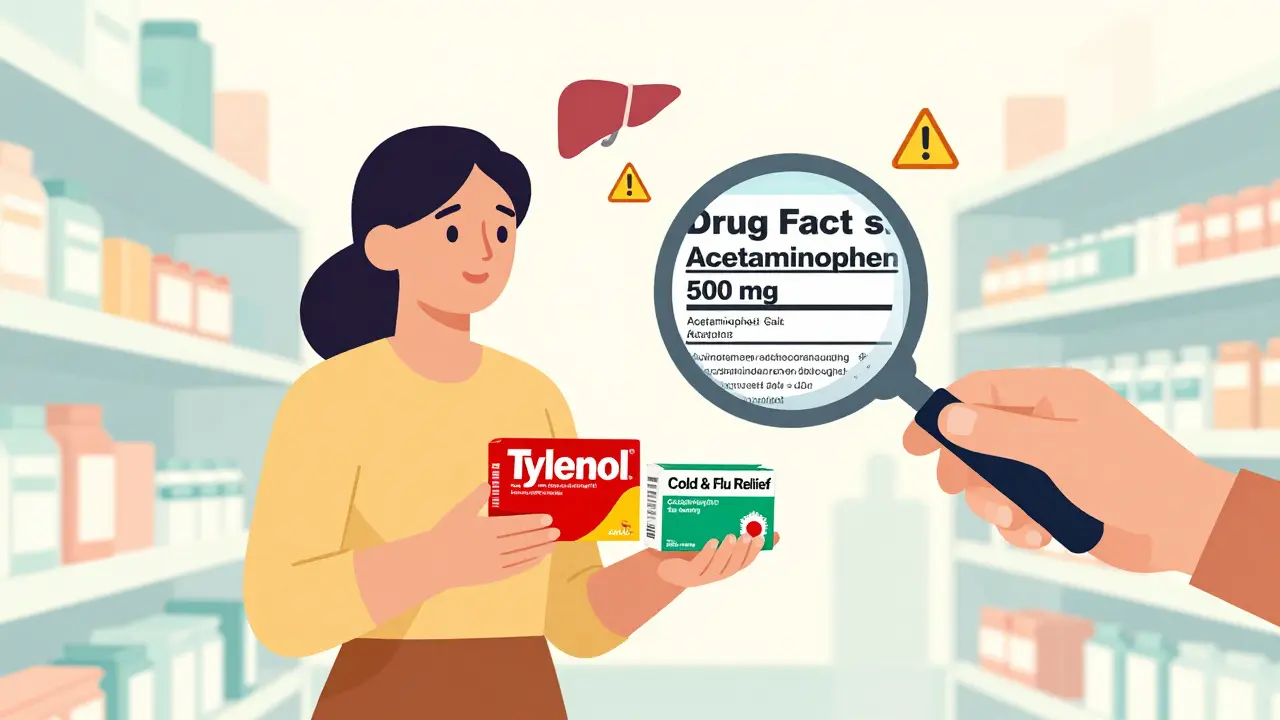
Before you grab a bottle, flip it over. Look for the black-and-white box labeled “Drug Facts.” That’s your cheat sheet. It’s not marketing fluff. It’s a federal requirement, created by the FDA in 1999 after studies showed most shoppers couldn’t tell what was in their medicine.
The first section? Active Ingredients. Always first. Always in bold. Always with the exact amount per dose. For example:
- Acetaminophen 325 mg
- Ibuprofen 200 mg
- Diphenhydramine HCl 25 mg
That “mg” matters. It tells you how much medicine you’re swallowing. And if you take two products with the same active ingredient, you’re doubling-or tripling-the dose.
Some labels list multiple active ingredients. That’s common in cold and flu mixes. You might see: “Acetaminophen 325 mg, Dextromethorphan 15 mg, Phenylephrine 5 mg.” Each one does something different. But if you’re already taking Tylenol for pain, and you grab this cold med, you’re hitting your liver with extra acetaminophen. No warning. No second chance.
Why Brand Names Lie (And What to Do About It)
“I bought Advil because I thought it was different from Tylenol,” one Reddit user wrote after ending up in the ER. They didn’t know Advil = ibuprofen. Tylenol = acetaminophen. Two completely different chemicals. But here’s the twist: Tylenol and Advil aren’t the only ones. Excedrin? Also contains acetaminophen. TheraFlu? Often has it too. NyQuil? Yep. Even some store brands copy the exact same formula.
Studies show 42% of shoppers believe different brand names mean different ingredients. That’s wrong. And deadly.
Here’s how to fix it: Always ignore the brand. Always check the active ingredient. If two products say “acetaminophen 500 mg,” they’re the same. It doesn’t matter if one says “CVS Health” and the other says “Tylenol.” The chemical is identical. The price? Not so much.
And don’t assume “children’s” or “nighttime” versions are safer. Children’s Motrin has ibuprofen. Children’s Zyrtec has cetirizine. Nighttime cold meds often add diphenhydramine-a sedating antihistamine that can make you groggy the next day. If you’re driving or operating machinery, that’s a risk you didn’t sign up for.
The Silent Killer: Acetaminophen Overdose
Acetaminophen is the most common active ingredient in OTC pain relievers. It’s in over 600 products. And it’s the number one cause of acute liver failure in the U.S.
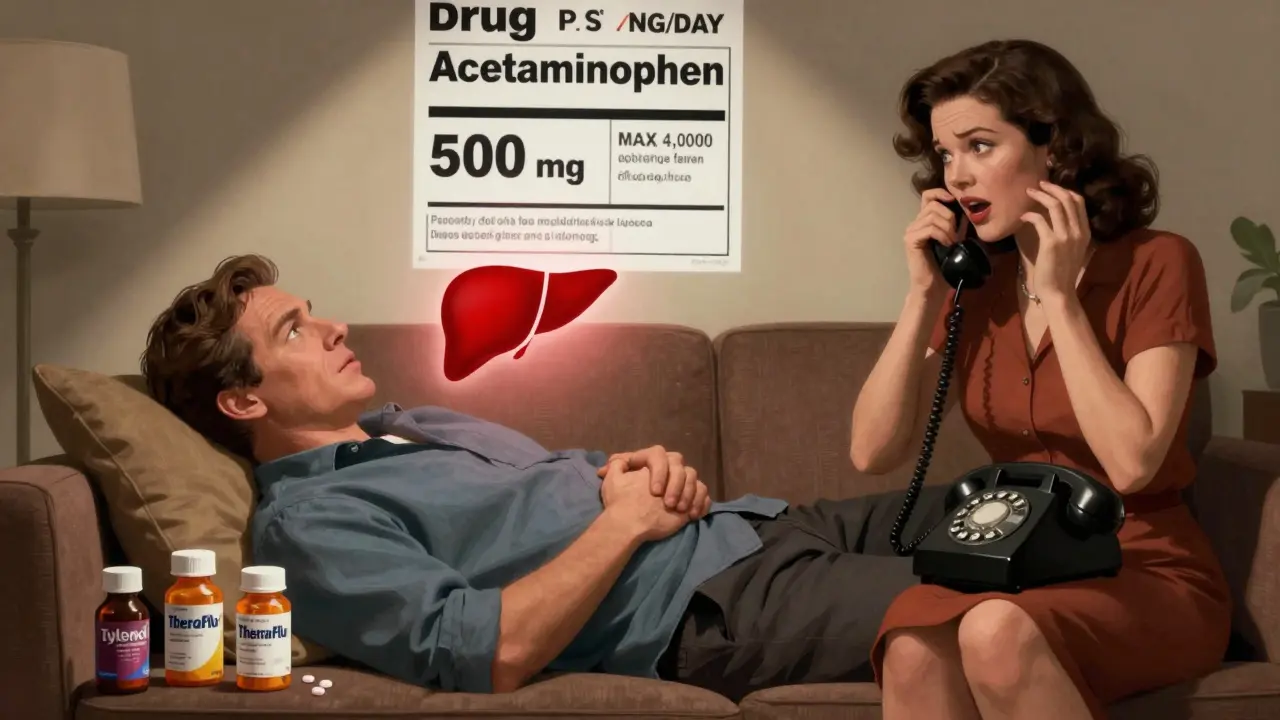
Why? Because it’s invisible. You take a Tylenol for a headache. Then you take a cold medicine for your cough. Then you take a sleep aid because you can’t rest. All three have acetaminophen. You didn’t mean to overdose. You just didn’t check.
The FDA limits OTC acetaminophen to 650 mg per tablet now (down from 1,000 mg), but many older bottles still have the higher dose. The daily maximum? 4,000 mg. That’s eight 500 mg tablets. But if you’re drinking alcohol, taking other liver-metabolizing drugs, or have liver disease, that limit drops. Way down.
One man in Manchester took two Tylenol PMs before bed. He’d already taken one Extra Strength Tylenol for his back. He woke up vomiting, confused, and barely breathing. His liver enzymes were through the roof. He survived. But only because his wife found the empty bottles and called 999.
Don’t be that person. Write down every active ingredient you take in a day. Use the FDA’s free printable cheat sheet. Or just use your phone: snap a pic of each label and keep it in your notes app.
What’s Not on the Label (But Should Be)
Active ingredients are the stars. But the supporting cast? Inactive ingredients. These are fillers, dyes, preservatives, and flavorings. They don’t treat your symptoms. But they can hurt you.
If you’re allergic to red dye #40, and you give your kid Children’s Motrin, you might get hives. If you’re gluten-sensitive, some chewable tablets use wheat starch. If you’re diabetic, some liquid cold syrups have high sugar content.
That’s why the “Inactive Ingredients” section matters. It’s at the bottom of the Drug Facts label. Scroll down. Read it. Especially if you have allergies, sensitivities, or dietary restrictions.
And here’s a new thing: QR codes. Starting in 2026, all OTC drugs in the U.S. will need a scannable code that links to a full digital label. That means you can scan with your phone and get a breakdown of every ingredient-even ones too small to print. It’s coming. But don’t wait. Right now, you’ve got to read the paper label.
How to Shop Smart: A 4-Step Rule
You don’t need a pharmacy degree. Just follow this simple routine every time you buy OTC medicine:
- Find the Drug Facts label. It’s on the back or side. Not the front.
- Read the active ingredient first. What’s the chemical? What’s the dose?
- Compare to what you’re already taking. Are you doubling up? Check your prescriptions, supplements, and other OTC meds.
- Check the daily limit. Don’t assume “more is better.” Acetaminophen max = 4,000 mg. Ibuprofen max = 1,200 mg. Don’t go over.
Spending 45 seconds on this can save you a hospital trip. Nationwide Children’s Hospital found that parents who followed this routine cut their medication errors by 68%.
What’s Changing in 2026
The OTC drug system is getting an upgrade. Thanks to the CARES Act of 2020, the FDA is now forced to finalize rules for every single OTC monograph by the end of 2023. That means clearer rules, stricter limits, and more transparency.
By 2026, every bottle will have a QR code. Scan it, and you’ll see a full list of ingredients, warnings, and even interactions with your other meds. It’s not magic. It’s just better labeling.
But until then? Your eyes are your best tool. Your brain is your best pharmacist. Don’t outsource your safety to a brand name or a shelf display.
Top 5 Active Ingredients You Should Know
Here’s what’s in the most common OTC drugs:
- Acetaminophen - Pain and fever. Found in Tylenol, Excedrin, TheraFlu, NyQuil. Max daily: 4,000 mg.
- Ibuprofen - Pain, fever, inflammation. Found in Advil, Motrin, Nurofen. Max daily: 1,200 mg.
- Naproxen sodium - Longer-lasting pain relief. Found in Aleve. Max daily: 660 mg.
- Diphenhydramine HCl - Allergy and sleep aid. Found in Benadryl, NyQuil, ZzzQuil. Can cause drowsiness.
- Cetirizine - Non-drowsy allergy relief. Found in Zyrtec. Safe for daytime use.
Keep this list handy. Print it. Save it on your phone. Know what’s in your medicine before you take it.
Katie and Nathan Milburn
January 31, 2026 AT 05:24It's astonishing how many people treat OTC medications like candy. I once saw a colleague take three different cold remedies simultaneously because ‘they all do different things.’ The reality? Two of them contained acetaminophen. He ended up in the ER with elevated liver enzymes. The Drug Facts label isn't decorative-it's a lifeline.
Beth Beltway
February 1, 2026 AT 15:32Of course the FDA doesn't do enough. They let manufacturers bury the active ingredients in tiny print and slap flashy brand names on them. It's a scam. People aren't stupid-they're manipulated. And if you don't know the difference between ibuprofen and acetaminophen, you shouldn't be allowed near a medicine cabinet. This isn't rocket science. It's basic biology.
kate jones
February 1, 2026 AT 16:31Understanding active ingredients is fundamental to pharmacological literacy. The Drug Facts label is a federally mandated disclosure framework designed to mitigate polypharmacy risks. Acetaminophen, for instance, has a narrow therapeutic index and is metabolized primarily via hepatic glucuronidation and sulfation pathways. Concurrent use of alcohol or CYP2E1-inducing agents significantly increases the risk of hepatotoxicity. Always cross-reference with your current medication regimen. Documentation is non-negotiable.
Kelly Weinhold
February 2, 2026 AT 00:00I used to just grab whatever looked good until my mom had a scare with Tylenol and NyQuil. Now I keep a little note on my phone with all the active ingredients I take. It’s changed everything. I even screenshot the labels and label them ‘Morning,’ ‘Night,’ ‘Cold,’ etc. It’s so easy-and it saved me from accidentally doubling up last week. You don’t need to be a scientist to stay safe. Just be a little organized. Your liver will thank you ❤️
Sidhanth SY
February 2, 2026 AT 12:52In India, we call this ‘brand confusion.’ People pay double for the same pill just because it has a fancy name. I showed my cousin how Advil and generic ibuprofen are identical. He was shocked. Now he buys the cheapest version and saves money. Knowledge isn’t just power-it’s savings. And safety. Simple.
Kathleen Riley
February 3, 2026 AT 18:06The commodification of health through proprietary branding represents a profound epistemological rupture in public medical understanding. The active ingredient, as a material essence, is rendered invisible by the semiotic excess of corporate packaging. We are not consumers of medicine-we are subjects of pharmaceutical semiotics. To read the label is to perform an act of ontological resistance.
Gaurav Meena
February 5, 2026 AT 15:39Bro, I used to mix NyQuil and Advil all the time. Thought they were different. Then I got so dizzy I couldn’t walk. Now I always check the label. Seriously, if you’re reading this and you don’t know what’s in your meds-stop. Look. Learn. You’re not invincible. Your body’s not a lab experiment. 🙏
Jodi Olson
February 5, 2026 AT 20:55Acetaminophen is the silent killer because we’ve been conditioned to trust brands not chemistry. The FDA’s 4000mg limit is arbitrary. Some people metabolize it slower. Some have fatty liver from diet. Some drink coffee. No one talks about that. The real problem isn’t ignorance-it’s systemic neglect. We’re told to trust the bottle. But the bottle doesn’t know you.
Kimberly Reker
February 7, 2026 AT 04:01My grandma taught me to always read the small print. She said, ‘If it’s not written down, it’s not real.’ She was right. I used to buy whatever was on sale until I realized my ‘headache’ medicine had the same stuff as my ‘sleep’ medicine. Now I keep a little chart taped to my medicine cabinet. It’s saved me so many times. Don’t be afraid to be the person who reads the label. You’re doing everyone a favor.
calanha nevin
February 8, 2026 AT 15:12The QR code initiative by 2026 is a necessary evolution. Current labeling is inadequate for populations with visual impairments, low literacy, or non-native English speakers. The passive assumption that everyone can read fine print is a form of ableism. Digital access to ingredient transparency isn’t a luxury-it’s a civil right. The FDA is late, but better late than never.
Diksha Srivastava
February 9, 2026 AT 23:44I teach my students this every semester. ‘Don’t trust the color. Don’t trust the name. Trust the chemical.’ One girl told me she used to take three different cold pills because ‘they all had different colors.’ Now she scans labels with her phone. I’m so proud. Knowledge is the best medicine. And it’s free.
Jason Xin
February 11, 2026 AT 04:58Wow. A whole article about reading labels. Groundbreaking. Next you’ll tell us to check expiration dates or not to mix bleach and ammonia. Maybe we should also warn people not to breathe air. Truly, the pinnacle of public health advocacy.
Yanaton Whittaker
February 12, 2026 AT 22:43AMERICA IS WEAK. We pay $12 for Tylenol when we could get the same damn chemical for $2. We trust logos over science. We let corporations tell us what’s safe. This isn’t freedom. It’s brainwashing. If you’re not checking the active ingredient, you’re not American-you’re a consumer. Wake up.
Beth Cooper
February 14, 2026 AT 17:34Wait… are you sure the FDA isn’t hiding something? What if the active ingredients are just a distraction? What if the real danger is the preservatives? Or the QR codes? Maybe they’re tracking us. I heard they’re putting microchips in OTC meds now. You think this is about safety? Nah. It’s about control.
Donna Fleetwood
February 14, 2026 AT 19:19I just want to say thank you for writing this. I’m a single mom and I used to just grab whatever was closest. Now I take 30 seconds to check. I even showed my 12-year-old how to read the label. She caught me last week when I grabbed a nighttime cold med-‘Mom, that has diphenhydramine! You’re driving tomorrow!’ I cried. She’s smarter than I was at her age. We’re all learning. And that’s okay.