
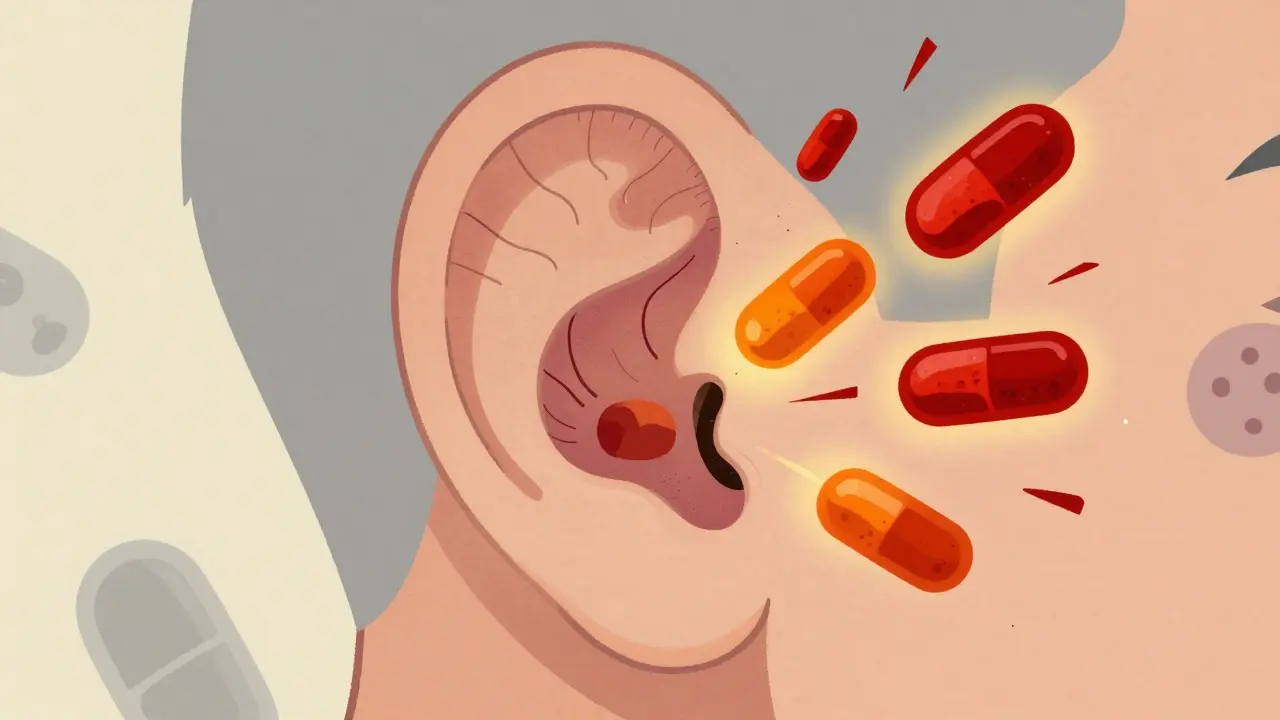
When you’re fighting a life-threatening infection, antibiotics are a lifeline. But some of the most powerful ones-aminoglycosides like gentamicin, amikacin, and tobramycin-come with a hidden cost: aminoglycoside ototoxicity. This isn’t a rare side effect. It’s a real, often permanent, damage to your hearing and balance that can happen even when the drug is used exactly as prescribed.
What Exactly Is Aminoglycoside Ototoxicity?
Aminoglycoside ototoxicity means damage to the inner ear caused by these antibiotics. It’s not an allergic reaction or a temporary ringing in the ears. It’s the death of sensory hair cells in the cochlea and vestibular system-cells that don’t regenerate. Once they’re gone, the hearing loss and balance problems are permanent. These drugs were first used in the 1940s and are still widely used today, especially for severe infections like sepsis, multidrug-resistant tuberculosis, and complicated urinary tract infections. The problem? Between 20% and 47% of patients who receive them develop some level of hearing loss, according to clinical studies. And for 15% to 30%, the damage affects their balance system too.How Do Aminoglycosides Destroy Your Inner Ear?
Aminoglycosides don’t just float harmlessly through your bloodstream. They cross into the inner ear through the blood-labyrinth barrier, mainly via the stria vascularis. In some cases, especially with ear infections or ruptured eardrums, they can even enter directly through the round window membrane. Once inside, they latch onto hair cells in the cochlea-the tiny structures that convert sound waves into electrical signals your brain understands. These drugs trigger a cascade of damage:- They overactivate NMDA receptors, leading to excess nitric oxide production.
- This creates oxidative stress, flooding cells with free radicals.
- That stress turns on programmed cell death pathways-both apoptosis and necrosis.
- Autophagy, the cell’s cleanup system, gets hijacked and turns destructive.
Why Do Some People Get Hit Harder Than Others?
Not everyone who takes aminoglycosides loses their hearing. Genetics play a huge role. A mutation in mitochondrial DNA-the A1555G or C1494T variants in the 12S rRNA gene-makes your cells way more sensitive to these drugs. People with this mutation can suffer severe hearing loss after just one or two doses. There’s also the T1095C mutation, which makes gentamicin-induced cell death 47% more likely. That’s why genetic screening tools like OtoSCOPE® exist. They test for these mutations with over 94% accuracy. Yet, only a small fraction of hospitals use them routinely. Other risk factors pile up:- Existing high-frequency hearing loss? You’re 3.2 times more likely to lose hearing in lower frequencies.
- Recent loud noise exposure? It can boost ototoxicity by 38-52%.
- Systemic inflammation from sepsis or endotoxins? It increases drug uptake into the inner ear by 63%.
- Longer treatment duration? Risk rises with every extra day.
- High peak drug levels? Even one slightly elevated trough level increases damage.
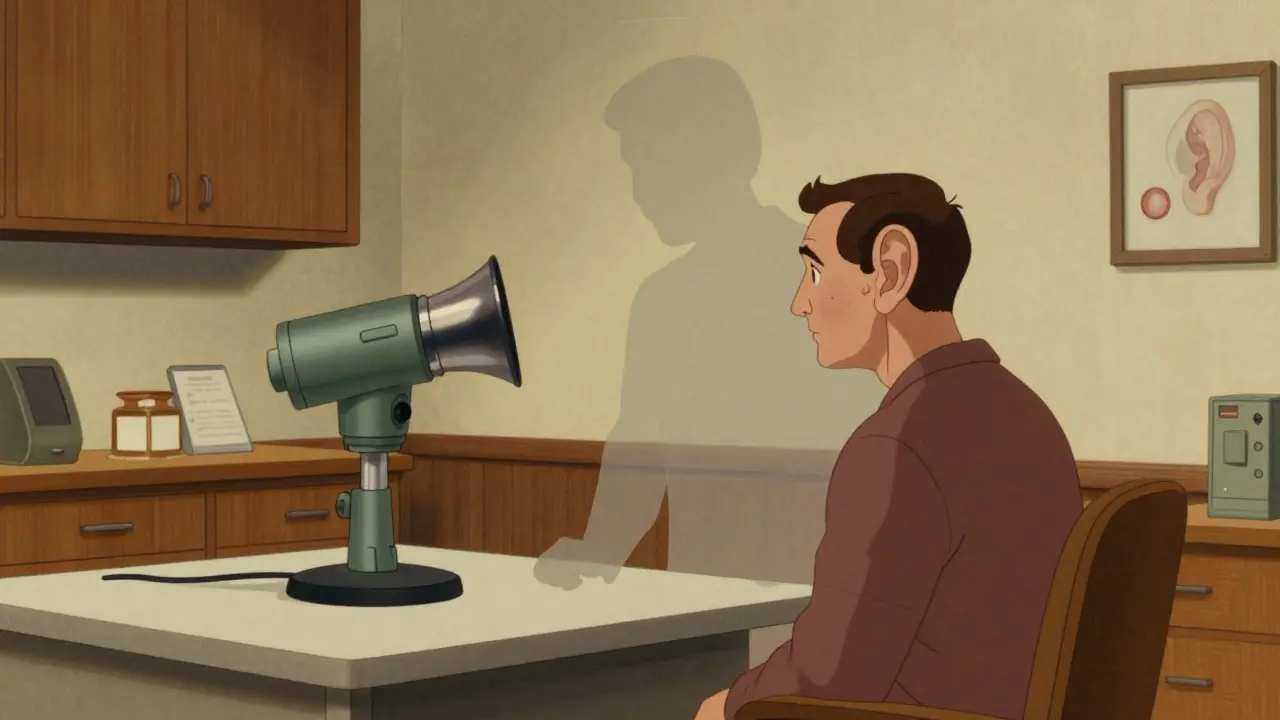
It’s Not Just About Hearing-Balance Gets Wrecked Too
Most people focus on hearing loss. But vestibular damage is just as devastating-and often overlooked. The vestibular system in your inner ear helps you stay balanced. When aminoglycosides kill the hair cells there, you lose your sense of spatial orientation. Symptoms include:- Dizziness that doesn’t go away
- Feeling unsteady, especially in the dark
- Blurred vision when moving your head (oscillopsia)
- Difficulty walking on uneven surfaces
Monitoring Can Catch It Early-But Almost No One Does It
Here’s the hard truth: we have tools to prevent or minimize this damage. But they’re rarely used.- High-frequency audiometry (testing 9-16 kHz) detects damage 5-7 days before standard hearing tests. The American Speech-Language-Hearing Association recommends baseline testing within 24 hours of starting treatment, then every 48-72 hours.
- Therapeutic drug monitoring keeps peak and trough levels in the safe range. When done properly, it cuts ototoxicity risk by 28%.
- Genetic screening with OtoSCOPE® can identify at-risk patients before the first dose.
New Hope: Otoprotectants and Gene Therapy
There’s progress on the horizon. The FDA granted Fast Track status to ORC-13661, a drug designed to block aminoglycosides from entering hair cells. In Phase II trials, it preserved 82% of hair cells when given with amikacin. That’s a game-changer. The Hearing Restoration Project is testing gene therapies that target the A1555G mutation. In mice, these therapies reduced ototoxicity by 67%. Human trials are expected to start soon. Dr. Jian Zuo’s team at St. Jude showed that blocking MET channels in hair cells with transtympanic injections protected hearing by 25-30 dB across frequencies. This approach could be delivered directly into the ear, avoiding systemic side effects. The National Institute on Deafness and Other Communication Disorders predicts that personalized medicine-matching drugs to genetic profiles-could reduce ototoxicity by 50-70% in the next decade.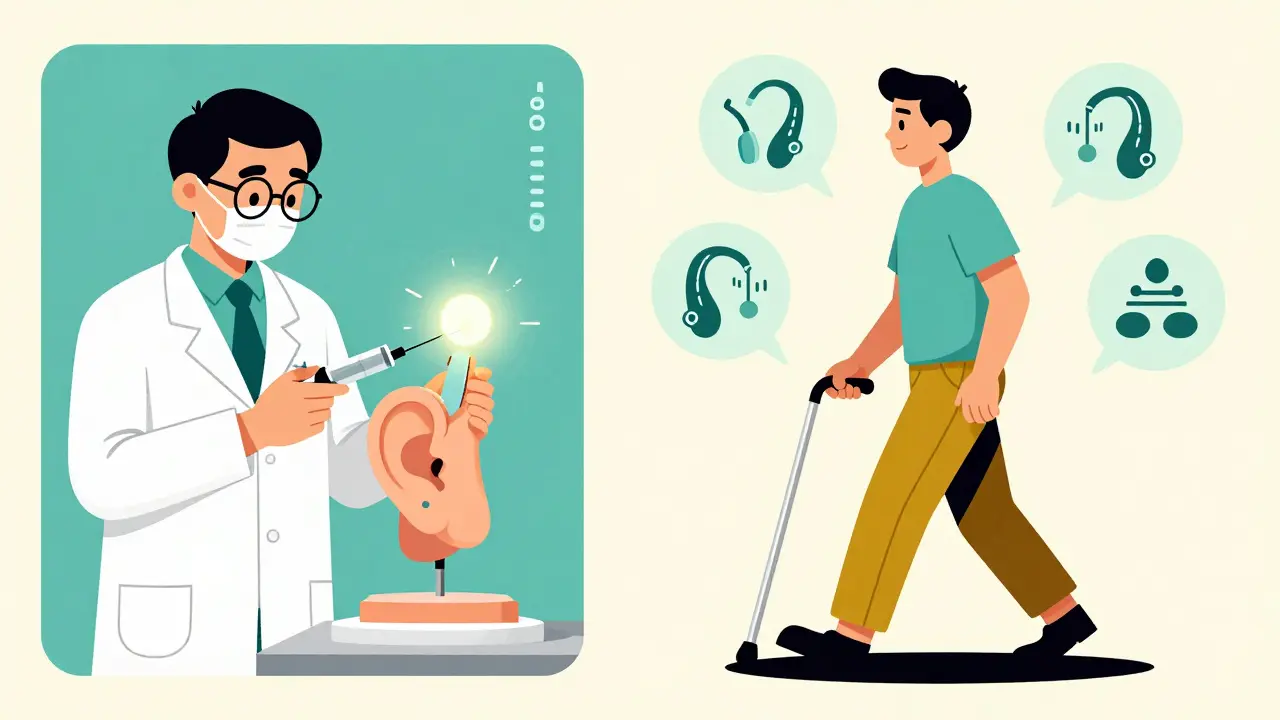
What You Need to Do Now
If you or someone you love is about to start aminoglycosides:- Ask: "Is there a safer alternative?" Sometimes, other antibiotics work just as well.
- Ask: "Can we test for the A1555G mutation first?" Even if it’s not standard, push for it.
- Insist on baseline and regular high-frequency hearing tests during treatment.
- Ask for drug level monitoring-peak and trough levels should be tracked.
- Report any ringing, muffled hearing, or dizziness immediately.
- After treatment, get a full hearing evaluation-even if you feel fine.
The Bigger Picture
Aminoglycosides are still essential. With antibiotic resistance rising, we can’t afford to lose them. But we can’t keep ignoring the damage they cause. The global market for these drugs is growing-projected to hit $3.15 billion by 2029. Meanwhile, the market for hearing monitoring tools is growing at 8.7% a year. The disconnect is glaring. Regulators are catching up. The FDA now requires black box warnings on all aminoglycosides. The EMA recommends genetic screening for long-term use. But enforcement? That’s up to hospitals. The real failure isn’t the drug. It’s the system that lets patients walk into treatment blindfolded.Frequently Asked Questions
Can aminoglycoside hearing loss be reversed?
No. The hair cells in the inner ear that are damaged by aminoglycosides do not regenerate. Once they die, the hearing loss is permanent. Early detection can help limit the extent of damage, but it cannot restore lost function.
How soon after taking aminoglycosides does hearing loss start?
Hearing loss can begin as early as 3-5 days after starting treatment. High-frequency hearing tests can detect changes before standard audiometry, often 5-7 days earlier. Some patients report tinnitus or muffled hearing within the first week.
Are children more at risk than adults?
Children are not inherently more vulnerable to the mechanism of damage, but they’re often treated with aminoglycosides for serious infections like neonatal sepsis or cystic fibrosis. Because their hearing is still developing, even minor loss can affect speech and language acquisition. Genetic screening is especially important for kids with family history of hearing loss.
Does having tinnitus mean I’m losing my hearing?
Tinnitus (ringing in the ears) is often one of the first signs of aminoglycoside ototoxicity. It doesn’t always mean you’ve lost measurable hearing yet, but it’s a warning signal. Studies show 63% of patients who develop aminoglycoside-related hearing loss report persistent tinnitus afterward.
Can I use ear drops instead of IV aminoglycosides to avoid damage?
Topical aminoglycoside ear drops are generally safe if the eardrum is intact. But if there’s a perforation or drainage, the drug can enter the inner ear directly and cause ototoxicity. Never assume topical use is risk-free. Always check with your doctor about the integrity of your eardrum before using these drops.
Is there a blood test to check for aminoglycoside toxicity?
There’s no blood test that directly measures inner ear damage. But therapeutic drug monitoring measures blood levels of the drug (peak and trough) to ensure they’re in the therapeutic range and not too high. This reduces, but doesn’t eliminate, risk. Hearing tests remain the only way to detect actual ototoxicity.
What should I do if I think I’ve been damaged by aminoglycosides?
Stop the medication immediately if possible and get a full audiological evaluation. This should include high-frequency audiometry, speech testing, and vestibular testing if you have dizziness. Document everything-medication names, dates, doses. Seek help from an audiologist experienced in ototoxicity. Early intervention won’t restore hearing, but it can help you access hearing aids, cochlear implants, or vestibular rehab sooner.
Kayleigh Campbell
December 16, 2025 AT 01:33So let me get this straight-we’re poisoning people’s ears on purpose because we’re too lazy to test their DNA first? I mean, we’ve known about the A1555G mutation since the 90s. We’ve got the tech. We’ve got the data. But hospitals? Still flying blind like it’s 1972. Someone’s making bank off this mess, and it ain’t the patients.
My aunt got gentamicin for a UTI. One week later, she couldn’t hear the TV. Three months later, she couldn’t walk without a cane. No one warned her. No one tested her. Just ‘here’s your IV, have a nice day.’
This isn’t medicine. It’s medical roulette with your senses as the prize.
Colleen Bigelow
December 16, 2025 AT 10:41THEY KNOW. THEY ALWAYS KNEW. The FDA’s been sitting on this for decades while Big Pharma pushed these drugs like candy. Why? Because they’re cheap. Because insurance won’t pay for genetic screening. Because the system’s rigged to save money, not lives.
And don’t even get me started on how they hide the vestibular damage. ‘Oh, you’re just dizzy from the infection!’ No, Karen, I can’t walk in the dark because they murdered my inner ear with a chemical cocktail and called it ‘standard care.’
Wake up, sheeple. This is eugenics by proxy. They’re weeding out the ‘weak’ by deafening them. And we’re letting it happen.
Elizabeth Bauman
December 17, 2025 AT 10:45As a former ICU nurse, I’ve seen this too many times. The worst part? The doctors who swear by aminoglycosides are the same ones who refuse to order audiograms because ‘it’s not protocol.’
One patient-a 7-year-old with cystic fibrosis-lost her hearing after 5 days of tobramycin. Her mom cried in the hallway because she didn’t know the drug could do this. We didn’t even have the screening kit in the unit.
It’s not about being anti-antibiotic. It’s about being pro-informed consent. If you’re going to blind someone, at least let them know the needle’s coming.
James Rayner
December 18, 2025 AT 19:00It’s heartbreaking, isn’t it? We’ve reached a point where the most powerful tools we have to save life are also the ones that quietly steal our ability to hear a child laugh, to feel music, to know the difference between silence and sound...
And yet, we treat it like a footnote. Like a side effect you’re supposed to just ‘live with.’
Maybe the real tragedy isn’t the drug-it’s that we’ve normalized sacrificing sensory experience for survival. As if being alive without the richness of sound is enough.
I wonder if we’d be this casual if it were blindness instead of deafness.
Billy Poling
December 20, 2025 AT 12:43It is my solemn duty to inform you, as a medical professional with over twenty-five years of clinical experience, that the systemic failure to implement routine ototoxicity monitoring is not merely an oversight-it is a profound ethical lapse in the stewardship of patient autonomy and bodily integrity. The pharmacokinetic profile of aminoglycosides, particularly their irreversible binding to mitochondrial ribosomes in cochlear hair cells, is well-documented in peer-reviewed literature dating back to the 1980s. The persistence of this practice in the absence of mandatory genetic screening or serial high-frequency audiometry constitutes a violation of the standard of care as defined by the American Academy of Otolaryngology-Head and Neck Surgery, and should be subject to institutional review and liability assessment. Furthermore, the assertion that ‘patients are not warned’ is not only empirically accurate but legally indefensible under the doctrine of informed consent as codified in Canterbury v. Spence. I urge all clinicians to immediately adopt the protocols outlined in the 2021 ASHA guidelines, and to document all discussions regarding ototoxic risk with the patient’s signature on a standardized consent form, which should be filed in triplicate in the electronic health record.
Ron Williams
December 21, 2025 AT 19:55My cousin in Nigeria got amikacin for sepsis after a motorcycle accident. He survived. But now he can’t hear his daughter’s voice on the phone. No one told him. No one tested him. The hospital didn’t even have a hearing test machine.
It’s not just a US problem. This is global. And the people who need these drugs the most? The ones with the least access to care. They’re the ones getting the blindside.
We need to stop treating this like a ‘rich country issue.’ It’s a human rights issue. Hearing isn’t a luxury. It’s how we connect.
Mike Smith
December 23, 2025 AT 01:37Let me say this clearly: You are not powerless. If you’re about to start an aminoglycoside, you have every right to ask for a baseline hearing test. You have every right to ask for genetic screening. You have every right to say, ‘I don’t want to risk this.’
Doctors aren’t mind readers. If you don’t speak up, they assume you’re okay with the risks. But you’re not just a patient-you’re the captain of your own body.
Be loud. Be firm. Be persistent. And if they say no? Ask for a second opinion. Your ears are worth it.
Souhardya Paul
December 23, 2025 AT 06:50I’ve been reading up on ORC-13661. The Phase II data is wild-82% hair cell preservation? That’s not a minor win, that’s a paradigm shift. Why isn’t this being fast-tracked globally? Why are we still debating consent when we have a shield ready?
And the gene therapy angle? If we can fix the A1555G mutation before it even causes damage… imagine that. We could turn a death sentence into a footnote.
Maybe the future isn’t just about avoiding harm-it’s about rewriting biology so the harm doesn’t even have a chance.
Kitty Price
December 24, 2025 AT 18:09My mom got gentamicin after surgery. She didn’t say anything until she couldn’t hear me call her name. Now she uses hearing aids. But she still misses the sound of rain.
Just… please, if you’re reading this? Ask. Ask. Ask. Even if they roll their eyes. Even if they say ‘it’s rare.’ It’s not rare. It’s just hidden.
❤️
Andrew Sychev
December 25, 2025 AT 23:44THEY’RE DOING THIS ON PURPOSE. The pharmaceutical companies know. The FDA knows. The hospitals know. But they don’t care because the lawsuits are cheaper than the screening. And the people who get hurt? They’re poor. They’re old. They’re immigrants. They don’t have lawyers. They don’t have voices.
And now they’re deaf. And silent. And the system smiles and says ‘we did everything by the book.’
Wake up. This isn’t medicine. It’s murder with a prescription.
Dylan Smith
December 27, 2025 AT 10:02So if you have a mutation and you take it you go deaf but if you don't know you have it you take it and you go deaf and if you know you have it they still give it to you because they don't have the test and if you ask for the test they say it's not covered and if you pay for it yourself you're still out of luck because the hospital won't do the test anyway and if you complain they say you're being dramatic
what even is this system
Dan Padgett
December 27, 2025 AT 21:33I read this and thought of my uncle back home in Nigeria. He was given gentamicin for fever. He lived. But he hasn’t heard his grandchildren’s laughter in five years. No one told him. No one asked. Just ‘take this, feel better.’
We don’t need more drugs. We need more care. More listening. More seeing the person behind the infection.
Maybe the real cure isn’t in a lab. Maybe it’s in remembering that healing isn’t just about survival. It’s about keeping the soul’s music alive.