
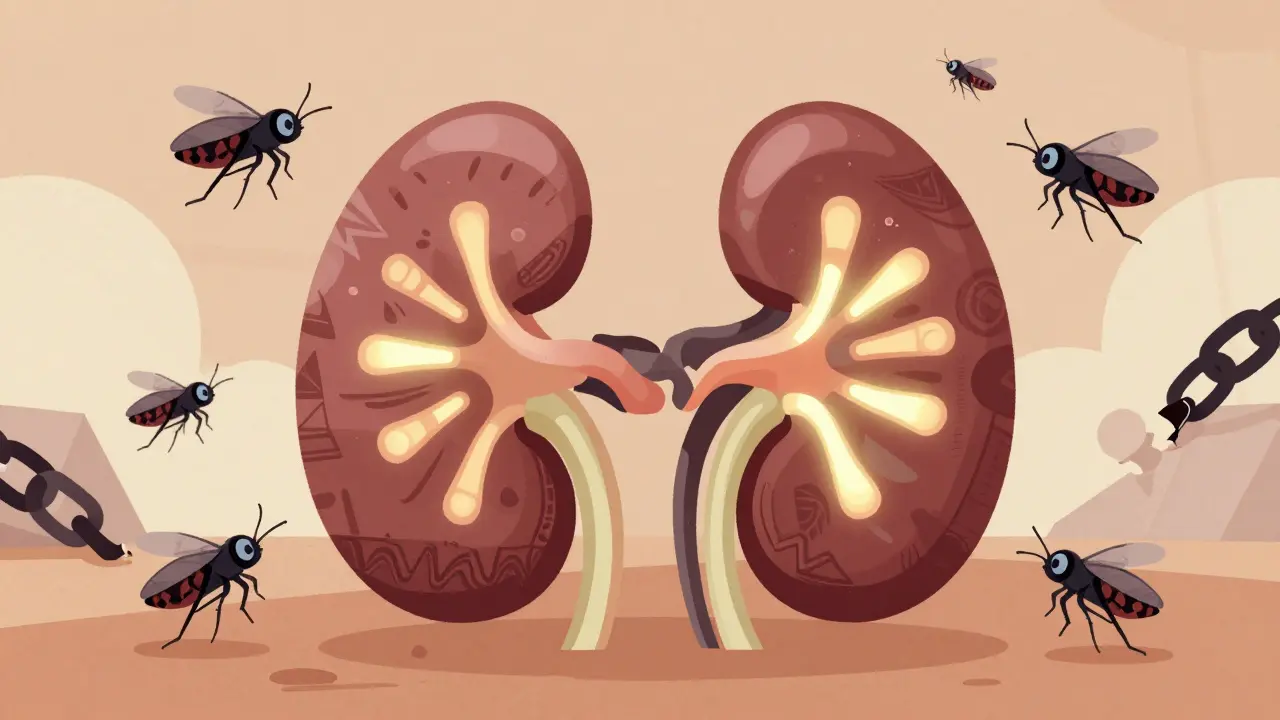
For people of African ancestry, kidney disease isn’t just about high blood pressure or diabetes. Behind many cases lies a hidden genetic factor - one that’s been shaped by thousands of years of evolution and now affects who gets sick, who stays healthy, and who gets overlooked by the healthcare system.
What Is APOL1 and Why Does It Matter?
The APOL1 gene is a small piece of DNA that makes a protein involved in your body’s first line of defense against infections. In sub-Saharan Africa, certain versions of this gene - called G1 and G2 - evolved to protect people from African sleeping sickness, a deadly parasite spread by tsetse flies. These variants let the protein punch holes in the parasite’s membrane, killing it before it could cause harm.
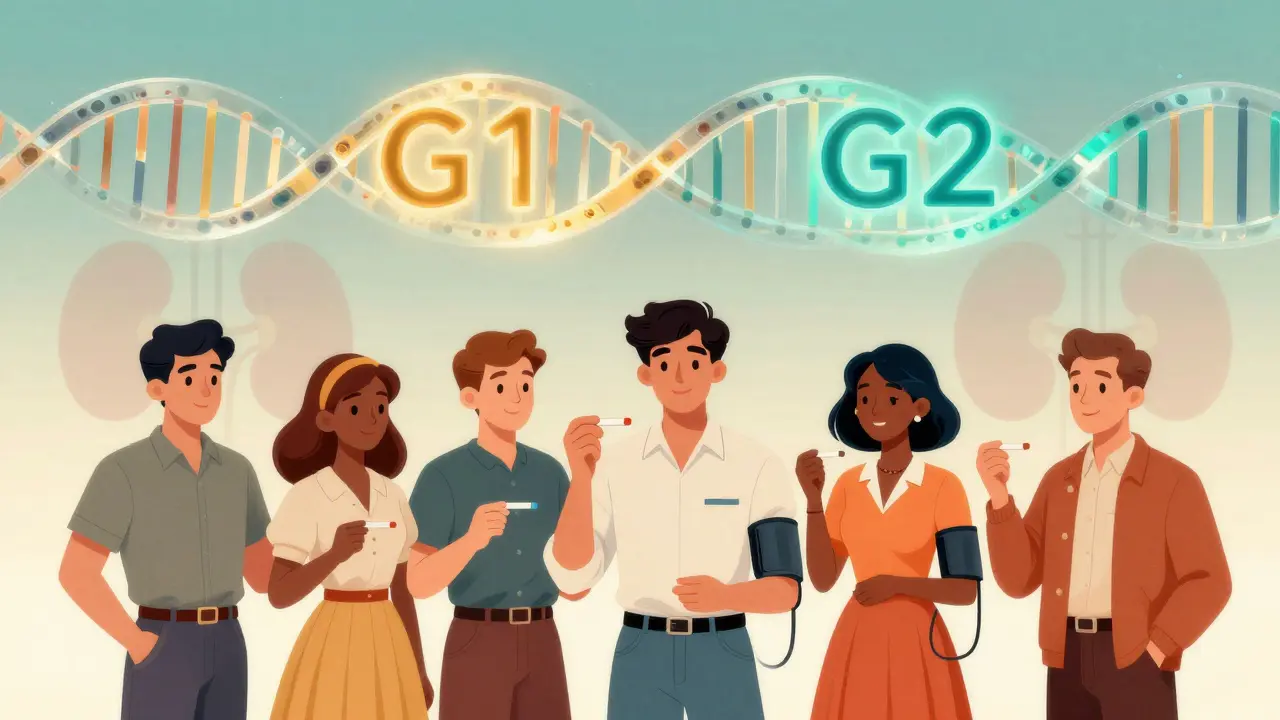
That survival advantage meant people with these variants were more likely to live, have children, and pass them on. Over time, the G1 and G2 variants became common in populations from West and Central Africa. Today, they’re found in about 30% of people from those regions. But when these populations were forcibly moved during the transatlantic slave trade, the variants came with them - to the Americas, the Caribbean, and Europe.
Here’s the catch: while these variants saved lives from parasites, they also increased the risk of kidney damage. The same protein that kills trypanosomes can also harm kidney cells under stress. And unlike most inherited diseases, you need two copies of a risk variant - either G1/G1, G2/G2, or G1/G2 - to be at high risk. About 13% of African Americans carry this high-risk combination.
Who’s Most Affected?
People with African ancestry are 3 to 4 times more likely to develop kidney failure than white Americans. For decades, doctors assumed this was due to higher rates of diabetes, hypertension, or poverty. But research since the 2010s has shown something else: APOL1 explains about 70% of that extra risk.
Among African Americans with non-diabetic kidney disease, nearly half have high-risk APOL1 genotypes. In the UK, nearly half of all end-stage kidney disease cases in Black patients with HIV were linked to APOL1, according to the 2023 GEN-AFRICA study. The same pattern shows up in Afro-Caribbean communities.
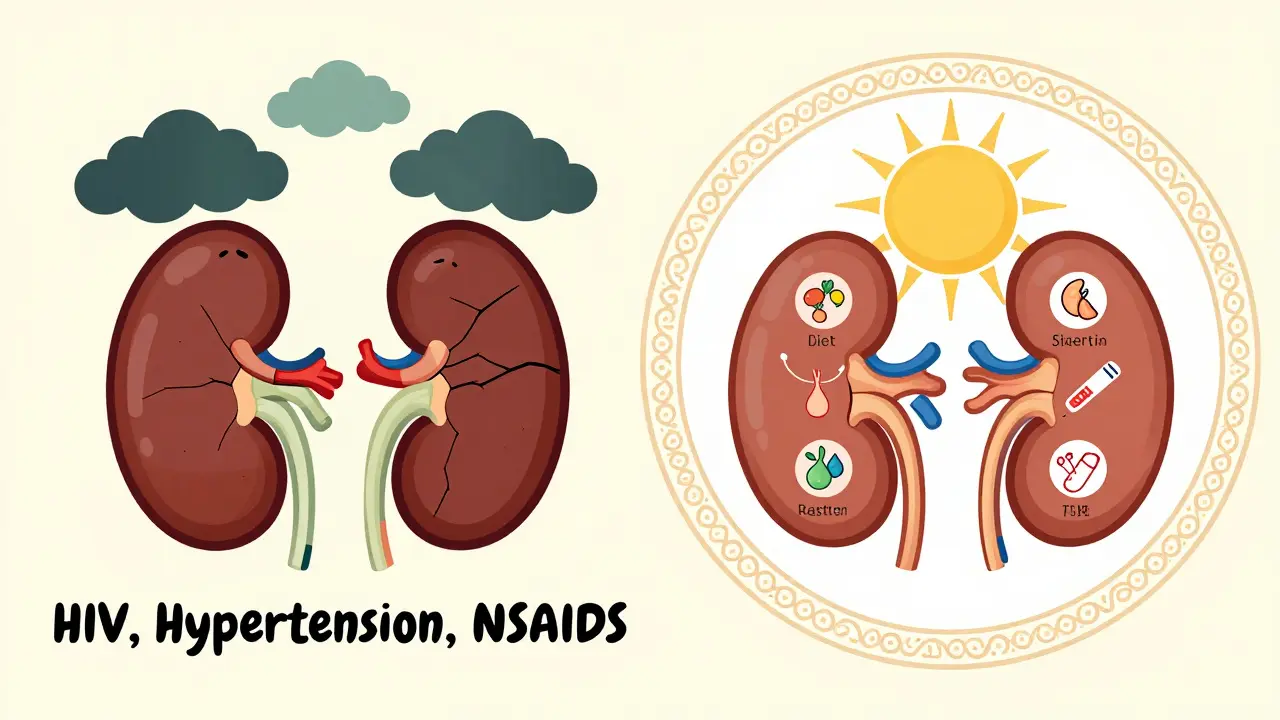
What’s surprising? Most people with these high-risk genes never get sick. About 80% of them keep normal kidney function their whole lives. That’s called incomplete penetrance. Something else - a second hit - has to trigger the damage. That could be a viral infection like HIV, extreme stress on the kidneys from uncontrolled blood pressure, obesity, or even certain medications.
What Kidney Diseases Are Linked to APOL1?
APOL1 doesn’t cause one single disease. It increases the risk for several aggressive forms of kidney damage:
- Focal segmental glomerulosclerosis (FSGS) - a condition where parts of the kidney’s filtering units scar over.
- Collapsing glomerulopathy - a severe, fast-progressing form often seen in people with HIV.
- HIV-associated nephropathy (HIVAN) - once a common cause of kidney failure in Black patients with HIV, now much rarer thanks to antiviral drugs, but still heavily tied to APOL1.
- Arterionephrosclerosis - kidney damage from high blood pressure, but much worse in people with APOL1 risk variants.
These conditions often show up earlier and progress faster than other types of kidney disease. Many patients are diagnosed in their 30s or 40s - decades before the average age for diabetic kidney disease.
Testing for APOL1: Who Should Get It?
Genetic testing for APOL1 became available in 2016. It’s a simple blood or saliva test that looks for the G1 and G2 variants. But it’s not for everyone.
The American Society of Nephrology recommends testing in these cases:
- People of African ancestry with unexplained kidney disease (especially if not caused by diabetes or high blood pressure).
- Living kidney donors of African ancestry - because donating a kidney could increase their own risk if they carry two risk variants.
- Patients with HIV and kidney problems, even if their virus is controlled.
The test costs between $250 and $450 without insurance. Some insurers cover it if there’s a clear medical reason. Results usually come back in 7 to 14 days.
But here’s the problem: many doctors still don’t know how to interpret the results. A 2022 survey found that 78% of nephrologists felt unprepared to counsel patients on APOL1. Patients often walk away thinking they’re doomed - when in reality, their lifetime risk is only about 15-20%.
What Can You Do If You Have High-Risk APOL1?
There’s no cure yet. But you can dramatically lower your chances of kidney damage.
Based on 2023 clinical guidelines, here’s what works:
- Control your blood pressure. Target is below 130/80 mmHg. ACE inhibitors or ARBs are often preferred because they also reduce protein in the urine.
- Get annual urine tests. Check your albumin-to-creatinine ratio (UACR). Even small amounts of protein in urine can signal early kidney stress.
- Avoid NSAIDs. Drugs like ibuprofen or naproxen can hurt kidneys faster in people with APOL1 risk.
- Manage your weight and diabetes. If you have either, keeping them under control is even more critical.
- Don’t smoke. Smoking speeds up kidney damage in everyone - but especially in those with APOL1.
One woman, Emani, found out she had high-risk APOL1 during a routine check-up. She didn’t have symptoms. But because she started monitoring her blood pressure and urine, and changed her diet, she’s kept her kidney function stable for over five years - so far.
The Bigger Picture: Race, Ancestry, and Ethics
It’s easy to hear “APOL1 affects Black people” and think it’s about race. But it’s not. It’s about ancestry - specific genetic markers that came from West Africa. Someone with Nigerian roots carries the same risk whether they live in London, Atlanta, or Lagos.
And that matters. For years, doctors used race-based formulas to estimate kidney function. These formulas assumed Black patients had higher muscle mass, so they adjusted results upward - even if their kidneys were failing. That meant many Black patients were diagnosed later, missed treatments, or waited longer for transplants.
In 2022, the American Medical Association officially recommended stopping race-based eGFR calculations. APOL1 research helped make that change possible. Now, doctors are moving toward genetic-informed care - not racial assumptions.
What’s Next? New Treatments on the Horizon
For the first time, drugs are being designed to block the harmful effects of APOL1. Vertex Pharmaceuticals’ drug VX-147 showed a 37% drop in proteinuria in a 2023 trial - a big deal, because protein in urine is a key sign of kidney damage.
The NIH has invested over $125 million in APOL1 research since 2020. A 10-year study called the APOL1 Observational Study (AOS) is now tracking 5,000 people with high-risk genotypes to understand what triggers disease - and how to stop it.
By 2035, experts estimate APOL1-targeted therapies could reduce kidney failure rates in African ancestry populations by 25-35%. But that won’t happen unless access is fair. Right now, only 12% of low- and middle-income countries can test for APOL1. The real challenge isn’t just science - it’s equity.
Real Stories, Real Impact
One Reddit user, a medical student with high-risk APOL1, writes: “I check my blood pressure every week. I get my urine tested every year. I don’t panic. But I don’t ignore it either.”
Another, on the National Kidney Foundation’s forum, shared: “I thought I just had high blood pressure. My doctor said it was ‘just aging.’ When I finally got tested, I found out I had two APOL1 mutations. That’s when everything changed.”
Knowledge is power. Not because it guarantees disease - but because it gives you a chance to prevent it.
What does it mean to have a high-risk APOL1 genotype?
Having a high-risk APOL1 genotype means you inherited two copies of a risk variant - either G1/G1, G2/G2, or G1/G2. This increases your chance of developing certain types of kidney disease, especially if you’re exposed to other triggers like HIV, uncontrolled blood pressure, or obesity. But it doesn’t mean you will definitely get kidney disease - about 80% of people with these variants never develop serious kidney problems.
Can I get tested for APOL1 if I’m not sick?
Yes, but testing is usually recommended only if you’re of African ancestry and have a reason to suspect kidney risk - like unexplained kidney damage, a family history of kidney failure, or if you’re considering being a living kidney donor. Testing healthy people without risk factors isn’t routinely advised because most won’t develop disease, and the emotional impact can be significant without clear medical action.
Is APOL1 testing covered by insurance?
Some insurance plans cover APOL1 testing if it’s ordered for a specific medical reason - like evaluating unexplained kidney disease or assessing a living donor. Without insurance, the test costs $250-$450. Always check with your provider before testing. The American Kidney Fund may offer financial assistance in some cases.
Does APOL1 affect kidney transplant outcomes?
Yes. If someone with high-risk APOL1 receives a kidney from a donor without the risk variants, the transplanted kidney usually works well. But if the donor also has high-risk APOL1, the kidney is more likely to fail early - sometimes within a few years. That’s why living donors of African ancestry are now routinely tested before donation.
Why do some people with APOL1 never get kidney disease?
APOL1-related kidney disease needs a “second hit” to trigger damage. That could be HIV, uncontrolled high blood pressure, obesity, certain medications, or even viral infections. People who avoid these triggers - and manage their health carefully - often never develop symptoms. That’s why lifestyle and monitoring are so important.
What Should You Do Next?
If you’re of African ancestry and have kidney disease with no clear cause - talk to your doctor about APOL1 testing. If you’re healthy but have a family history of early kidney failure, ask if testing makes sense. If you’re considering donating a kidney, get screened before you commit.
Don’t wait for symptoms. The best time to act is before damage starts. Keep your blood pressure in check. Get your urine tested yearly. Avoid drugs that harm kidneys. And know that having the gene doesn’t mean you’re doomed - it means you have a chance to protect yourself.
Kelly McRainey Moore
January 21, 2026 AT 18:03Wow, this was eye-opening. I had no idea a gene from ancient Africa could be quietly shaping kidney health today. My cousin just got diagnosed with FSGS at 38 - no diabetes, no high BP. Now I’m wondering if APOL1 played a role. Thanks for laying it out so clearly.
Ashok Sakra
January 22, 2026 AT 06:03OMG this is wild!! So Black people are just born with a ticking time bomb in their kidneys?? Like why didn’t anyone tell us this before?? This is literally genetic racism!! Why do they test us but not white people?? I’m so mad right now!!
Gerard Jordan
January 22, 2026 AT 06:20Bro, this is why representation in medicine matters 💪🏽. I’m a Black med student and I literally cried reading this. My grandma died of kidney failure at 52 and they just said ‘it was high blood pressure.’ Now I know it was probably APOL1. I’m gonna push for testing in my clinic next month. Let’s change this. 🙌🏽
michelle Brownsea
January 23, 2026 AT 21:12It is profoundly disturbing - and, frankly, ethically indefensible - that the medical establishment ignored this genetic reality for decades, instead resorting to crude, race-based estimations that actively harmed patients. The fact that APOL1 explains 70% of the disparity is not a coincidence - it is a consequence of systemic negligence. We must not allow pseudoscientific assumptions to replace molecular truth - and we must hold institutions accountable for the lives lost while they clung to outdated paradigms.
Furthermore, the notion that ‘race’ is a biological category - rather than a social construct - has been repeatedly debunked, yet it persists in clinical algorithms. This is not just outdated; it is dangerous. APOL1 testing is not about race - it is about ancestry, inheritance, and precision medicine. Let us not confuse the map for the territory.
And yes - NSAIDs are absolutely contraindicated in high-risk individuals. I cannot stress this enough. Ibuprofen is not ‘harmless’ - it is a silent killer for those with G1/G2 variants. Please, for the love of science, stop treating this like a suggestion.
Roisin Kelly
January 25, 2026 AT 09:31So let me get this straight - they found a gene that makes Black people more likely to get sick, and now they want to test us for it? Sounds like a eugenics experiment to me. Who’s paying for this? Pharma? Are they gonna charge us extra for insurance if we test positive? I’m not getting tested. I’d rather just die than give them data.
Yuri Hyuga
January 26, 2026 AT 08:34This is one of the most important medical breakthroughs of the decade - not because it reveals a problem, but because it gives us a path forward. 🌱 We’ve moved from guessing to knowing. From assumptions to science. From ‘race’ to ancestry. From passive observation to active prevention.
For every person who says ‘this is scary’ - I say: knowledge is power. You don’t have to be doomed. You just have to be informed. Monitor. Manage. Protect.
And to those in low-resource settings - this is a call to action. We need global equity in genetic screening. Not charity. Justice. Let’s not let geography decide who lives and who dies. 🌍❤️
Kevin Narvaes
January 28, 2026 AT 04:36so like… if u got the gene but u dont get kidney problems… does that mean ur just lucky? or is it just that u aint stressed enough?? like i got a friend who smokes and eats chips all day and still has perfect kidneys… what gives??
Dee Monroe
January 28, 2026 AT 11:43I’ve been thinking about this all day - and honestly, it makes me feel both hopeful and overwhelmed. There’s something so powerful about understanding that your body carries ancient survival tools - tools that were meant to protect you from a parasite you’ve never even seen - and now, those same tools might be quietly damaging your kidneys. It’s poetic, in a tragic way. But here’s the beautiful part: you’re not powerless. You don’t need a miracle drug to change your fate. You just need to check your blood pressure once a week, skip the ibuprofen, and get that urine test. It’s not glamorous. It’s not a cure. But it’s a shield. And for so many of us, that’s enough. I’m not scared of my genes anymore. I’m just committed to outliving them - one healthy choice at a time.