
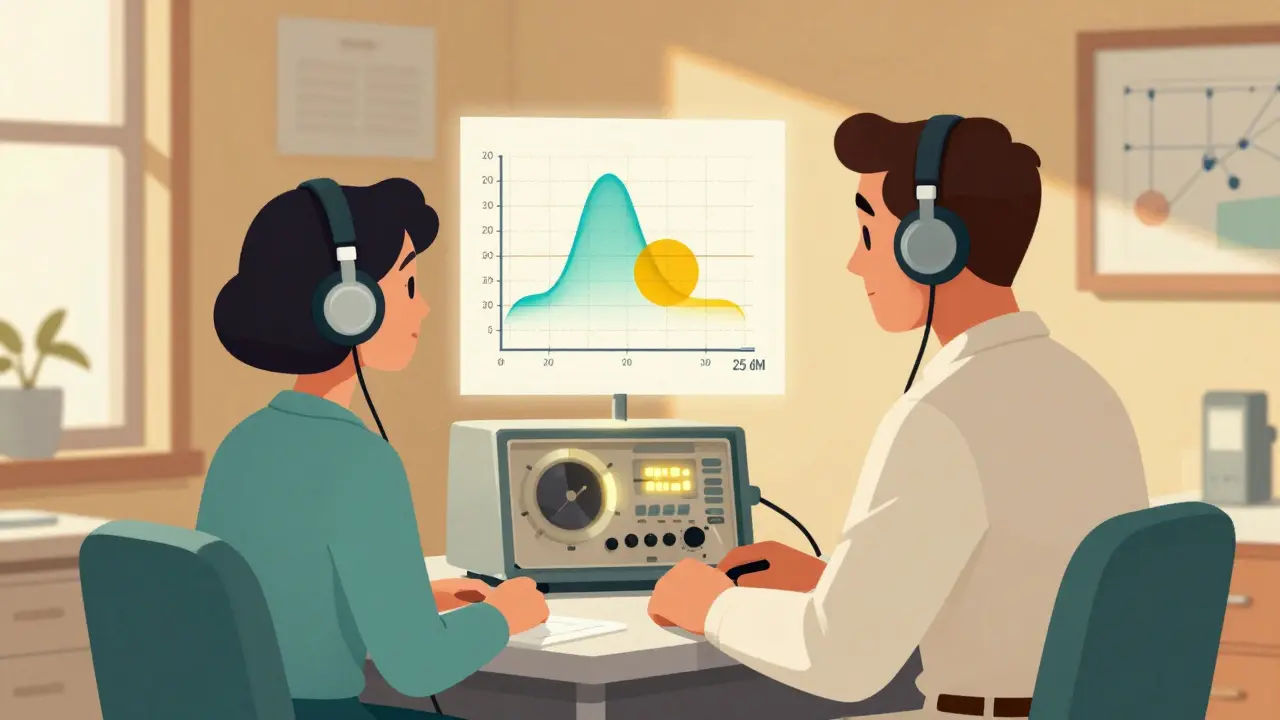
When you can't hear the doorbell, struggle to follow conversations in noisy rooms, or keep asking people to repeat themselves, it's not just frustration-it could be hearing loss. Audiometry testing is the most reliable way to find out exactly what's going on. This isn't a quick check. It's a detailed, science-backed process that measures how well your ears pick up sounds at different pitches and volumes, using decibels (dB) as the universal language of hearing.
What Happens During an Audiometry Test?
You sit in a quiet room, wear headphones, and press a button every time you hear a tone. Sounds simple, right? But behind that simple action is a precise method called pure-tone audiometry. The test checks your hearing across a range of frequencies-from low rumbles at 250 Hz to high-pitched whistles at 8000 Hz. These are the exact sounds that make up speech. A tone might start at 40 dB, loud enough to hear easily. Then, the audiologist slowly lowers the volume in 10 dB steps until you stop responding. Once you miss it, they go back up in 5 dB jumps to find the quietest sound you can hear about half the time. That number? That's your threshold.
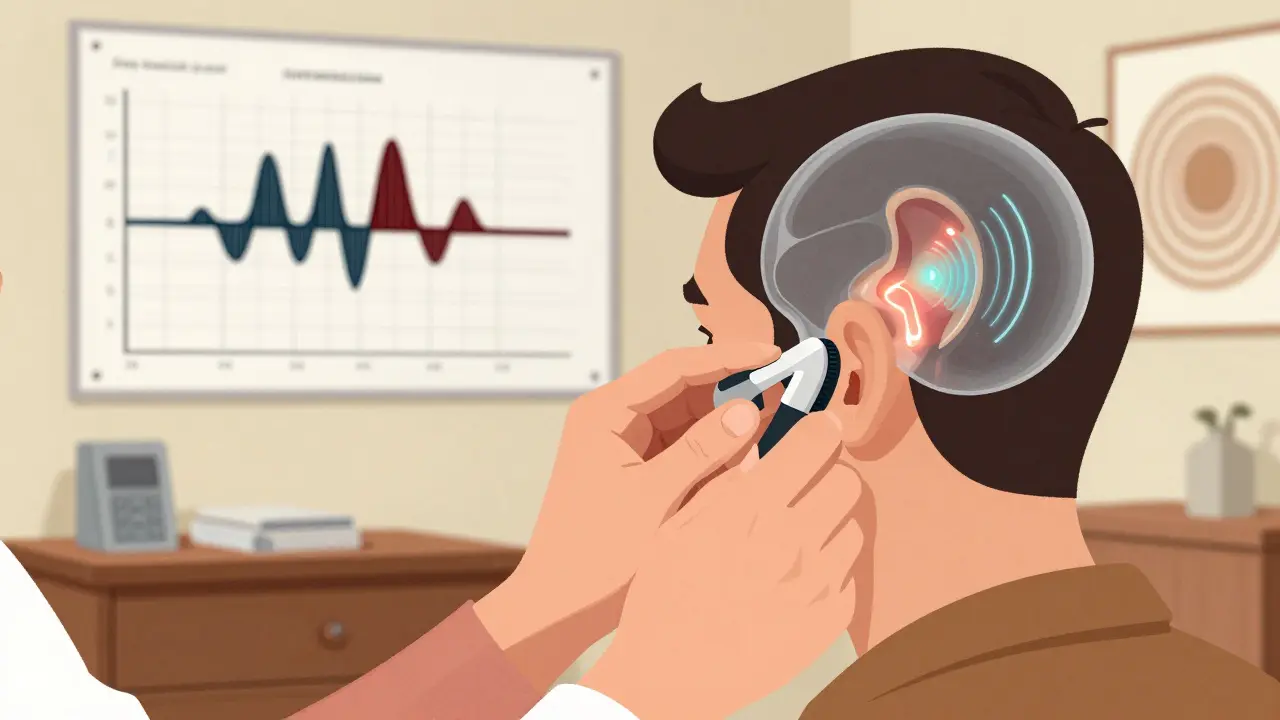
It's not just one ear tested. Both ears go through the same process. And then there's bone conduction. A small device is placed behind your ear, on the bone of your skull. It sends sound vibrations straight to your inner ear, skipping your ear canal and eardrum. If your air conduction (headphones) thresholds are worse than your bone conduction ones by 15 dB or more at multiple frequencies, it points to a problem in the middle ear-like fluid buildup or earwax blockage. That's called conductive hearing loss. If both are equally poor, the issue is likely in your inner ear or nerve pathways-sensorineural hearing loss.
Decibels: The Numbers That Tell the Story
Decibels (dB) aren't just numbers on a chart. They're the key to understanding how much hearing you've lost. Normal hearing is defined as being able to hear sounds at 25 dB or better across all tested frequencies. Anything above that? That's hearing loss. Mild loss starts at 26-40 dB. You might miss soft speech or whispers. Moderate loss (41-55 dB) means you struggle with regular conversation, especially in groups. Moderately severe (56-70 dB) makes TV volume too loud, and you often ask people to slow down. Severe (71-90 dB) means you hear only loud voices or shouting. Profound loss (91+ dB) means you may rely mostly on lip reading or sign language.
On your audiogram-the visual map of your hearing-you'll see circles for your right ear's air conduction, X's for your left, brackets for bone conduction. A gap between air and bone lines? That tells the audiologist where to look. A drop in hearing around 4000 Hz? That's often noise damage. A steep decline after 500 Hz? Could be age-related or genetic.
More Than Just Tones: Speech and Middle Ear Tests
Audiometry doesn't stop at tones. Speech testing adds another layer. The speech reception threshold (SRT) asks you to repeat simple two-syllable words like "baseball" or "hotdog" at lower and lower volumes. Your SRT should match your average pure-tone threshold within ±10 dB. If it doesn't, something's off. Maybe your brain isn't processing sound correctly, even if your ears are picking it up.
Then comes the word recognition test. You hear a list of words at a volume above your threshold-usually 30-40 dB above. You repeat them back. A score below 80% suggests trouble understanding speech, even when it's loud enough. This is critical. Some people hear tones fine but can't make sense of words. That's often a sign of damage to the inner ear or auditory nerve, not just volume loss.
And then there's tympanometry. A tiny probe seals your ear canal and changes the air pressure. It measures how well your eardrum moves. A flat line? That's a sign of fluid behind the eardrum-common in kids with ear infections. A stiff eardrum? Could be scarring from past infections. This test takes seconds but tells the audiologist if the problem is in the middle ear or deeper.
Who Gets Tested and Why?
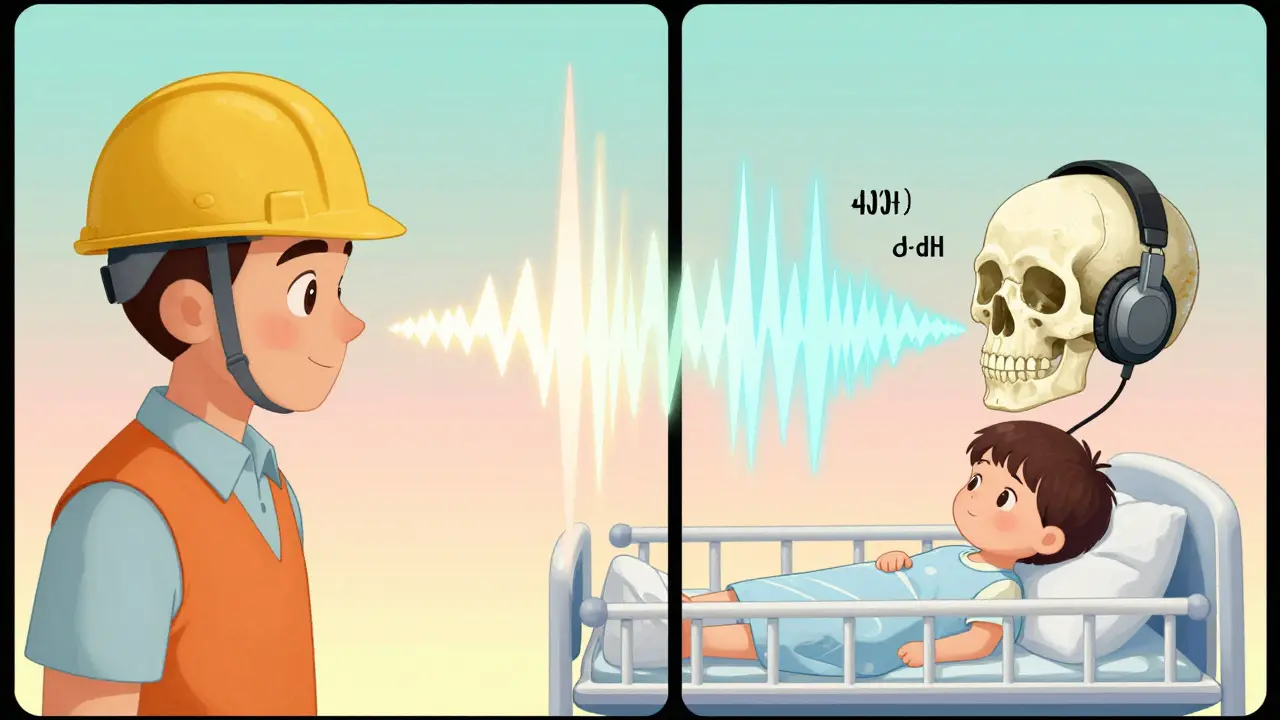
It's not just for older adults. Newborns are screened before leaving the hospital. The CDC recommends all babies get a hearing check before one month old. If they fail, a full diagnostic audiometry test is done by three months. Early detection means early intervention-critical for speech and language development.
Adults with noise exposure-construction workers, musicians, military personnel-get regular tests as part of workplace safety programs. OSHA requires annual audiograms for those exposed to loud environments. The goal? Catch changes early, before permanent damage sets in.
People with sudden hearing loss, ringing in the ears (tinnitus), dizziness, or ear pain should get tested immediately. So should anyone who notices a change in how clearly they hear, even if they're under 50. Hearing loss doesn't wait for retirement.
What the Experts Say About Accuracy
The American Speech-Language-Hearing Association (ASHA) and the American Academy of Audiology set strict standards. Audiometers must be calibrated annually to within ±3 dB. Test rooms must meet soundproofing standards. Masking-playing noise in the non-test ear-is required when one ear is significantly better than the other. Skip masking, and you'll get false results. About 12% of inaccurate tests come from poor masking, according to Mayo Clinic data.
For infants, non-verbal children, or patients who can't respond reliably, there's the auditory brainstem response (ABR). Electrodes on the scalp record electrical signals from the hearing nerve as sounds are played. No response needed from the patient. It's objective. It's used in NICUs and for diagnosing tumors on the auditory nerve.
And now, AI is stepping in. New software like Otometrics' 2023 system can scan an audiogram and flag patterns of conductive loss with 87% specificity. It doesn't replace the audiologist-it helps them spot what the eye might miss.
Common Misconceptions and What to Expect
Some think audiometry is painful. It's not. Bone conduction might feel odd-like a vibration on the skull. Glasses can get in the way. Some patients report discomfort, especially if the oscillator presses against their frames. That’s why audiologists adjust placement.
Others think one test is enough. It’s not. Hearing changes over time. Annual checks are recommended after age 50, or sooner if you’re at risk. A 45-year-old with normal hearing today might have a 20 dB loss at 4000 Hz in five years from noise exposure. Catching it early means better options-ear protection, hearing aids, or lifestyle changes.
And yes, the test takes time. Pure-tone testing alone takes 10-15 minutes per ear. Add speech and tympanometry? You’re looking at 30-45 minutes. But it’s worth it. One patient said, "The audiologist showed me my audiogram and explained why I kept missing the 's' and 'th' sounds. I finally understood why I was struggling at family dinners."
Access and the Future of Hearing Care
There are about 14,300 audiologists in the U.S. But they're not evenly spread. Rural areas have just 0.7 per 100,000 people. Urban centers have more than double that. Tele-audiology is filling gaps-remote testing with validated equipment like the KUDUwave booth. But it’s not perfect. Accuracy drops below 25 dB, so fine-tuning hearing aids remotely still needs in-person follow-up.
By 2026, hearing loss affects nearly 50 million Americans. The market for hearing care is growing fast. But the real win isn’t in sales-it’s in early detection. The sooner you know your hearing levels, the sooner you can protect what’s left and restore what you can.
Is audiometry testing painful?
No, audiometry testing is not painful. You’ll hear tones through headphones and may feel a slight vibration when bone conduction is tested. Some people find the placement of the bone oscillator uncomfortable if they wear glasses, but it’s never sharp or invasive. The test is entirely non-invasive and relies on your responses to sounds.
How long does an audiometry test take?
A full diagnostic audiometry test usually takes 30 to 45 minutes. Pure-tone testing alone takes about 10-15 minutes per ear. Adding speech testing and tympanometry extends the session. If you’re being tested for hearing aid fitting, expect a longer appointment for counseling and discussion.
What does 25 dB mean in hearing loss?
25 dB is the upper limit of normal hearing. If your threshold is 25 dB or lower at all frequencies, your hearing is considered normal. If your threshold is 26 dB or higher, you have some degree of hearing loss. For example, 30 dB means you miss soft speech, and 40 dB means you struggle with normal conversation unless the speaker is close and speaking clearly.
Can audiometry detect earwax blockage?
Audiometry alone can’t see earwax, but it can show signs of it. If air conduction thresholds are worse than bone conduction by 15 dB or more, it suggests a conductive hearing loss-often caused by blockages like earwax, fluid, or a perforated eardrum. Tympanometry will confirm if the eardrum is moving properly. A physical exam by the audiologist or doctor is needed to remove the wax.
Do I need a referral to get an audiometry test?
In most cases, no. Many audiology clinics accept direct appointments. Insurance may require a referral from a primary care doctor for coverage, especially if you’re seeking hearing aids. But if you’re paying out-of-pocket or using Medicare (which covers diagnostic tests with a referral), you can often schedule directly. Check with your provider.
Can I do audiometry testing at home?
Some apps and online tools claim to test hearing, but they’re not reliable for diagnosis. They lack proper calibration, soundproofing, and controlled conditions. The FDA recognizes only a few tele-audiology systems-like KUDUwave-for remote screening, but even those aren’t meant to replace in-person diagnostic testing. For accurate results, especially if you suspect hearing loss, see an audiologist in person.
Gaurav Kumar
March 17, 2026 AT 02:37Finally, someone explains audiometry without dumbing it down. 😎 25 dB is the ceiling of normal? Nah, bro. 25 dB is the floor. If you need 30 dB to hear a whisper, you're already in the red zone. And don't get me started on those 'home hearing tests'-I've seen Indian uncle's WhatsApp forwards claiming their phone mic can diagnose tinnitus. 😂 We need real science, not TikTok audiometry.
Jeremy Van Veelen
March 18, 2026 AT 09:07THIS. IS. A. MASTERPIECE. 🎭 I’ve sat through 17 audiometry sessions in 3 years (yes, I’m a hearing loss drama queen) and NO ONE has ever explained bone conduction like this. That moment when the oscillator vibrates your skull and you think, 'Wait, is my brain hearing through my forehead?'-that’s the moment you realize your ears are just middlemen. The real MVP? The auditory nerve. And if you’re not getting masked properly? You’re getting a lie. Period. End of story. 💥
Laura Gabel
March 18, 2026 AT 18:39Andrew Mamone
March 20, 2026 AT 17:59Love how this breaks down the science without fluff. 🤝 The SRT matching pure-tone thresholds within ±10 dB? That’s the golden rule. I’ve seen so many clinics skip speech testing because 'it takes too long.' But if your ears hear tones but your brain turns 'butterfly' into 'butter fly,' you’ve got neural noise, not volume loss. And yes, AI is helping-Otometrics’ new system flagged a hidden retrocochlear pattern I missed on my last 300 audiograms. Still, nothing replaces the human eye. 👨⚕️🧠
MALYN RICABLANCA
March 21, 2026 AT 14:08OH MY GOD. I JUST HAD MY FIRST AUDIOMETRY TEST AND IT WAS A TRAUMATIC EXPERIENCE. 😭 I thought I was just 'getting older'-but my audiogram looked like a death spiral! 45 dB at 4000 Hz? That’s not age, that’s a crime. I’ve been to 3 concerts in the last year. 3. That’s it. And now I’m being told I need hearing aids? By 30? I’m not ready. I’m not emotionally prepared. My husband says I'm 'overreacting.' But he doesn’t hear the way I do. He doesn’t know the sound of silence when you can’t catch the 's' in 'yes.' I’m crying. I’m terrified. I’m 28. I’m not old. I’m broken. 💔
gemeika hernandez
March 21, 2026 AT 16:22Nicole Blain
March 22, 2026 AT 01:39So many people think hearing loss is just about volume. But the real issue? Clarity. 🧠 I used to think I was bad at understanding accents. Turns out, I was missing the high-frequency consonants-'s,' 't,' 'f.' Now I get why my dog barks and I hear 'bark.' 🐶 I got my first hearing aids last year. Life changed. Not because I hear louder. But because I hear *right*.
Kathy Underhill
March 23, 2026 AT 04:01Thank you for the thorough breakdown. The distinction between conductive and sensorineural loss is critical-not everyone understands that bone conduction isolates inner ear function. I’ve counseled patients who thought their hearing loss was 'just temporary' after an ear infection. But if air-bone gap persists beyond 3 months? It’s not fluid. It’s structural. And early intervention isn’t about convenience-it’s about neuroplasticity. The brain rewires quickly in youth. Delay? You lose the window. Always test. Always follow up. No exceptions.