
The Pharmaceutical Benefits Scheme (PBS) is the backbone of Australia’s healthcare system when it comes to prescription drugs. It’s not just a subsidy program-it’s the reason millions of Australians can afford life-saving medications. Since 1948, the PBS has ensured that essential medicines are available at prices most people can handle, not just those who can pay full retail. Today, nearly 87% of all prescriptions in Australia are covered by the PBS, and about 84% of those are generics. That means for most common conditions-high blood pressure, diabetes, cholesterol, depression-Australians are getting affordable, effective treatment because the government stepped in to control prices and push for competition.
How the PBS Actually Works
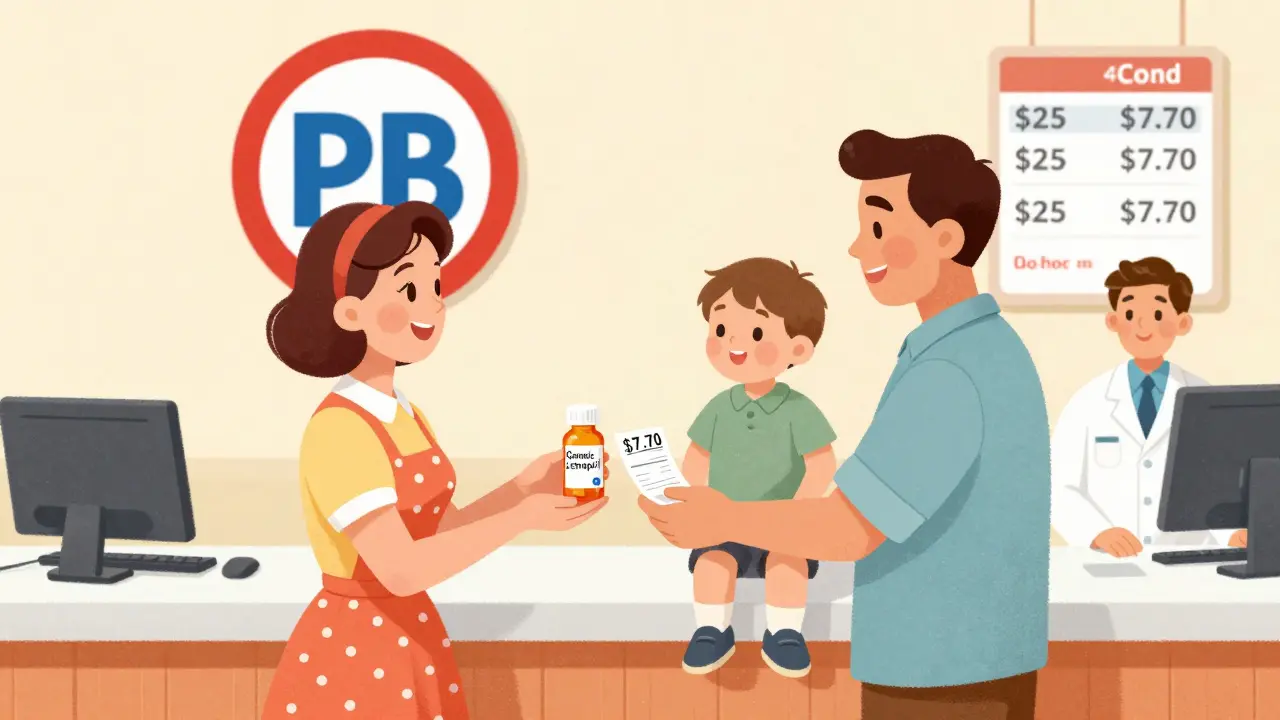
The PBS doesn’t give out free medicine. Instead, it caps what patients pay. As of January 1, 2026, general patients pay $25 per script, down from $31.60. Concession card holders pay just $7.70. That’s it. After that, the government picks up the rest. For most people, this is a huge relief. But behind that simple co-payment is a complex system designed to balance access, cost, and quality.
The key player here is the Pharmaceutical Benefits Advisory Committee (PBAC). This group of doctors, pharmacists, economists, and patient advocates reviews every new drug before it gets listed on the PBS. They don’t just ask, “Is this effective?” They ask, “Is it worth the price?” Their main tool is the cost-per-QALY metric-quality-adjusted life year. If a drug costs more than about AU$50,000 per extra year of healthy life it gives someone, it’s usually rejected. But there are exceptions. For rare diseases, the PBAC will approve drugs costing over AU$150,000 per QALY under the Highly Specialised Drugs Program (HSDP). That’s rare, but it happens.
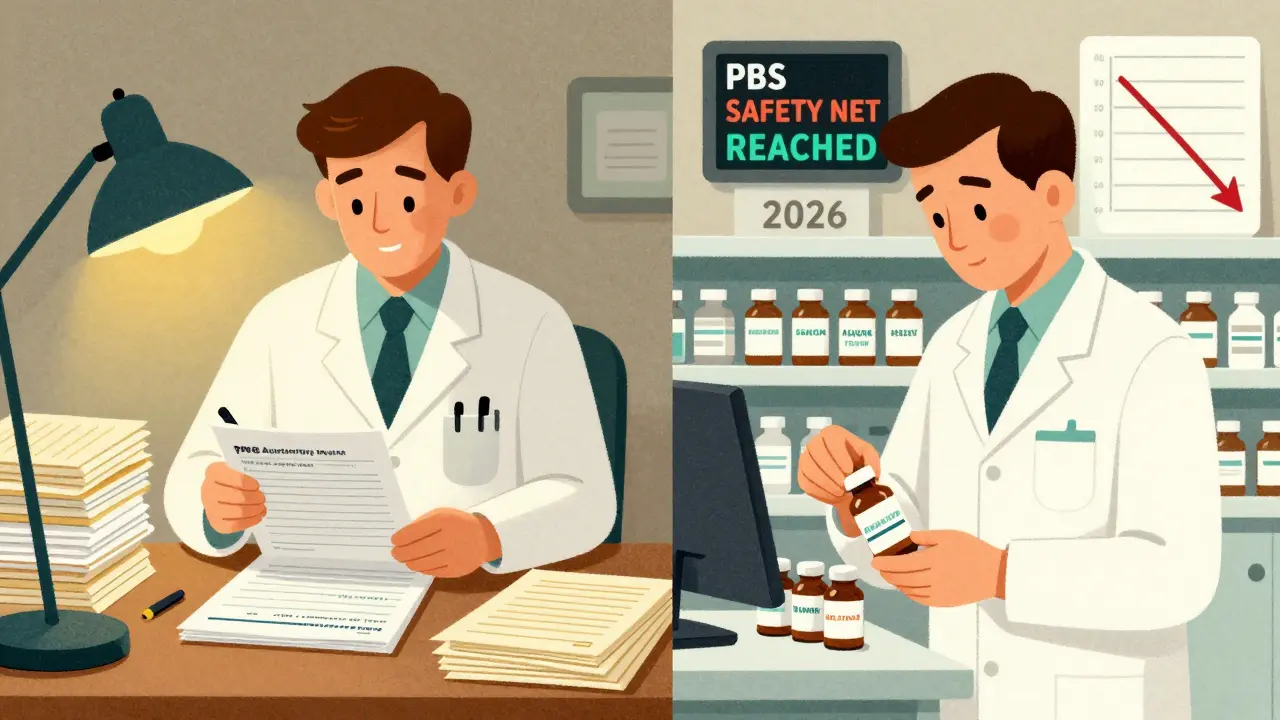
There are three types of PBS listings: general (anyone can get it), restricted (only for specific conditions like stage 3 cancer), and authority-required (needs pre-approval). About 42% of PBS medicines are restricted, and 28% need authority approval. That means your doctor can’t just write a script-they might need to fill out extra forms, send in test results, or wait days for approval. For patients with chronic conditions, this adds stress. For pharmacists, it adds hours. One pharmacist in Brisbane told me they spend nearly 30% of their day just handling PBS paperwork.
The Power of Generic Medicines
Generics make the PBS work. They’re chemically identical to brand-name drugs but cost a fraction of the price. In Australia, generics make up 84% of all prescriptions by volume. That’s higher than the OECD average of 78%. But here’s the twist: they only make up 22% of total PBS spending. Why? Because the most expensive drugs-biologics, cancer treatments, rare disease therapies-are still mostly brand-name. Generics dominate the cheap, high-volume drugs: statins, metformin, lisinopril, sertraline.
The PBS pushes generics hard through its reference pricing system. If five drugs treat the same condition, the government sets the subsidy based on the cheapest one. So if a generic hits the market at $5, and the brand-name version costs $30, the government only pays $5. The patient still pays $25 (or $7.70), but the brand-name drug loses most of its market share overnight. This system forces companies to compete on price, not marketing.
After a drug’s patent expires, the price of generics can drop by 62% within a year. In cardiovascular drugs, the drop is even steeper-74%. That’s why you’ll see pharmacies pushing generics: they’re cheaper for the system, and they’re just as safe. A 2024 study from the University of Sydney found no difference in outcomes between patients taking brand-name or generic blood pressure meds over five years.
Who Pays What-and Who Struggles
The PBS safety net is one of its most underrated features. Once you’ve spent $1,571.70 on PBS medicines in a year, your co-payment drops to $7.70 for concession holders and $25 for everyone else-even if you’re on 10 different drugs. That’s a lifesaver for people with multiple chronic conditions.
But not everyone benefits equally. In 2024, 12.3% of general patients-about 1.8 million Australians-said they skipped doses or didn’t fill prescriptions because of cost. That’s not just inconvenience. It’s dangerous. People with diabetes, heart disease, or mental health conditions are at higher risk of hospitalization or death when they can’t afford their meds. Reddit threads from r/AusFinance are full of stories: retirees choosing between insulin and groceries, single parents skipping asthma inhalers to pay rent.
Concession card holders are protected. They get 60-day prescriptions for the price of one co-payment. That’s a 50% savings. But if you’re not on a pension, don’t have a healthcare card, and earn too much to qualify, you’re on your own. The $25 co-payment sounds low-but if you’re on five scripts a month, that’s $150 a month. For someone on a minimum wage job, that’s 10% of their take-home pay.
Why Australia’s System Is Different
Compare Australia to the U.S. In America, a 30-day supply of insulin can cost $300. In Australia, it’s $7.70 with a concession card, $25 without. The PBS saves Australian households an estimated $13 billion a year in out-of-pocket costs. That’s not a small number-it’s bigger than the entire annual budget for Australia’s public hospitals.
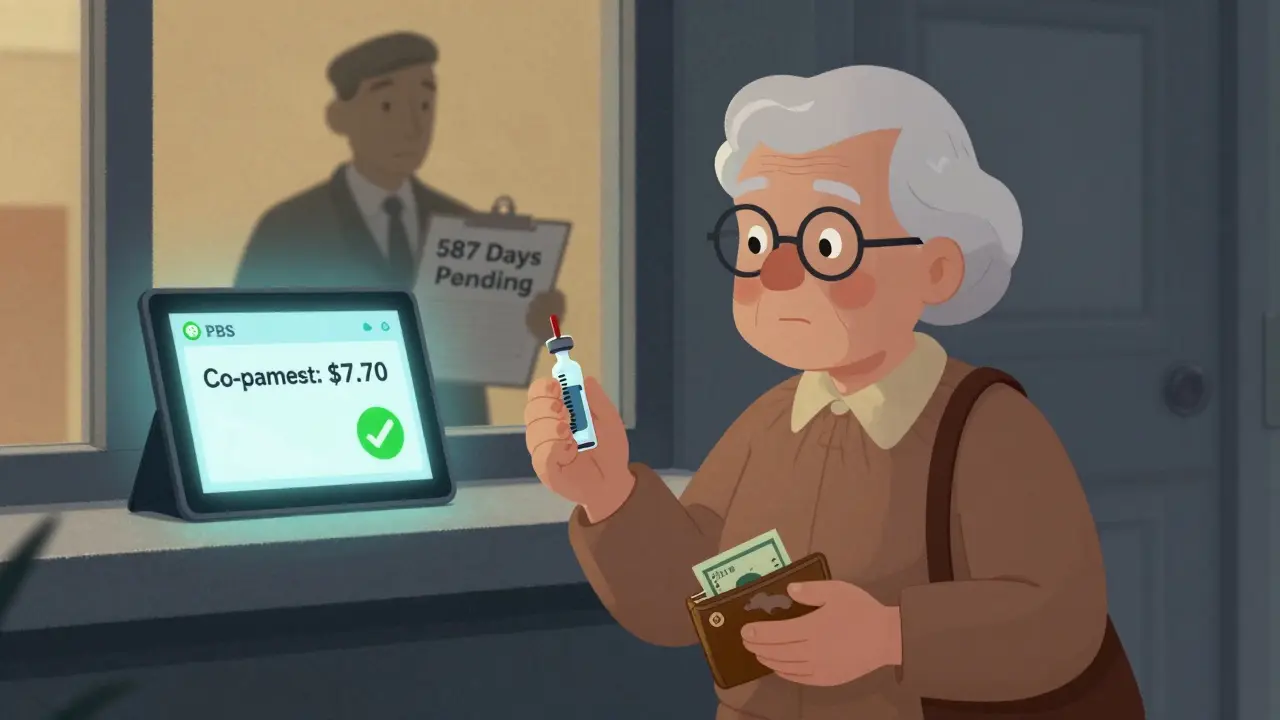
But the PBS isn’t perfect. It’s slower than other countries. The average time from when a drug is approved globally to when it’s listed on the PBS is 587 days. In Germany, it’s 320 days. That means Australians wait nearly two years to get new treatments. For cancer drugs, that delay can mean the difference between life and death. The “PBS black hole”-the gap between Therapeutic Goods Administration (TGA) approval and PBS listing-costs patients an average of $1,850 out-of-pocket during that wait.
Canada and the UK have tighter price controls, but Australia has more flexibility. The UK’s NICE system has a strict £20,000-£30,000 per QALY limit. If a drug exceeds that, it’s almost always rejected. Australia’s PBAC has a higher unofficial threshold-$50,000-but still approves expensive drugs for rare conditions. That’s why Australia gets more breakthrough treatments than the UK, but fewer than the U.S.
What’s Changing in 2026 and Beyond
The biggest change? The co-payment drop to $25 on January 1, 2026. It’s a $784 million saving for patients over four years. But it also means the government will spend an extra $689 million to cover the difference. That’s a trade-off: more patient relief, more taxpayer cost.
The Highly Specialised Drugs Program is also being reformed. After a 2024 Senate inquiry found too many rare disease patients were being denied access, two of the eight eligibility criteria were relaxed. That means more patients with ultra-rare conditions will get access to drugs that cost over $100,000 per year.
Also, the government added 150,000 new Australians to the PBS in 2025 by listing new drugs for prostate cancer and endometriosis. That’s progress. But the biggest threat isn’t cost-it’s delay. The PBAC is overloaded. The average time to review a new drug application has increased by 30% since 2020. Without more staff or better tech, the backlog will only grow.
Digitization is coming. The PBS app has been downloaded 1.2 million times. Real-time prescription monitoring is being rolled out to catch overprescribing. AI is being tested to flag inappropriate use. But none of this fixes the core problem: too many drugs, too few reviewers, too much red tape.
What This Means for You
If you’re on the PBS, you’re getting one of the best drug deals in the world. You’re paying a fraction of what people in the U.S., Japan, or Switzerland pay for the same medicine. You’re getting generics that work just as well. You’re protected by the safety net. But if you’re not on a concession card, and you’re on multiple scripts, you’re still paying a lot. And if you need a new, expensive drug for a rare condition? You might be waiting years.
The PBS isn’t broken. It’s working-just under strain. The real challenge isn’t whether it’s fair-it’s whether it can keep up. As the population ages, as new biologics flood the market, and as drug prices climb, the PBS will face harder choices. Will it keep covering everything? Or will it start saying no more often?
Right now, it’s still the most affordable system in the developed world. But that won’t last forever unless we fix the delays, fund the reviewers, and keep pushing for faster generic entry.
How much do Australians pay for generic medicines under the PBS?
As of January 1, 2026, general patients pay $25 per prescription, and concession card holders pay $7.70. These amounts are indexed annually to the Consumer Price Index (CPI), but the government has frozen increases in recent years to reduce out-of-pocket costs. After reaching the annual PBS safety net threshold of $1,571.70 (2025 figure), patients pay only $25 per script regardless of their status.
Why are generic drugs cheaper in Australia than in the U.S.?
Australia uses a reference pricing system that sets the government subsidy based on the lowest-priced medicine in a therapeutic group. Once a generic enters the market, the price of the brand-name drug drops dramatically because the PBS won’t pay more than the cheapest option. In the U.S., drug prices are negotiated privately between manufacturers and insurers, with no public price controls. This leads to much higher costs for the same drugs.
What is the PBS safety net and how does it help?
The PBS safety net is a cap on annual out-of-pocket spending for prescription medicines. Once a patient reaches $1,571.70 in PBS co-payments in a calendar year, their co-payment drops to $7.70 for concession holders and $25 for general patients for the rest of the year. This protects people with chronic conditions who need multiple medications from financial hardship.
Why do some medicines take so long to get listed on the PBS?
The Pharmaceutical Benefits Advisory Committee (PBAC) must evaluate each drug for clinical effectiveness and cost-effectiveness before listing. With over 200 applications per year and limited staff, the review process takes an average of 587 days from global launch to PBS listing. This delay is much longer than in countries like Germany or Canada, where approval processes are faster and more streamlined.
Can I get PBS-subsidized medicines if I’m not an Australian citizen?
Yes, if you’re a permanent resident or a visitor from one of the 11 countries with a Reciprocal Health Care Agreement with Australia (including New Zealand, the UK, Ireland, Sweden, the Netherlands, Finland, Italy, Malta, Norway, Slovenia, and Belgium). You must have a valid Medicare card or equivalent documentation to access subsidized medicines under the PBS.
jonathan soba
January 28, 2026 AT 03:46The PBS is a marvel of bureaucratic efficiency-until you need a drug that costs more than $50k per QALY. Then it’s like trying to get a visa from a consulate that’s closed for ‘maintenance.’ The math checks out on paper, but real people are stuck waiting 18 months for life-extending drugs while their savings evaporate. And don’t get me started on the ‘authority-required’ forms. My uncle spent three weeks filling out paperwork just to get his chemo covered. Three weeks. He’s 72. Not a bureaucrat.
Chris Urdilas
January 28, 2026 AT 17:30Y’all are acting like Australia invented healthcare. The U.S. spends 18% of GDP on health and still has people choosing between insulin and rent. At least here, you can walk into a pharmacy and not get handed a bill that looks like a mortgage application. Yeah, the wait times suck. But I’ll take 587 days of bureaucracy over $1,200 for a month’s supply of metformin any day. Also, generics work. I’ve taken them for years. No magic pills, no side effects I didn’t already have. Just cheaper.
Phil Davis
January 30, 2026 AT 01:54It’s funny how people act like $25 is nothing. Try being on minimum wage and paying that for five scripts a month. That’s $150. That’s half your bus fare for the month. That’s two weeks of groceries if you’re lucky. The safety net helps-but only if you live long enough to hit it. And the ‘concession card’ system? It’s a minefield. You’re either poor enough to qualify or just above the line and screwed. There’s no middle ground. Just a cliff.
Irebami Soyinka
January 31, 2026 AT 12:34Wow. So Australia lets the government decide who lives and who dies based on math? 🤦♀️ And you call this a system? In Nigeria, if you need medicine, you pay for it-no forms, no committees, no waiting. If you can’t afford it? You pray. But at least you don’t have some white dude in Canberra deciding your life’s worth $48,000. I don’t care if it’s ‘cost-effective.’ My grandma didn’t die because she couldn’t afford insulin. She died because the system said her life wasn’t worth the price tag. 🇳🇬💔
Mel MJPS
January 31, 2026 AT 22:26I just want to say thank you for writing this. My mom’s on five meds, and the PBS safety net saved us last year when her COPD flared up. We went from paying $180/month to $25 after hitting the cap. I cried when I saw the receipt. People don’t talk enough about how this system keeps real families from falling apart. Yeah, it’s slow. Yeah, the forms are a nightmare. But it works. And for a lot of us? That’s everything.
Katie Mccreary
February 1, 2026 AT 13:03So let me get this straight-you’re proud that Australians pay $25 for insulin while Americans pay $300? Cool. Now tell me why your government takes 2 years to approve a drug that’s already on the market in Canada. That’s not a system. That’s a delay tactic. And don’t give me the ‘it’s cheaper’ line. My cousin got diagnosed with stage 4 melanoma and had to pay $22,000 out of pocket for 6 months because the PBS hadn’t approved the drug yet. You call that ‘affordable’? I call it cruel.
SRI GUNTORO
February 2, 2026 AT 17:43This is why Western countries are collapsing. You’ve turned medicine into a spreadsheet. People aren’t numbers. Lives aren’t QALYs. You let a committee decide who gets to live based on cost? That’s not healthcare. That’s eugenics with a spreadsheet. And you wonder why people are angry? You’ve made compassion a budget line item. Shame on you.
Rose Palmer
February 4, 2026 AT 04:29Thank you for the comprehensive and well-researched overview. The PBS is indeed a model of equitable access, albeit under significant strain. The structural delays in drug listing, while concerning, are not insurmountable. Increased funding for the PBAC, investment in digital triage systems, and strategic partnerships with international regulators could significantly reduce review times. Furthermore, the reference pricing model remains one of the most effective mechanisms for curbing pharmaceutical inflation. The challenge is not whether the system is fair-it is-but whether we have the political will to sustain it. We must advocate for adequate resourcing, not dismantling. This system saves lives. Let’s fix it, not abandon it.