
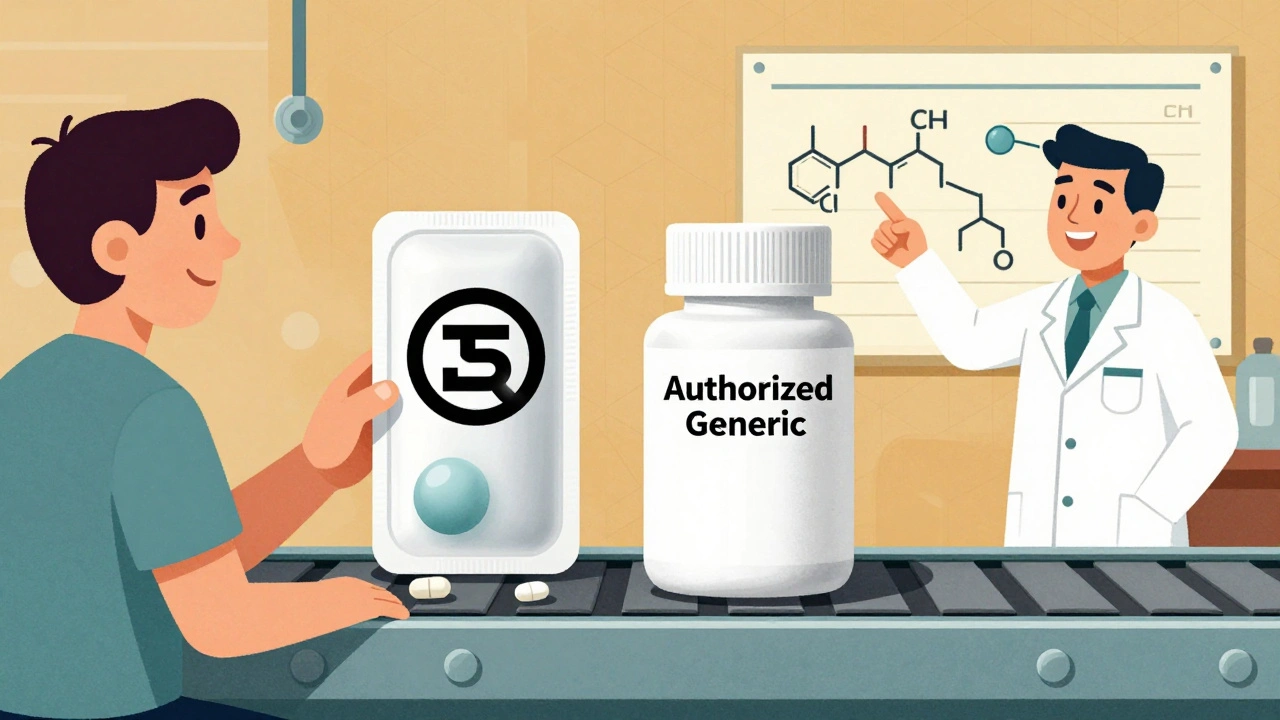
When you switch from a brand-name drug to a generic, you expect to save money - but what if you also lose the exact same formula you’ve been taking for years? That’s where authorized generics come in. They’re not just another cheap alternative. They’re the same pill, same capsule, same inactive ingredients - just sold under a different label at a lower price.
What Exactly Is an Authorized Generic?
An authorized generic is a version of a brand-name drug made by the same company that produces the original, but sold without the brand name. It’s not a copy. It’s the exact same product, right off the same production line. The only differences? The packaging and the label. No changes to the active ingredient. No changes to the fillers, dyes, or coatings. If your brand drug is white and round with a score line, the authorized generic will be too - maybe just a different color or marking to tell them apart. The FDA confirms this. According to their rules, authorized generics are approved under the original brand’s New Drug Application (NDA), not through the usual generic approval process. That means they don’t need to prove bioequivalence - because they’re not equivalent. They’re identical. This matters most for drugs with a narrow therapeutic index - where tiny changes can cause big problems. Think levothyroxine for thyroid conditions, warfarin for blood thinning, or seizure medications like phenytoin. For these, even small differences in inactive ingredients can throw off absorption. A 2023 study in US Pharmacist found that 32% of patients reported side effects after switching to traditional generics - mostly due to fillers or coatings they couldn’t tolerate. But with authorized generics, those issues drop dramatically.Why Authorized Generics Cost Less (But Are the Same)
You might wonder: if it’s the same drug, why is it cheaper? The answer is simple: competition. Brand-name companies often launch authorized generics when they know a generic version is about to hit the market. They do this to stay competitive. Instead of letting a single generic company have 180 days of exclusive sales (as allowed under the Hatch-Waxman Act), they enter the market themselves with their own low-cost version. That drives prices down faster. According to the Federal Trade Commission, when an authorized generic enters the market during the first generic’s exclusivity window, prices drop 25-30% more than they would without it. And because the authorized generic comes from the same manufacturer, it avoids the supply chain delays and quality inconsistencies that sometimes plague independent generic makers. The price difference? Typically 15-20% lower than the brand-name version. Not as steep as some traditional generics, but still meaningful - especially for chronic medications taken daily. And because it’s identical, you don’t risk a reaction or a drop in effectiveness.Authorized Generics vs. Traditional Generics: The Real Difference
Here’s the key distinction:- Traditional generics: Must have the same active ingredient and meet bioequivalence standards. But they can - and often do - use different inactive ingredients. That’s allowed by the FDA. And while most people don’t notice a difference, some do.
- Authorized generics: Same active ingredient. Same inactive ingredients. Same size, shape, coating, and release mechanism. Identical to the brand in every way except the name on the bottle.
How to Know If Your Drug Has an Authorized Generic
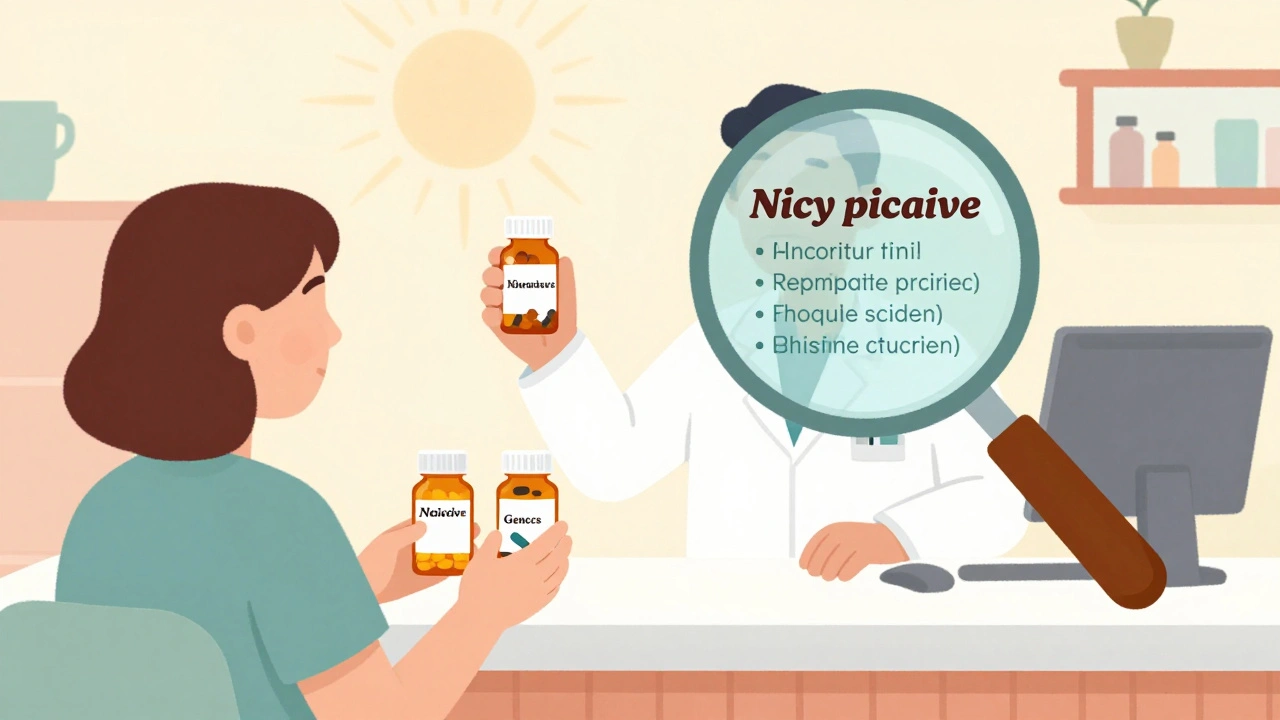
Not every brand-name drug has one. As of 2023, only 15-20% of brand-name medications have an authorized generic version available. But many of the most commonly prescribed ones do. Drugs like Lipitor (atorvastatin), Plavix (clopidogrel), Prozac (fluoxetine), and Synthroid (levothyroxine) all have authorized generics. You won’t find them listed in the FDA’s Orange Book as separate entries - because they’re marketed under the brand’s NDA. But your pharmacist can find them using the National Drug Code (NDC). Ask your pharmacist: “Does this brand have an authorized generic?” They’re trained to check. In fact, 87% of chain pharmacies now have systems in place to identify authorized generics by cross-referencing NDC numbers. It takes just a few seconds. You can also check GoodRx or other price comparison tools. If you see two listings for the same drug - one labeled “brand,” one labeled “generic” - and the generic price is only slightly lower, it might be the authorized version. Look for the manufacturer name. If it matches the brand, you’ve found it.Insurance Coverage and What to Expect at the Pharmacy
Good news: most insurance plans treat authorized generics like regular generics. Medicare Part D covers them at generic copay levels 92% of the time. Commercial insurers follow suit in about 78% of cases. But here’s the catch: you might not know you got one. A 2022 Kaiser Family Foundation survey found that 28% of patients didn’t realize they were given an authorized generic until after they picked up the prescription. They saw a different-looking pill and assumed it was a different drug. Some even called their doctor in panic. That’s why it’s important to ask. If your prescription is switched, ask your pharmacist: “Is this the brand, a traditional generic, or an authorized generic?” Don’t assume. And if you’re told it’s “just a generic,” push a little. You have the right to know what you’re getting.
Why Some Experts Are Concerned
Authorized generics aren’t perfect. There’s a dark side. Some brand companies use them as a tactic to block real generic competition. By launching an authorized generic right when the first generic company gets its 180-day exclusivity, they can flood the market and drive down prices so fast that the independent generic company can’t profit. This undermines the incentive system Congress created in 1984 to encourage generic innovation. The Generic Pharmaceutical Association found that 43% of authorized generics launched during that critical 180-day window. The FDA and FTC have flagged this as a potential anti-competitive practice. In 2022, the Biden administration directed the FDA to look into these tactics. But here’s the thing: even if the strategy is questionable, the result for patients is still positive. Prices drop. Access improves. And for people who need stability in their medication, the authorized generic is still the safest bet.Who Benefits Most From Authorized Generics?
Three groups benefit the most:- Patients on narrow therapeutic index drugs - like thyroid meds, blood thinners, or epilepsy drugs - where even small changes in formulation can cause harm.
- People who had bad reactions to traditional generics - if you switched and felt off, you’re not imagining it. An authorized generic might be your solution.
- Those on long-term prescriptions - if you’re on a drug for years, consistency matters. Why risk a new filler when you can stick with the exact same formula?
What to Do Next
If you’re thinking about switching from a brand-name drug:- Ask your pharmacist: “Is there an authorized generic for this?”
- Check your prescription label. If the manufacturer name matches the brand, it’s likely an authorized generic.
- Don’t assume a cheaper generic is better. Ask what’s in it.
- If you’re on a critical medication, talk to your doctor before switching - even to an authorized generic. Some prescribers still write “do not substitute.”
Are authorized generics safe?
Yes. Authorized generics are made by the same company that produces the brand-name drug, using the exact same ingredients, manufacturing process, and quality controls. The FDA considers them therapeutically equivalent because they are identical to the brand product - not just similar. There’s no increased risk.
Can I switch from a brand to an authorized generic without consulting my doctor?
In most cases, yes - unless your doctor specifically wrote “dispense as written” or “no substitution” on the prescription. Pharmacists can legally switch you to an authorized generic without a new prescription, just like they can with traditional generics. But it’s always smart to inform your doctor if you make the switch, especially for critical medications.
Why don’t more drugs have authorized generics?
Only brand-name drug manufacturers can produce authorized generics, and they only do so when it makes financial sense - usually when generic competition is imminent. Many brands choose to wait until patents expire fully before allowing any generic versions. As of 2023, only 15-20% of brand-name drugs have authorized generic versions available.
Do authorized generics work as well as the brand name?
They work exactly the same. Since they contain the same active and inactive ingredients, delivered in the same way, they’re absorbed and processed by your body identically. For patients who had issues with traditional generics - like inconsistent effects or side effects - authorized generics often solve the problem.
How do I know if I’m getting an authorized generic at the pharmacy?
Check the label. The manufacturer name will match the brand-name drug’s maker. You can also ask your pharmacist directly: “Is this an authorized generic?” Most chain pharmacies now track this via NDC codes. If you’re unsure, ask for the packaging or bottle - the manufacturer’s name is always printed on it.
Suzanne Johnston
December 8, 2025 AT 19:54So let me get this straight - you’re telling me I’ve been overpaying for years because I didn’t know my thyroid med was just a brand-name pill in a different bottle? I feel like I got scammed by Big Pharma and my own ignorance. This is the kind of info that should be shouted from rooftops, not buried in a 3000-word post.
Graham Abbas
December 9, 2025 AT 14:34Man, this is wild. I used to think generics were just cheaper knockoffs, but now I realize it’s not about the drug - it’s about the packaging and the corporate games. The fact that the same factory makes both? That’s not marketing, that’s just capitalism being weird. I’m going to ask my pharmacist tomorrow. No more guessing.
Elliot Barrett
December 10, 2025 AT 13:51Why are we even talking about this? Just take the cheapest one. If it doesn’t work, go back to the brand. It’s not rocket science. Stop overcomplicating your meds.
Shubham Mathur
December 11, 2025 AT 07:53Bro I’ve been on levothyroxine for 8 years and switched to generic last year and I felt like a zombie for 3 months I thought I was going crazy then I found out it was the filler I switched to the authorized one and boom back to normal like magic I’m telling everyone now
Ryan Brady
December 13, 2025 AT 02:35USA! USA! We got the best drugs in the world and now we’re being told to just switch labels? 😤 I don’t care if it’s the same pill - I paid for the brand name and I want the brand name experience! 🇺🇸💊
Delaine Kiara
December 14, 2025 AT 17:07Okay so I’m a nurse and I’ve seen this happen SO MANY TIMES. One patient switched to a traditional generic for her seizure med and had a seizure in the waiting room. Another one cried because she couldn’t sleep after switching her blood thinner. Then they got the authorized generic? Back to normal. Like, overnight. This isn’t theory. This is real life. And no, the FDA doesn’t care enough to force manufacturers to list inactive ingredients clearly. So we have to fight for ourselves.
And yes, I’ve had patients call me at 2 a.m. because their pill looked different. They thought they were poisoned. It’s terrifying. Authorized generics aren’t just smart - they’re lifesavers.
Also, why is no one talking about how insurance companies don’t tell you? They just swap it out. You don’t get a notification. You don’t get a choice. You just get a different-looking pill and are told it’s ‘the same.’ It’s not the same. Not unless it’s authorized.
And if you think this is just about money - think again. It’s about dignity. It’s about control over your own body. If you’ve been stable on a drug for a decade, why should you risk it because some bean counter decided to cut costs?
I’ve seen people go from functioning to barely able to walk because of a filler change. I’ve seen depression return because of a coating. I’ve seen people quit their meds because they didn’t trust the new version. This isn’t a niche issue. It’s a public health blind spot.
And yeah, I know some companies use authorized generics to kill competition. But that doesn’t make the patient benefit any less real. We can be mad at the system AND still use the tool that saves lives.
So if you’re on a narrow-therapeutic-index drug - ask. Ask. ASK. Don’t wait for a crisis. Don’t wait for a seizure. Ask your pharmacist today. It takes 10 seconds. And if they don’t know? Find someone who does.
Also - if you’re on Synthroid? Please, for the love of all that is holy, don’t switch to a generic unless it’s authorized. I’m begging you.
Gilbert Lacasandile
December 15, 2025 AT 10:30Interesting stuff. I never knew this existed. I’ve been on Lipitor for 12 years and never thought to ask. I’ll definitely check next refill. Thanks for the clarity.
Haley P Law
December 17, 2025 AT 00:39Wait… so I’ve been taking the same pill for 5 years… but it’s been a different color every time? And I thought I was losing my mind? 😭 I need to call my pharmacy right now.
Andrea DeWinter
December 17, 2025 AT 05:11For anyone on warfarin - DO NOT SWITCH WITHOUT TALKING TO YOUR DOCTOR. Even authorized generics can have slight differences in how they’re absorbed if your body’s sensitive. INR levels can shift. Get tested after switching. Don’t assume it’s fine. I’ve seen people nearly bleed out because they thought ‘same pill = same effect.’ It’s not that simple.
And if you’re on Synthroid - yes, authorized generic is your best friend. But if you’re on a different thyroid med? Same rule. Test your TSH after 6 weeks. Always.
Angela R. Cartes
December 17, 2025 AT 17:09Wow. So we’re supposed to be impressed that a drug company decided to sell their own product cheaper? Groundbreaking. I’m sure they did this out of the goodness of their hearts. 😒 Meanwhile, the real generics are still being held hostage by patent trolls and pharma monopolies. This is just a PR move dressed up as patient care.