
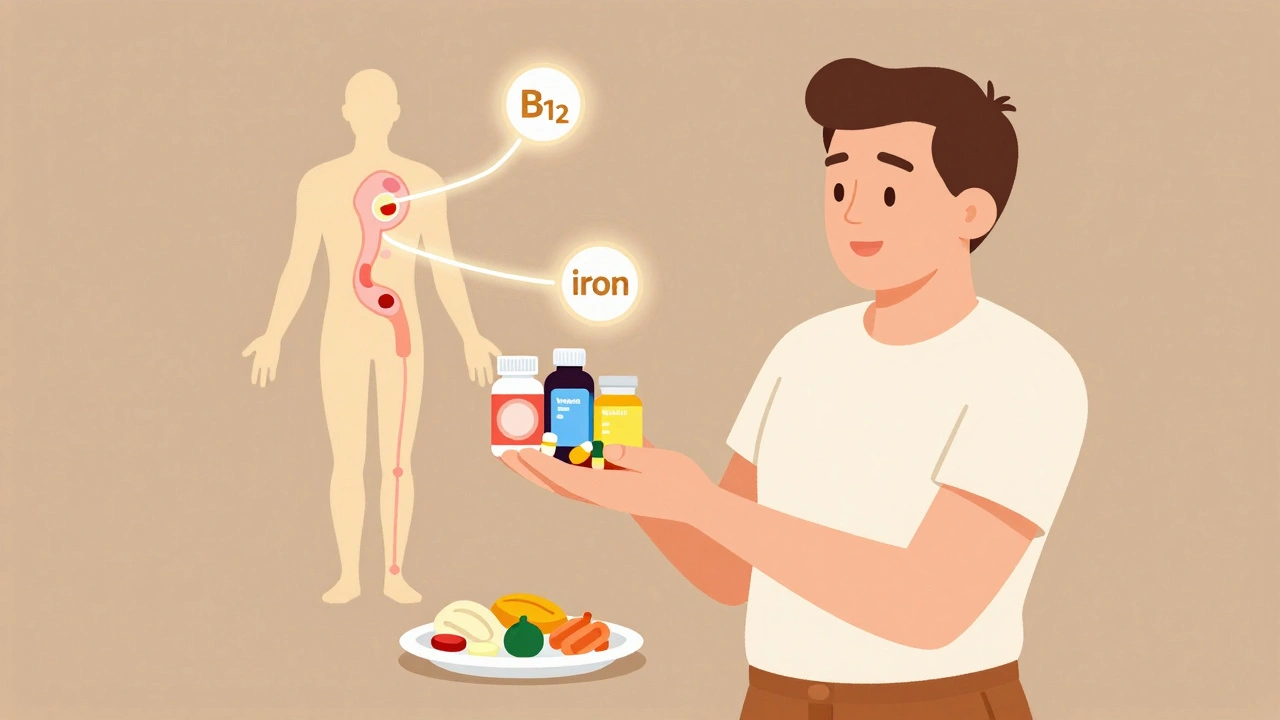
After weight-loss surgery, your body changes in ways most people don’t expect. Your stomach is smaller. Your intestines are rerouted. And suddenly, the vitamins you used to get from food don’t get absorbed the same way-maybe not at all. That’s why bariatric vitamins aren’t optional. They’re life-saving.
Why Standard Multivitamins Won’t Cut It
You might think, "I’ll just take my usual multivitamin." But that’s like trying to fill a gas tank with a teaspoon after your car got a bigger fuel line. Standard supplements are designed for healthy people with normal digestion. After gastric bypass, sleeve gastrectomy, or other bariatric procedures, your body can’t absorb nutrients the way it used to.Take vitamin B12, for example. It’s naturally bound to protein in food and needs stomach acid and intrinsic factor to be absorbed. After a Roux-en-Y gastric bypass, the part of your stomach that makes intrinsic factor is bypassed. Without it, you can’t absorb B12-even if you eat steak every day. Studies show 60% of RYGB patients develop B12 deficiency within the first year. Left untreated, this can cause memory loss, nerve damage, and even permanent neurological issues.
Vitamin D is another silent threat. Up to 90% of patients have low levels before surgery. After surgery, your body absorbs even less. Without daily supplementation of 3,000 IU of vitamin D3, you risk bone fractures, muscle weakness, and chronic pain. Iron deficiency is equally common, especially in women, leading to fatigue, dizziness, and anemia.
What’s in Bariatric Vitamins? The Numbers That Matter
Bariatric vitamins aren’t just stronger-they’re specifically formulated. The American Society for Metabolic and Bariatric Surgery (ASMBS) sets the standard. Here’s what you need daily:- Iron: At least 18 mg (higher for women or those with prior anemia)
- Vitamin B12: 500 mcg (oral) or 1,000 mcg sublingual-sometimes more
- Calcium: 1,000-1,200 mg total per day, split into 500-600 mg doses
- Vitamin D3: 3,000 IU (75 mcg)
- Vitamin A: 5,000-10,000 IU
- Folic acid: 400-800 mcg
- Thiamine (B1): 12 mg daily-often overlooked but critical
Calcium citrate is the only form you should take. Calcium carbonate needs stomach acid to dissolve-and after surgery, you don’t make enough. Taking the wrong kind means your bones are at risk.
Form Matters: Chewables, Liquids, and Why Pills Don’t Work
For the first 3 to 6 months after surgery, your stomach is too small to handle large pills. Solid tablets can get stuck, cause nausea, or just pass through unabsorbed. That’s why chewables and liquids are non-negotiable early on.Many patients report relief after switching from pills to liquid B12. One user on Reddit said, "My tingling hands vanished after two months of sublingual B12." Another shared that liquid iron helped them avoid the constipation that came with tablet versions.
Even after the initial healing phase, many find that chewables are easier to stick with. Some bariatric vitamins now come in gummy form-but be careful. Gummies often lack iron, calcium, or enough B12. Always check the label.

Not All Surgeries Are the Same
Your supplement needs depend on the type of surgery you had.- Roux-en-Y Gastric Bypass (RYGB): Highest risk for B12, iron, calcium, and fat-soluble vitamins (A, D, E, K). You’ll need the full dose of everything.
- Sleeve Gastrectomy: Less malabsorption, but still at risk for iron, B12, and vitamin D. You’ll need less than RYGB, but still more than a healthy person.
- Biliopancreatic Diversion (BPD/DS): Extreme malabsorption. Requires the highest doses of everything, including fat-soluble vitamins and protein.
- Adjustable Gastric Band: Least malabsorption, but still needs vitamin D and iron due to reduced food intake.
One study found that 47% of RYGB patients develop folic acid deficiency, while only 15-30% of sleeve patients do. If you had a bypass, don’t assume your sleeve friend’s regimen works for you.
Adherence Is the Real Challenge
You might start strong. You buy the vitamins. You take them daily. You feel better. But five years later? Only 30-50% of patients are still taking them.Why? Pill fatigue. Cost. Side effects. Life gets busy. Iron causes constipation. Calcium makes you bloated. B12 shots require appointments. And the monthly cost? $30 to $60-out of pocket for many.
Solutions? Use a pill organizer. Set phone alarms. Switch to once-daily formulas if they meet ASMBS standards. Some brands now offer combined supplements that reduce your daily count from 8 pills to 3. But never compromise on iron or calcium doses.
And if you can’t afford them? Talk to your bariatric team. Some hospitals have free or discounted programs. Nonprofits sometimes provide samples. Don’t skip-your health depends on it.
Monitoring: Blood Tests Are Non-Negotiable
You can’t feel a vitamin deficiency until it’s advanced. That’s why blood tests every 3-6 months for the first two years, then annually, are mandatory.Your doctor should check:
- Complete blood count (for iron and B12)
- Ferritin, serum iron, TIBC
- Vitamin B12 and folate
- 25-hydroxyvitamin D
- Calcium, magnesium, phosphorus
- Thiamine (B1)-often not tested unless symptoms appear
If your levels are low, don’t wait. Your doctor might prescribe injections for B12 or IV iron. Oral supplements can take months to fix a serious deficiency. Don’t gamble with your nerves or bones.

What Happens If You Skip?
Skipping vitamins doesn’t just mean you’ll feel tired. It can lead to:- Neuropathy: Numbness, burning, or pain in hands and feet from B12 deficiency
- Osteoporosis: Bones become brittle and break easily from low vitamin D and calcium
- Anemia: Fatigue, shortness of breath, pale skin from iron or B12 lack
- Wernicke’s encephalopathy: A rare but deadly brain disorder from thiamine deficiency-can cause confusion, vision changes, and loss of coordination
- Blindness: Severe vitamin A deficiency can damage the retina
These aren’t theoretical risks. They’re documented in medical journals and reported by patients. One woman lost her vision after skipping vitamin A for two years. Another developed permanent nerve damage from untreated B12 deficiency.
Top Brands and What Real Users Say
Popular brands include Nature’s Bounty Bariatric Formula, Bariatric Fusion, and Kirkland Signature (Costco). Amazon’s top-rated bariatric multivitamin has over 1,200 reviews with a 4.5-star rating.Common praise:
- "The chewables are easy to take, even right after surgery."
- "No more constipation with the ferrous fumarate version."
- "My energy came back after fixing my B12."
Common complaints:
- "Calcium is too low-I still need to buy extra."
- "The pills are still too big for me."
- "It’s expensive. I can’t afford it every month."
Look for products that meet ASMBS 2019 guidelines. Don’t rely on marketing claims like "for weight loss"-those aren’t bariatric vitamins.
The Bottom Line: This Is Lifelong
Bariatric surgery isn’t a cure. It’s a tool. And vitamins are the fuel that keeps your body running right.You didn’t just lose weight-you changed how your body works. That means lifelong responsibility. No exceptions. No "I’ll skip it this week." Your bones, nerves, brain, and blood depend on these supplements.
Take them. Get your blood tested. Talk to your dietitian. If you’re struggling, ask for help. There’s no shame in needing support. Millions have walked this path. You’re not alone.
And if you’re considering surgery? Get your vitamins checked before you go in. Fix any deficiencies before the operation. It makes recovery smoother and prevents problems from getting worse.
Do I need bariatric vitamins if I had a sleeve gastrectomy?
Yes. Even though sleeve gastrectomy doesn’t bypass the intestines, your stomach is smaller, so you eat less. That means you’re not getting enough vitamins from food alone. You still need daily supplements for iron, B12, vitamin D, and calcium. The doses are lower than for gastric bypass, but skipping them still leads to deficiencies.
Can I take regular multivitamins after bariatric surgery?
No. Regular multivitamins don’t contain enough iron, B12, calcium, or vitamin D for post-surgery needs. They often use calcium carbonate, which your body can’t absorb without stomach acid. Stick to bariatric-specific formulas designed for your anatomy.
Why do I need to split my calcium into two or three doses?
Your body can only absorb about 500-600 mg of calcium at once. Taking 1,200 mg all at once means half of it just passes through unused. Splitting it-say, 500 mg with breakfast, 500 mg with dinner, and 200 mg with a snack-ensures you get the full benefit.
Is it safe to take high doses of vitamin A?
It’s safe when taken as directed-5,000-10,000 IU daily. But vitamin A is fat-soluble, so it builds up in your liver. Don’t exceed the recommended dose, and don’t take additional retinol supplements. Too much can cause liver damage, bone pain, and blurred vision. Always follow your provider’s guidance.
What if I can’t swallow pills after surgery?
Use chewables, liquids, or powders. Many brands offer B12 in sublingual form (under the tongue), which bypasses the digestive system entirely. Iron and calcium are available in liquid form too. Talk to your dietitian-they can help you find a regimen that works with your tolerance.
How long do I need to take these vitamins?
For life. Bariatric surgery permanently changes how your body absorbs nutrients. Even if you feel fine, your levels can drop without symptoms. Stopping supplements-even for a few months-can lead to serious, irreversible damage. Think of them like insulin for diabetes: necessary for survival.
Doris Lee
December 10, 2025 AT 12:08Just wanted to say thank you for this. I had gastric bypass 3 years ago and I still take my vitamins every single day. It’s not glamorous, but it’s how I stay alive. You’re not alone in this.
Aileen Ferris
December 11, 2025 AT 04:22wait u mean u cant just take one of them fancy gummies from the pharmacy? i thought they were like magic vitamin pills now??
Rebecca Dong
December 12, 2025 AT 13:47THEY’RE LYING TO YOU. The vitamin companies are in bed with the surgeons. They want you dependent. I stopped all mine after 18 months and my energy went through the roof. Coincidence? I think not.
Sarah Clifford
December 13, 2025 AT 16:04omg i tried the gummies and i got so bloated i thought i was gonna explode. then i switched to liquid b12 and it was like a whole new person. why does no one talk about this??
Michaux Hyatt
December 14, 2025 AT 20:04Important note: Thiamine deficiency can sneak up fast. I had a patient who went from fine to confused and unsteady in under 6 weeks. Get your levels checked. Don’t wait for symptoms. This isn’t a suggestion - it’s a survival checklist.
Michelle Edwards
December 15, 2025 AT 06:51Hey, I’ve been where you are. First year after surgery, I was overwhelmed. Took me 3 months to figure out what worked. I started with chewables, set phone alarms, and kept a little journal. You don’t have to do it perfectly - just consistently. And you’re doing better than you think.
Regan Mears
December 16, 2025 AT 02:14Let me just say - if you’re skipping calcium because it gives you gas, you’re not alone. But here’s the thing: try calcium citrate with food. And if it still wrecks your stomach, talk to your dietitian about a different brand. Some have magnesium added to help with absorption and less bloating. You don’t have to suffer through it.
Queenie Chan
December 18, 2025 AT 02:06It’s wild how something so small - a pill, a liquid, a chewable - becomes the quiet backbone of your entire post-surgery existence. You don’t celebrate these things. No one takes a photo of your vitamin organizer. But without them? Your body forgets how to be a body. And that’s the real ghost story of bariatric surgery.
David Palmer
December 18, 2025 AT 13:05Ugh I hate this. I spent $50 a month on these vitamins and still ended up with anemia. The whole system is rigged. I’m just tired of being told to take more pills when nothing works.
Jack Appleby
December 19, 2025 AT 07:11Actually, the ASMBS guidelines were revised in 2023 - you’re citing outdated figures. The new standard for B12 is 1,000 mcg oral daily, not 500. And thiamine? 50 mg is now recommended for high-risk patients. This post is dangerously incomplete.
Neelam Kumari
December 19, 2025 AT 19:25Oh wow. So after all this surgery, you still need to be a pill-popping zombie? How is this progress? In India, we just eat food. Real food. No magic powders. You people are so obsessed with supplements you forgot how to live.
Stephanie Maillet
December 21, 2025 AT 17:06It’s fascinating, isn’t it? We alter anatomy to change weight - but the body still remembers its old needs. The vitamins aren’t just supplements… they’re a language your body speaks now. And if you stop listening? It stops speaking back. Quietly. Slowly. Until you can’t hear anything at all.
Kaitlynn nail
December 22, 2025 AT 09:16the fact that you need 8 pills a day just to not die is kinda wild tbh. like, congrats on losing weight, now enjoy your pharmaceutical lifestyle.
Raj Rsvpraj
December 23, 2025 AT 19:31Why do Americans always need a pill for everything? In India, we have turmeric, ginger, and sunlight. You think your body is so broken that you need $60 a month in vitamins? Pathetic.
Frank Nouwens
December 24, 2025 AT 12:08While the clinical data presented is largely accurate, it is worth noting that individual variability in nutrient absorption is not uniformly accounted for in standardized dosing protocols. Personalized monitoring - including genetic polymorphism screening for nutrient transporters - may yield superior long-term outcomes. This is an area ripe for further research and clinical innovation.