
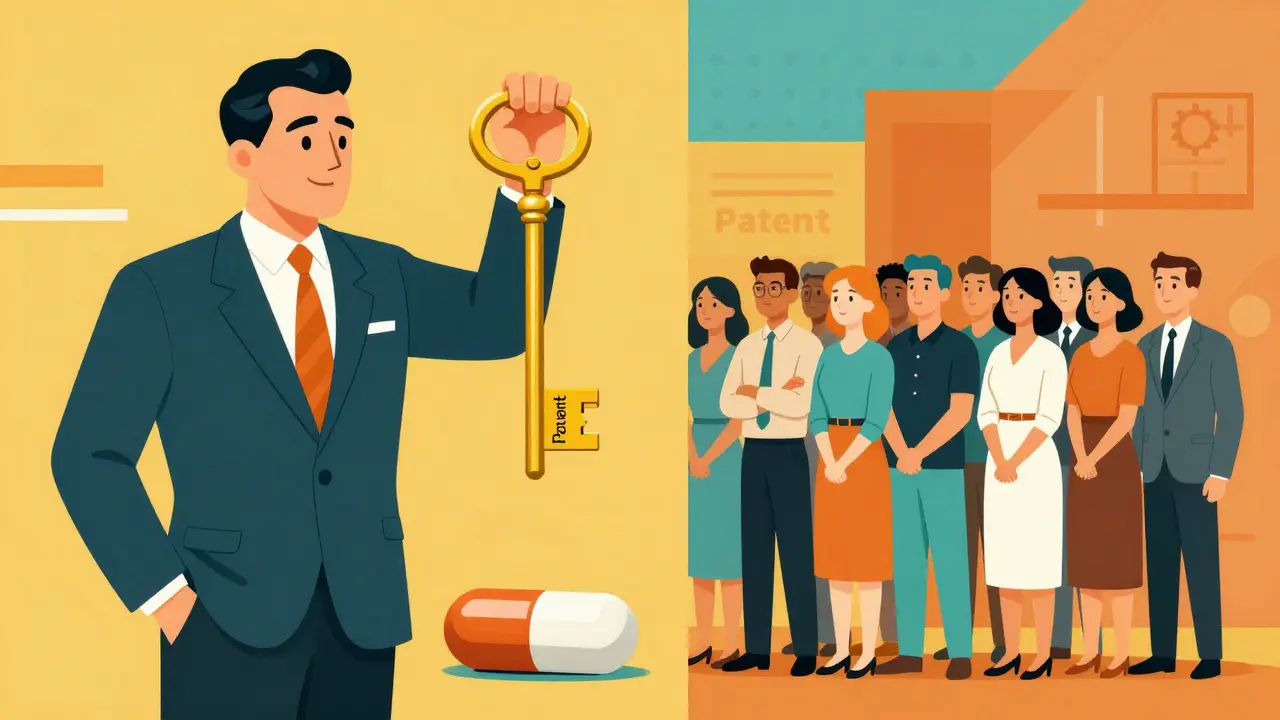
Imagine a world where a life-saving drug exists, but it's so expensive that only the wealthiest 1% can afford it. The company that invented it holds a patent, meaning they have a legal monopoly to set the price. Now, imagine the government stepping in and saying, "This is a public health emergency. We're allowing other companies to make this drug regardless of the patent." This is exactly how compulsory licensing is a legal mechanism that allows a government to authorize third parties to produce or use a patented invention without the patent holder's consent . It's a powerful tool designed to balance the private right to profit from an invention with the public's right to survive.
Key Takeaways
- Governments can bypass patents during emergencies or for public interest.
- Patent holders still receive "adequate remuneration" or royalties.
- The compulsory licensing process is heavily governed by the international TRIPS Agreement.
- It's most commonly used to slash the price of essential medicines.
- While it saves lives, critics argue it might discourage companies from investing in new research.
The Rules of the Game: TRIPS and International Law
You can't just seize a patent on a whim. There's a global rulebook. The TRIPS Agreement is the Trade-Related Aspects of Intellectual Property Rights agreement, which sets the minimum standards for intellectual property regulation worldwide . Specifically, Article 31 of TRIPS provides the legal framework for overriding patents.
Under these rules, a government can grant a license to a third party, but they have to follow a few strict conditions. First, the license is usually intended for the domestic market. Second, the patent owner must be paid a fair amount-what the law calls "adequate remuneration."
Normally, a company has to try and negotiate a voluntary license first. This means they ask the patent holder, "Can we pay you a fee to make this?" If the holder says no or asks for an impossible price, the government can step in. However, if there's a national emergency or "extreme urgency" (like a sudden pandemic), the government can skip the negotiation phase entirely and go straight to the override.
How Different Countries Handle Patent Overrides
Not every country uses this tool the same way. Some are aggressive about it, while others treat it as a nuclear option they never actually use.
In India, the approach is quite proactive. The Indian government has issued numerous compulsory licenses for cancer medications to make them affordable. Their process, governed by the Patents Act 1970, allows the state to intervene when the "reasonable requirements of the public" aren't being met.
Contrast that with the United States. The U.S. is much more restrictive. Most of their overrides happen under 28 U.S.C. section 1498, which lets the federal government use a patent for government purposes, but it doesn't let the government just give a license to any random company to sell a cheap generic to the public. They also have "march-in rights" under the Bayh-Dole Act, which allows the government to force a license if a federally funded invention isn't being made available to the public, though the government has almost never actually exercised this right.
Then you have countries like Thailand and Brazil. Brazil used this tool to tackle the HIV/AIDS crisis, famously forcing a price drop for the drug efavirenz from $1.55 to just $0.48 per tablet. Thailand saw even steeper drops-sometimes 65% to 90%-for heart disease and HIV meds between 2006 and 2008.
| Region/Country | Primary Goal | Common Trigger | Typical Outcome |
|---|---|---|---|
| India | Public Health Access | Unaffordable life-saving drugs | Generic production & price drops |
| United States | Governmental Utility | Federal agency needs/funding | Compensation via damages |
| Brazil | Epidemic Control | National health emergencies | Significant price reductions |
| European Union | Public Interest | National defense or health | Rarely used, though legally available |

The Cost of Innovation vs. The Cost of Life
This is where the debate gets heated. On one side, you have public health advocates. They argue that the threat of a compulsory license is actually a great negotiating tool. When a company knows the government might just override their patent, they are often more willing to lower their prices voluntarily. Some experts suggest that 90% of HIV medication price drops in developing countries happened because the patent holders were scared of being overridden.
On the other side, pharmaceutical giants and investors argue that this kills the incentive to invent. Why spend billions of dollars researching a new cure for Alzheimer's if a government can just take the recipe and give it away the moment it becomes successful? Some data suggests that in countries with active override frameworks, R&D investment in pharmaceuticals can drop by as much as 15-20%.
It's a classic tug-of-war. If we protect patents too strictly, people die because they can't afford medicine. If we override patents too often, we might stop inventing the medicines we need for the next pandemic.
Putting it into Practice: The Legal Hurdle
If you're a company wanting to apply for one of these licenses, don't expect a quick process. It's a legal minefield. You usually need a team of specialized patent attorneys with years of experience because the documentation is grueling.
One of the biggest headaches is figuring out "reasonable compensation." How do you price a license when the patent holder doesn't want to sell it? In the U.S., courts use the "Georgia-Pacific factors," which look at 15 different variables, including what other similar licenses are charging. In India, they've used a simpler formula, like taking 6% of net sales.
The timeline is also a killer. In the U.S., resolving a section 1498 case can take nearly three years. In India, the process usually takes 18 to 24 months. For a patient with a terminal illness, that's an eternity.
What's Happening Now? The Post-Pandemic Shift
The COVID-19 pandemic changed everything. In 2022, the WTO agreed to a temporary waiver for vaccine patents. This was a massive shift, effectively saying that during a global catastrophe, the traditional patent rules can't apply. While only a handful of facilities actually used this waiver, it set a precedent.
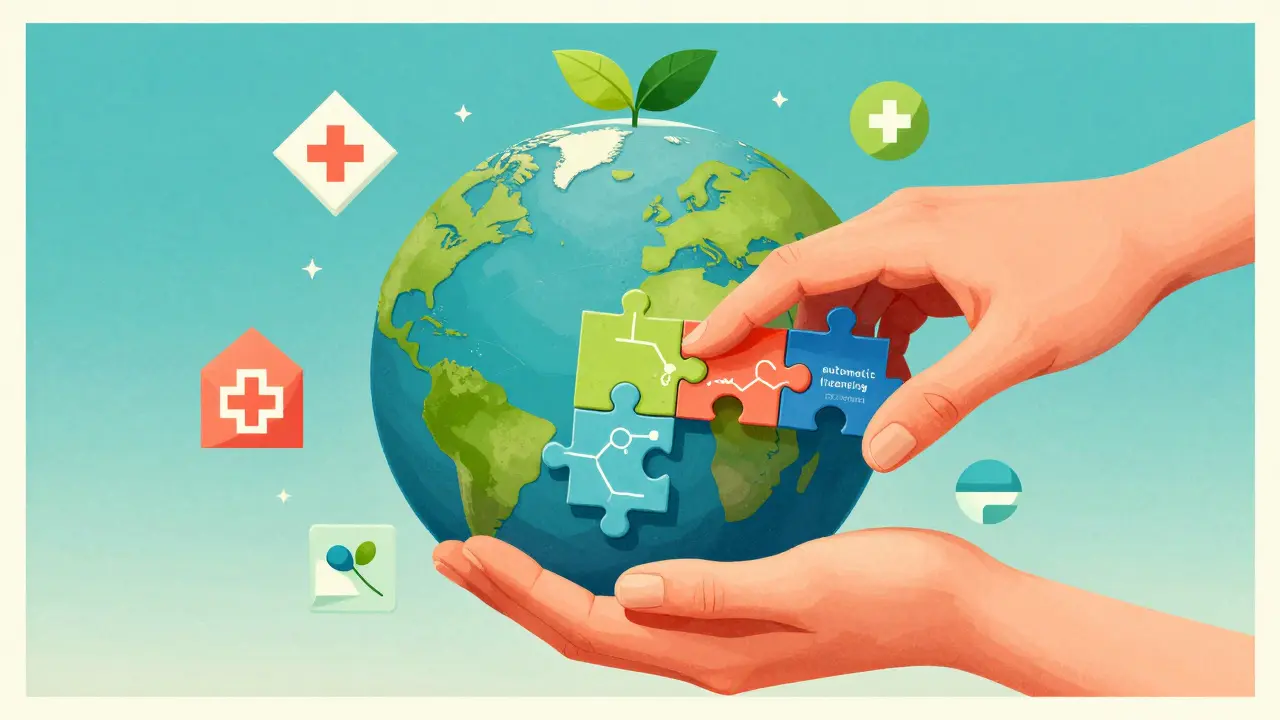
We're now seeing a trend toward "automatic licensing." There are discussions at the World Health Organization about a Pandemic Treaty that would make licensing automatic for essential products during a declared emergency. No more 24-month waits, no more three-year lawsuits-just immediate access.
Looking forward, this isn't just about medicine. We're likely to see these tools used for climate change technology. If a company holds a patent on a highly efficient carbon-capture method that could save the planet, governments might decide that the "public interest" outweighs the corporate profit margin.
Does a compulsory license mean the patent is cancelled?
No, the patent remains valid. The owner still holds the patent, but they lose the exclusive right to decide who uses it. They are still entitled to receive a royalty or a fee for every unit produced under the compulsory license.
Can a private company request a compulsory license?
Yes, though it's less common. Most compulsory licenses are initiated by governments (about 78% of cases). However, a third-party manufacturer (like a generic drug company) can petition the government to grant a license if they can prove the patent isn't being worked or the price is unfair.
What is the 'Export Clause' in TRIPS?
Originally, TRIPS required that compulsory licenses be for the domestic market. The 'export clause' (a 2005 amendment) allows countries with the capacity to manufacture drugs to produce them under a compulsory license specifically to export them to poorer countries that can't make them themselves.
How much do prices actually drop?
It varies, but the impact is usually huge. Research shows that in about 83% of cases, prices drop by 65% to 90%. For example, in Brazil, certain HIV meds dropped from over a dollar to under 50 cents per tablet.
Can the U.S. punish countries that use compulsory licensing?
The U.S. often puts countries that use these licenses on a "priority watch list" via the Special 301 Report. While this is a form of diplomatic pressure, actual trade sanctions are rare because the TRIPS agreement explicitly allows for these licenses under certain conditions.
Next Steps and Troubleshooting
If you are a policymaker or a legal entity exploring these tools, your path depends on your goal:
- For Health Departments: Focus on building technical capacity. Many low-income countries have the laws on the books but lack the administrative a-to-z process to actually issue a license.
- For Generic Manufacturers: Start by documenting "reasonable efforts" to negotiate. If you can't prove you tried to play fair with the patent holder first, your application for a compulsory license is likely to be rejected.
- For Patent Holders: The best defense against an override is proactive pricing. Offering tiered pricing (lower prices for poorer nations) often removes the "public interest" justification that governments use to trigger a license.
Andre Ojakäär
April 23, 2026 AT 20:46basically just a fancy way for governments to steal IP when they feel like it lol
Jaclyn Vo
April 24, 2026 AT 06:45Omg exactly!! It is literally so scandalous that some companies just hoard these patents while people are suffering 😱 Like, why is the profit margin more important than actual human lives?? It's honestly heartbreaking and just totally wrong! 🙄💔
Michael Chukwuma
April 24, 2026 AT 11:48I can see both sides of this. It's tough because we want new cures but we also need people to be able to afford them right now.
Eric Mwiti
April 25, 2026 AT 07:06Oh sure, because nothing says "innovation" like the government seizing your hard-won research and handing it out for pennies. I'm sure the shareholders are just thrilled about this benevolent redistribution of wealth.
Beena Garud
April 27, 2026 AT 02:48One must consider the ethical imperative that transcends mere commercial interests. When the sanctity of human life is at stake, the intellectual property framework should serve as a bridge to accessibility rather than a barrier. The Indian experience demonstrates that a balanced approach can preserve the dignity of the individual while acknowledging the necessity of innovation. It is a profound reflection of our societal values when the state prioritizes the collective survival over the concentrated accumulation of wealth. The philosophical tension between private ownership and public utility is the central crucible of modern jurisprudence. We must strive for a global equilibrium where the pursuit of knowledge does not come at the cost of the marginalized. Such a shift in perspective is not merely a legal necessity but a moral obligation to the global community. The TRIPS agreement provides a skeletal structure, but it is the moral courage of nations that breathes life into these provisions. True progress is measured not by the number of patents filed, but by the number of lives saved through the equitable distribution of medical breakthroughs. This is a testament to the evolution of human empathy in the face of systemic inequality. Only through such collective action can we hope to achieve a world where health is a fundamental right and not a luxury for the few. The discourse on compulsory licensing is, in essence, a discourse on the value of a human soul in a capitalist framework.
Elle Torres Sanz
April 28, 2026 AT 04:24It's really interesting to see how different cultures approach this. India and Brazil have such a strong history of fighting for access, and I think we can all learn a bit from their courage to put public health first while still trying to follow the international rules.
suresh kumar
April 28, 2026 AT 12:22Total madness! The big pharma sharks are just swimming in circles trying to trick everyone with these fancy patent laws while the poor folks are left in the dust. Just grab the recipe and start cooking the generics already!
Majestic Blue Band
April 29, 2026 AT 14:10It's just so convenient that this "public good" argument comes up exactly when the globalists want to dismantle private property rights on a massive scale, and if you actually look into who is funding the WHO and the Pandemic Treaty, you'll find the same puppet masters who want to control every single aspect of our biological existence through these supposed "health emergencies" which are just smokescreens for a larger agenda of total surveillance and dependency on state-mandated medicine that probably has hidden ingredients anyway to keep us docile and compliant while they erase the concept of ownership entirely so we are all just renters in our own lives.
Jon Moss
April 29, 2026 AT 20:33That's a pretty intense take. I think it's simpler than that, but I get why people are skeptical of the big organizations.
Karyn Tindall
May 1, 2026 AT 01:01The thought of a mother not being able to save her child because of a patent is absolutely devastating! It's an outrage that we even have to debate this in the 21st century!