
Imagine a patient taking their daily generic medication, only to find out later that the pill contains trace amounts of a chemical from a completely different drug. It sounds like a nightmare scenario, but for generic manufacturers, it is a very real risk. Contamination controls are systematic protocols designed to prevent cross-contamination, microbial intrusion, and chemical adulteration during production. These measures are not just about keeping things clean; they are the backbone of regulatory compliance and patient safety in the generic pharmaceutical industry.
The stakes are high. In fiscal year 2022, contamination-related violations accounted for 37.2% of all Warning Letters issued by the FDA to pharmaceutical manufacturers. When these controls fail, the consequences can be massive. Take the 2020 Valsartan incident, where nitrosamine contamination affected 22 generic manufacturers globally, resulting in $1.2 billion in product losses. For any company in this space, understanding how to prevent adulteration is not optional-it is survival.
Key Takeaways
- Regulatory Foundation: Contamination controls stem from Current Good Manufacturing Practices (CGMP) established under the U.S. Federal Food, Drug, and Cosmetic Act.
- Cleanroom Standards: Generic manufacturing typically requires ISO Class 5 environments for aseptic filling and ISO Class 8 for less critical areas, with strict air pressure differentials.
- Human Factor Dominance: Studies show that 83% of contamination events originate from human factors, making training and gowning compliance critical.
- Technology vs. Cost: Real-time monitoring systems reduce contamination incidents by 63%, but implementation costs range from $500,000 to $2 million per facility.
- Future Requirements: New FDA guidelines mandate health-based exposure limits (HBELs) for all products, requiring significant updates to cleaning validation protocols.
Understanding the Regulatory Landscape
To understand why contamination controls matter, you have to look at the rules that govern them. The framework originated from the 1963 amendments to the U.S. Federal Food, Drug, and Cosmetic Act, which established Current Good Manufacturing Practices (CGMP). Under 21 CFR 210.3(b)(3), a drug is considered adulterated if it has been prepared, packed, or held under conditions that are unsanitary or may have caused the drug to be contaminated with filth or rendered injurious to health.
This definition is broad. It covers everything from dust particles in the air to microbes on a worker’s hands. The FDA’s 2004 guidance 'Guidance for Industry: CGMP for Finished Pharmaceuticals' and subsequent ICH Q7 guidelines further tightened these requirements. Today, the focus is shifting from simply testing the final product to preventing issues before they happen. Dr. Janet Woodcock, former FDA CDER Director, emphasized in her 2021 testimony that relying solely on end-product testing for contamination control is a fundamental CGMP violation. This shift means manufacturers must prove their processes are robust enough to prevent errors, not just detect them after the fact.
Cleanroom Classifications and Facility Design
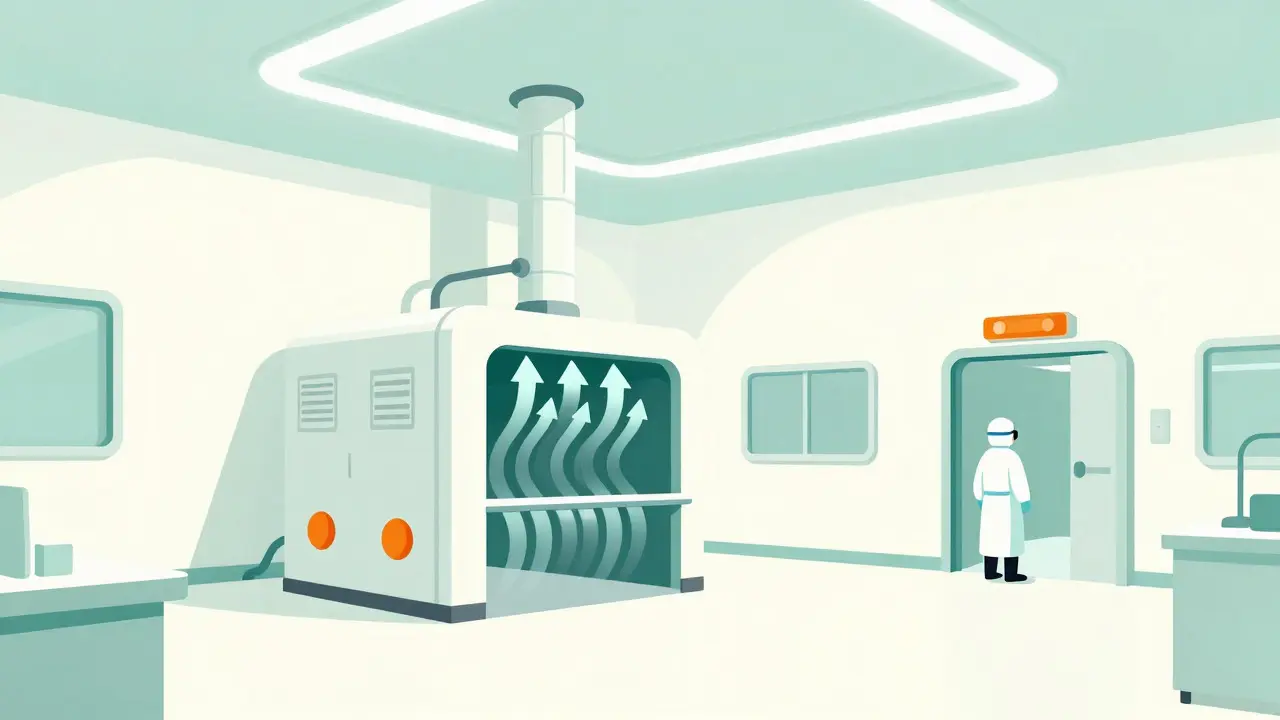
Physical separation is the first line of defense. Generic drug manufacturing facilities must adhere to ISO 14644-1 cleanroom classifications. Here is what that looks like in practice:
| ISO Class | Grade | Typical Use | Particle Limit (≥0.5μm/m³) | Air Changes Per Hour (ACH) |
|---|---|---|---|---|
| Class 5 | Grade A | Aseptic Filling | 3,520 | 60+ |
| Class 7 | Grade C | Background Environments | 352,000 | 20-30 |
| Class 8 | Grade D | Less Critical Areas | 3,520,000 | 15-20 |
Beyond particle counts, HVAC systems must maintain specific pressure differentials. EU GMP Annex 1 (2022 revision) specifies pressure differentials of 10-15 Pascals between adjacent zones to ensure air flows from cleaner to less clean areas. Modern facilities also implement segregated manufacturing suites for high-potency generics. Why? To prevent cross-contamination at levels as low as 1 nanogram per square centimeter, the threshold established by EMA's 2014 guideline on setting health-based exposure limits.
Facility design mandates physical separation through airlocks, dedicated corridors, and unidirectional flow principles. If you walk into a modern generic plant, you will notice distinct color-coding and separate entry points for different products. This isn't just aesthetic; it reduces mix-ups by 65% according to FDA compliance programs.
Cleaning Validation and Microbial Control
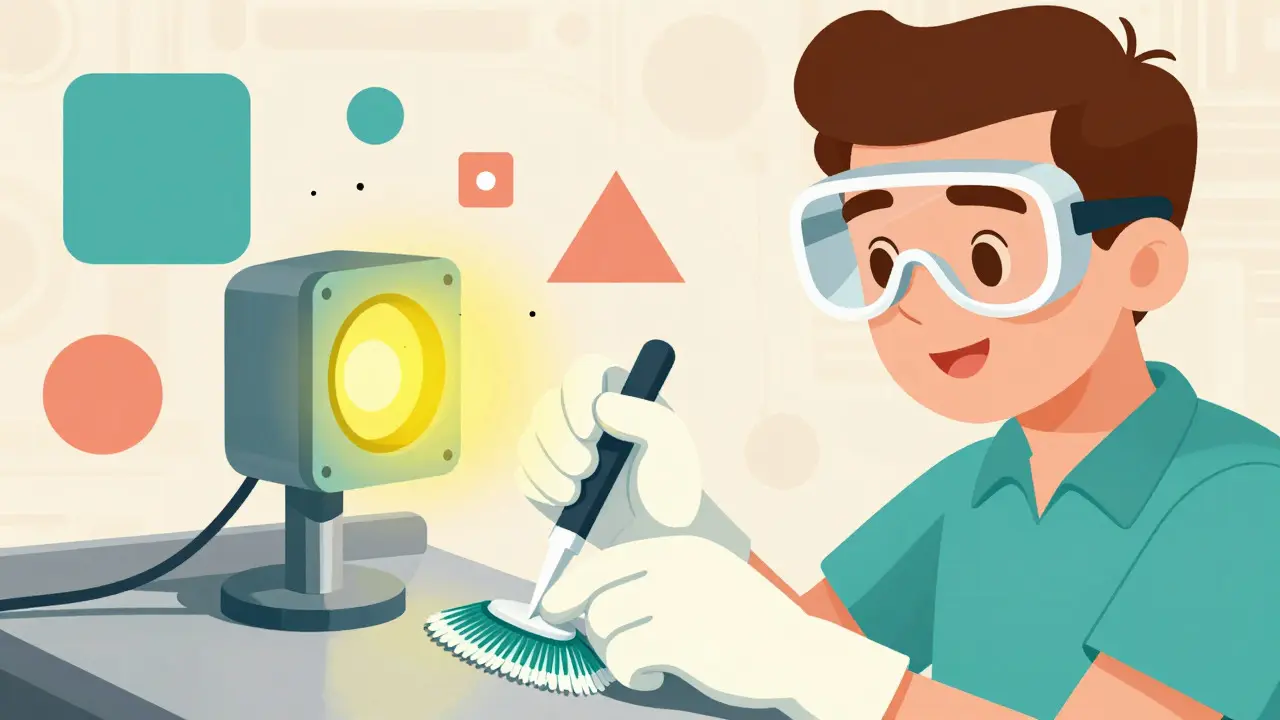
Once production ends, the battle shifts to cleaning. Cleaning validation protocols must demonstrate strict limits to ensure no residues remain. For microbial limits, the target is ≤10 colony-forming units (CFU) per 25cm² surface area. For chemical residues, the limit is ≤10 parts per million (ppm).
How do we verify this? Traditional methods involve swabbing and rinse sampling, followed by culture methods that take 5-7 days for results. That is too slow for modern operations. Rapid microbiological methods (RMMs) now provide results in 24-48 hours. Additionally, ATP bioluminescence systems offer quantitative data in just 5 minutes, with 95% correlation to culture methods per USP <1223> validation studies.
However, technology alone isn't enough. A 2023 PDA member survey of 217 generic drug manufacturers found that 68% experienced at least one contamination-related batch rejection in the previous year. The primary causes were human error (47%), equipment cleaning failures (29%), and raw material contamination (18%). This highlights a crucial point: no matter how advanced your sensors are, if your people aren't trained properly, you are vulnerable.
Human Factors and Operational Excellence
Let’s talk about the biggest variable: people. Dr. Michael Gamlen, Principal Consultant at Gamlen Consulting, asserts that failure modes and effects analysis (FMEA) shows 83% of contamination events originate from human factors. This includes everything from improper gowning to fatigue-induced mistakes.
Gowning compliance is a major challenge. A 2021 study at an AstraZeneca generics facility measured compliance dropping by 40% after 8 hours of work. During 12-hour shifts, maintaining discipline becomes difficult. Solutions documented by FDA's 2023 Compliance Program Guide include staggered shift changes to minimize personnel traffic and using reusable isolation gowns carefully managed to avoid non-compliances.
Another practical tip comes from industry forums. A senior validation specialist at Teva Pharmaceuticals reported a 30% increase in gowning non-compliances after switching to reusable isolation gowns, requiring an $185,000 investment in upgraded air showers to maintain particle counts. On the other hand, facilities using Dycem CleanZone mats reported reducing foot-borne contamination by 72%. These small, targeted interventions can make a big difference in overall control.
Monitoring Systems and Technology Investment
Manual monitoring protocols miss 78% of transient contamination events, according to FDA field investigations. This is why real-time monitoring has become standard for top-tier manufacturers. Real-time particle counters like the MetOne 3400+ cost between $15,000 and $25,000 per unit but reduce contamination incidents by 63% according to a 2022 ISPE benchmarking study.
Filter technology is also evolving. HEPA filters (99.97% efficiency at 0.3μm) remain the standard, but ULPA filters (99.999% efficiency at 0.12μm) are being used in high-risk areas. While ULPA systems increase energy costs by 25-40% due to higher pressure drops, they offer superior protection for sensitive products.
AI is entering the picture too. Honeywell's Forge Pharma system reduced false alarms by 68% in a 2023 Merck generics pilot. By predicting contamination risks before they happen, these systems allow teams to act proactively rather than reactively.
Innovator vs. Generic: Different Approaches
There is a common misconception that generic manufacturers cut corners compared to innovator companies. The reality is more nuanced. Innovator companies typically invest 2.3x more in facility design ($185 million versus $80 million for equivalent capacity) according to a 2023 McKinsey analysis. However, generic manufacturers compensate through operational excellence in procedural controls.
Generic companies often run tighter ships. They rely on rigorous SOPs, frequent audits, and leaner processes to achieve similar quality outcomes. The key is risk-proportionate approaches. Dr. Paul M. Garmory warns that over-engineering containment systems for low-risk generics creates unnecessary costs that can reach $2.8 million annually for medium-sized facilities without proportional safety benefits. The goal is to match the level of control to the risk of the product.
Future Trends and Regulatory Pressures
The landscape is changing fast. FDA's September 2023 draft guidance 'Cross-Contamination Controls for Solid Oral Dosage Forms' requires health-based exposure limits (HBELs) for all products by 2025. Implementation costs are estimated at $1.2 million per facility by the Generic Pharmaceutical Association. This deadline is forcing many smaller manufacturers to rethink their infrastructure.
Sustainability is also driving innovation. Waterless cleaning technologies are emerging, reducing utility costs by 22% as demonstrated in a 2022 GlaxoSmithKline generics facility case study. As regulations tighten and technology improves, the gap between large and small manufacturers may widen. Facilities investing in integrated contamination management systems are projected to achieve 3.2x ROI over 5 years through reduced batch failures.
Frequently Asked Questions
What is the main cause of contamination in generic drug manufacturing?
Human error is the leading cause, accounting for 47% of batch rejections. Equipment cleaning failures follow at 29%, while raw material contamination accounts for 18%. Proper training and consistent procedural adherence are critical to mitigating these risks.
How often should cleanrooms be monitored?
Real-time monitoring is recommended for critical areas like Grade A (ISO Class 5). For background areas, periodic sampling is acceptable, but trends should be analyzed continuously. Manual monitoring alone is insufficient as it misses up to 78% of transient events.
What is the cost of implementing advanced contamination controls?
Implementation costs vary widely. Real-time particle counters cost $15,000-$25,000 per unit. Full facility upgrades for HBEL compliance can cost around $1.2 million. Smaller facilities may spend $500,000 to $2 million depending on the scope of changes required.
Do generic drugs have stricter contamination rules than brand-name drugs?
No, the regulatory standards are the same. Both must meet CGMP requirements. However, generic manufacturers often face tighter margins, so they must achieve compliance through efficient operational controls rather than massive capital expenditure on facility design.
What are Health-Based Exposure Limits (HBELs)?
HBELs are scientifically derived limits for the amount of a substance that can be present in a drug without causing harm. They are used to set acceptance criteria for cross-contamination. The FDA requires HBELs for all solid oral dosage forms starting in 2025.