
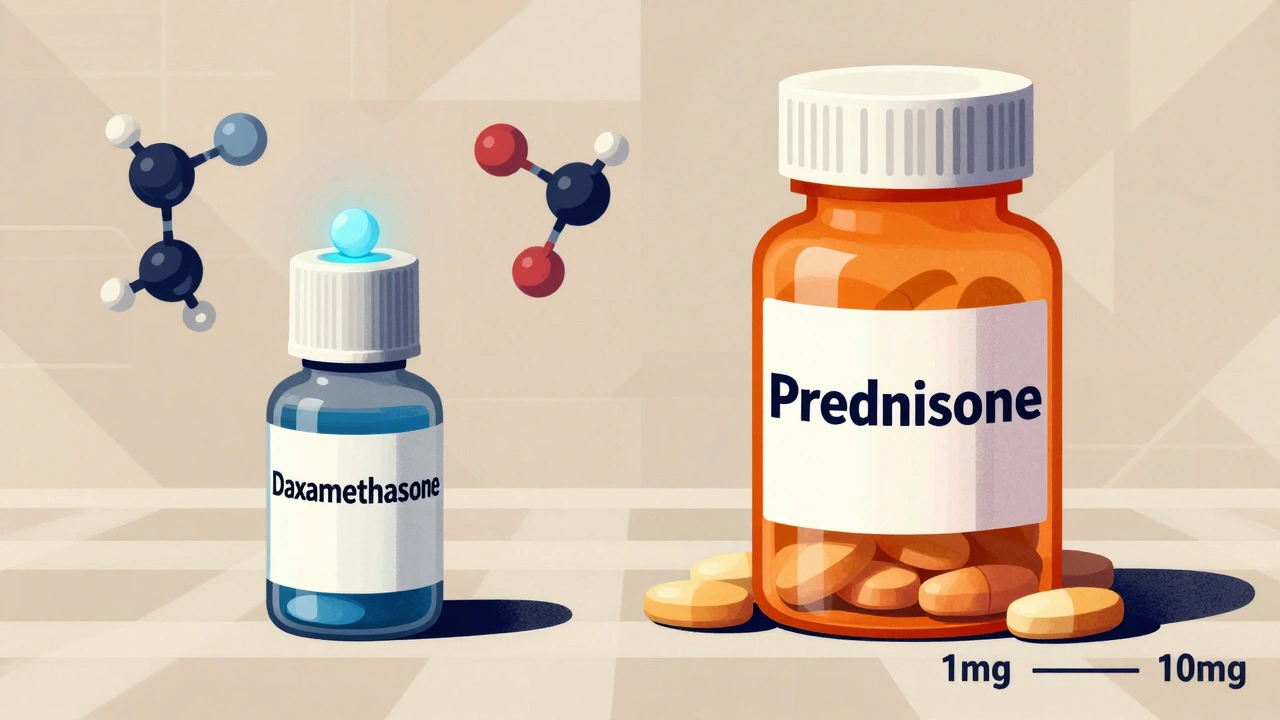
Steroid Conversion Calculator: Dexamethasone vs Prednisone
Dexamethasone is 5-10 times more potent than prednisone by weight. This calculator helps convert between equivalent doses based on medical guidelines. Note: Always consult your healthcare provider before making dose changes.
Equivalent Dexamethasone Dose
Enter a prednisone dose to see the equivalent dexamethasone range.
1 mg dexamethasone = 5-10 mg prednisone
For clinical use, a single dose of 0.75 mg dexamethasone often equals 5-10 mg prednisone.
Important Notes
Dexamethasone has a longer half-life (36-72 hours) versus prednisone (12-36 hours). This means dexamethasone has longer-lasting effects and may require different dosing schedules. Consult your doctor for medical advice.
When doctors prescribe a steroid for inflammation, allergies, or autoimmune issues, two names come up more than any others: dexamethasone and prednisone. They’re both powerful, both used for similar conditions, and both come with serious risks. But they’re not the same. One is far stronger. One lasts longer. And the side effects? They don’t always match up the way you’d expect.
How Strong Are They Really?
Let’s cut through the noise. Dexamethasone is not just a little stronger than prednisone-it’s 5 to 10 times more potent by weight. That means if you take 1 mg of dexamethasone, you’re getting the same anti-inflammatory punch as 5 to 10 mg of prednisone. Some studies, especially in cancer and immune cell research, show the difference can be as high as 9 to 10 times.
This isn’t just theory. In real patients, that potency matters. For kids with croup, a single dose of dexamethasone works better than five days of prednisone. For asthma flare-ups in children, one or two doses of dexamethasone cut down hospital visits by 24% compared to a longer prednisone course. In the hospital during the height of the COVID-19 pandemic, dexamethasone was the only steroid shown to lower death rates in patients on oxygen. That’s why it became a global standard overnight.
Why is it so strong? At the molecular level, dexamethasone binds to the glucocorticoid receptor more tightly than prednisone. It sticks around longer in your cells, turning down inflammation more effectively. That’s why even low doses can do what higher doses of prednisone can’t.
How Long Do They Last?
Prednisone lasts about 12 to 36 hours in your body. That’s why you take it once or twice a day. Dexamethasone? It hangs around for 36 to 72 hours. That’s why doctors often give it as a single shot or one daily pill-even for conditions that used to require multiple doses.
This long half-life is a double-edged sword. On one hand, it makes treatment easier. No more remembering to take pills five times a day. On the other hand, if something goes wrong-like high blood sugar or an infection-it’s harder to reverse. You can’t just skip a dose and wait for it to clear out. It stays in your system for days.
That’s why dexamethasone is great for short bursts: a single dose for croup, two days for asthma, one shot for spinal swelling. Prednisone is better when you need to fine-tune the dose over weeks or months-like in rheumatoid arthritis or lupus. You can raise or lower it slowly. With dexamethasone, you’re stuck with a longer, deeper effect.
Side Effects: Same or Different?
Both drugs cause the same classic steroid side effects: weight gain, mood swings, high blood sugar, trouble sleeping, weakened bones, increased infection risk. But because dexamethasone is so much stronger, you might think it’s worse. Surprisingly, that’s not always true.
Because you take less of it, some side effects are actually lower. For example, in children with asthma, studies found no difference in vomiting between dexamethasone and prednisone. In adults, people on prednisone report more moon face and weight gain-likely because they’re taking higher total doses over longer periods.
But dexamethasone has its own edge in side effects. It’s more likely to cause insomnia (29% vs 22%) and mood changes (24% vs 19%) at equivalent anti-inflammatory doses. One study showed dexamethasone users were 18% more likely to spike in blood sugar. That’s important for diabetics or people at risk.
And here’s the catch: even though you take less dexamethasone, its long stay in your body means your total exposure can be higher. One 10 mg dose of dexamethasone gives you the same steroid hit as five days of 60 mg prednisone. That’s a lot of cumulative stress on your body. If you’re on it for more than a few days, your adrenal glands can shut down. You can’t just stop it cold.

When Do Doctors Choose One Over the Other?
It’s not about which is ‘better.’ It’s about which fits the situation.
Dexamethasone wins when you need:
- A quick, powerful effect
- Short-term treatment (3-5 days max)
- Single-dose convenience
- Brain swelling, spinal cord pressure, or severe allergic reactions
- Acute asthma or croup in kids
- Hospitalized patients with severe COVID-19
Prednisone wins when you need:
- Long-term control (weeks to months)
- Fine control over dosage
- Chronic conditions like rheumatoid arthritis, lupus, or inflammatory bowel disease
- Patients who need to taper slowly
- People with a history of steroid-induced mood issues who need to avoid prolonged exposure
Guidelines back this up. The Global Initiative for Asthma (GINA) recommends dexamethasone for kids with acute asthma. The American College of Rheumatology still picks prednisone for long-term arthritis care. Why? Because you can’t easily adjust dexamethasone’s long half-life. If a patient needs to reduce the dose gradually, prednisone gives you more control.
Cost and Accessibility
Generic prednisone is dirt cheap. A 30-day supply of 20 mg tablets costs around $8.50. Dexamethasone 4 mg tablets run about $13. That seems like a win for prednisone.
But here’s the twist: you need far less dexamethasone. A typical asthma course might be one 6 mg dose. A croup dose? One 0.6 mg/kg shot. That’s one pill. One injection. So even though the pill costs more, the total treatment cost often ends up the same-or even lower.
Also, dexamethasone comes in injectable form, which matters in hospitals or ERs. Prednisone doesn’t. That’s why you see dexamethasone in ambulances and ERs. It’s fast, reliable, and works even if the patient can’t swallow pills.

What Do Real Patients Say?
Looking at over 2,000 patient reviews on Drugs.com, patterns emerge. People on prednisone complain more about:
- Moon face (42% vs 31%)
- Weight gain (58% vs 45%)
- Water retention
People on dexamethasone report more:
- Insomnia (37% vs 29%)
- Mood swings and anxiety (33% vs 26%)
- Feeling wired or jittery
These aren’t just random complaints. They match the science. Prednisone’s higher daily dose and longer treatment time lead to more visible physical changes. Dexamethasone’s brain-penetrating effect and longer half-life mess with sleep and mood circuits more intensely.
What About Older Adults?
If you’re over 65, both drugs come with red flags. The American Geriatrics Society’s Beers Criteria says both are potentially inappropriate for long-term use in older people. Why? Because steroids speed up bone loss, raise blood sugar, increase fall risk, and weaken immunity.
For seniors, the goal is to use the lowest dose for the shortest time possible. That’s why dexamethasone can be safer-if it means you only need one dose instead of a week of pills. But if you’re on it for more than three months, even small daily doses can cause fractures or diabetes. Always ask: Can this be done in 3 days instead of 21?
Bottom Line: Pick Based on Need, Not Preference
Dexamethasone is the sledgehammer. Prednisone is the scalpel.
Use dexamethasone when you need a fast, powerful, short-term hit. Use prednisone when you need to dial things in slowly over time. Neither is ‘better.’ But using the wrong one can mean more side effects, longer recovery, or even hospitalization.
Always follow your doctor’s dose exactly. Don’t switch between them on your own. And if you’re on either for more than a week, get your blood sugar, bone density, and blood pressure checked. Both drugs are powerful tools-but they’re not harmless.
Is dexamethasone stronger than prednisone?
Yes, dexamethasone is 5 to 10 times more potent than prednisone. A 0.75 mg dose of dexamethasone is roughly equal to 5-10 mg of prednisone in anti-inflammatory effect. This makes it ideal for short-term, high-impact situations like asthma attacks or brain swelling.
Which steroid has fewer side effects?
It depends. Dexamethasone may cause more insomnia and mood swings due to its strong brain effects and long half-life. Prednisone often causes more weight gain and moon face because patients take higher daily doses over longer periods. At equivalent anti-inflammatory doses, total side effect risk is similar-but dexamethasone’s prolonged exposure increases long-term risks like osteoporosis if used beyond a few days.
Can I switch from prednisone to dexamethasone?
Only under medical supervision. Because dexamethasone is so much stronger and lasts longer, switching without adjusting the dose can cause serious side effects or adrenal suppression. If your doctor recommends switching, they’ll calculate an exact equivalent dose based on your condition and current prednisone amount.
Why is dexamethasone used for COVID-19?
In the 2020 RECOVERY Trial, dexamethasone reduced death rates by up to one-third in hospitalized COVID-19 patients on oxygen or ventilators. It worked by calming the body’s dangerous overreaction to the virus-known as a cytokine storm. It’s not used for mild cases, only severe ones requiring oxygen support.
Is dexamethasone safe for children?
Yes, and often preferred. A single dose of dexamethasone is just as effective as a 5-day prednisone course for croup and asthma in kids, with fewer side effects like vomiting. It’s easier to give one dose than five days of pills, improving compliance and reducing hospital visits.
How long does it take for dexamethasone to leave the body?
Dexamethasone has a half-life of 36 to 72 hours, meaning it takes about 3 to 5 days for most of it to clear from your system. This is why it’s not used for long-term treatment unless absolutely necessary-it lingers and keeps suppressing your immune system and adrenal function.
Can I drink alcohol while taking prednisone or dexamethasone?
It’s not recommended. Alcohol increases the risk of stomach ulcers, liver stress, and high blood pressure-all of which are already raised by these steroids. It can also worsen mood swings and insomnia. If you’re on either drug, avoid alcohol unless your doctor says it’s okay.
Audrey Crothers
December 12, 2025 AT 19:29OMG I had dexamethasone for croup with my kid last winter and it was a GAME CHANGER 😭 One shot and he was breathing easy by morning. Prednisone was a 5-day nightmare of spitting out pills and crying. So glad they use this for kids now!
Adam Everitt
December 13, 2025 AT 06:58so like… dexamethasone is just prednisone but with more oomph? i mean its not magic right? its still just a steroid… kinda wild how something so small can wreck your insides for weeks
wendy b
December 14, 2025 AT 04:03It is profoundly disingenuous to suggest that dexamethasone and prednisone are interchangeable on the basis of potency alone. The pharmacokinetic profiles are fundamentally distinct, and the clinical implications of prolonged glucocorticoid receptor occupancy are not trivial. One must consider the hypothalamic-pituitary-adrenal axis suppression, which is significantly more pronounced with dexamethasone due to its extended half-life. This is not a matter of preference-it is a matter of physiological consequence.
Nathan Fatal
December 14, 2025 AT 09:26Exactly. People think 'stronger' means 'better' but that’s dangerous thinking. Dexamethasone is a precision tool for emergencies. Prednisone is the daily grind for chronic conditions. Mixing them up is like using a chainsaw to trim hedges. I’ve seen patients hospitalized because they switched on their own after reading a blog. Don’t. Ever. Without a doctor.
nikki yamashita
December 14, 2025 AT 23:18Yesss!! This is the info we need!! 💪 One dose for croup = less stress for parents, less ER visits. Dexamethasone is the quiet hero of pediatrics. Thank you for breaking this down so clearly!
sandeep sanigarapu
December 15, 2025 AT 05:31Very informative. In India, we use dexamethasone for allergic reactions and asthma in children. It is cost-effective and reduces hospitalization. But doctors must warn about sleeplessness. Many patients complain of night restlessness. Simple advice: take it in morning.
Robert Webb
December 15, 2025 AT 13:04I’ve been on prednisone for lupus for five years now, and I can tell you the moon face and weight gain are real. But I also had terrible insomnia when I tried dexamethasone during a flare-up. I couldn’t sleep for three nights straight. I switched back. I’d rather deal with the puffiness than the anxiety and racing thoughts. It’s a trade-off no one talks about enough. The brain doesn’t care about your inflammation-it just wants to be calm.
Rob Purvis
December 16, 2025 AT 15:51Wait, so if dexamethasone lasts 3-5 days, and you take it once, does that mean your body is still being suppressed for days after? That’s wild. So if you have an infection or get hurt, you’re basically defenseless for days? I never thought about that. This changes how I see it.
Laura Weemering
December 18, 2025 AT 14:16...and yet, who controls the pharmaceutical companies that push dexamethasone in hospitals? Who profits from the fact that it’s more expensive per pill but used less often? Why is it the 'gold standard' for COVID? Was it really the best option-or was it the one the WHO got paid to recommend? I’ve seen people die from steroid-induced psychosis… and no one talks about the real cost.
Stacy Foster
December 19, 2025 AT 09:41THEY’RE HIDING THE TRUTH! Dexamethasone was pushed by Big Pharma to replace prednisone because it’s easier to patent formulations! They knew it causes long-term adrenal damage but called it 'rare'! My cousin got diabetes after one dose-now he’s on insulin! This is a cover-up!
Reshma Sinha
December 19, 2025 AT 14:56As a pharmacist, I’ve seen dexamethasone used in ERs for anaphylaxis and severe asthma. The speed of action is unmatched. But I always counsel patients: 'This isn’t a maintenance drug.' It’s a fire extinguisher, not a sprinkler system. And yes, insomnia is real-many patients don’t realize it’s the drug, not stress.
Lawrence Armstrong
December 21, 2025 AT 11:31Used dexamethasone for a bad allergic reaction last year. One shot. Done. 😌 But I did sleep like a rock for 2 days straight after. Then woke up feeling like I’d been hit by a truck. Took me a week to feel normal again. So yeah, powerful-but it leaves a mark.
Donna Anderson
December 23, 2025 AT 02:15so i got prednisone for my eczema and i gained like 10 lbs in 2 weeks and my face looked like a balloon 😭 but my friend took dexamethasone for a flare and said she felt wired but didn't gain weight? so weird how it works different
Levi Cooper
December 23, 2025 AT 14:00Why do Americans always think foreign medicine is better? In my country, we use prednisone for everything. Dexamethasone is only for emergencies. You’re giving kids a nuclear option for a cough. This is why we have an opioid crisis-overmedicating for convenience.
Ashley Skipp
December 24, 2025 AT 06:07