
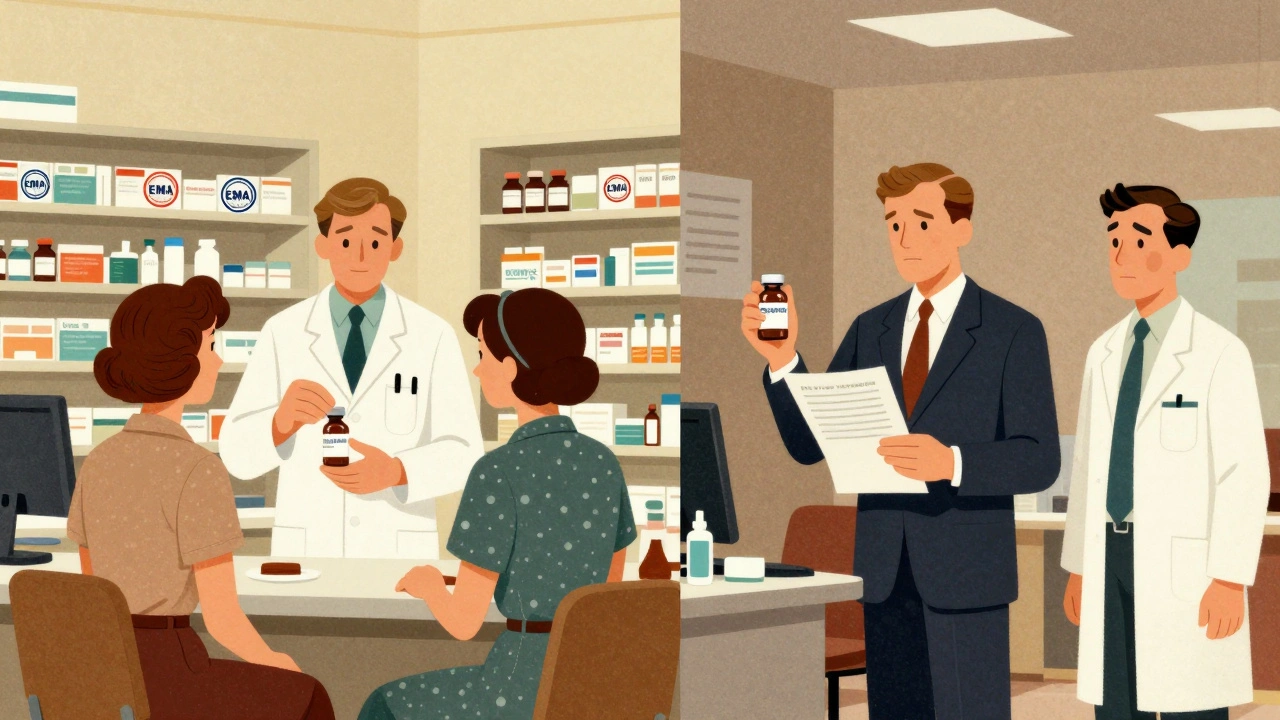
When it comes to cutting the cost of life-saving biologic drugs, biosimilars are the quiet revolution happening right now. But if you look at how Europe and the United States handle them, you’d think they’re two different worlds. Europe has been using biosimilars for nearly two decades. The US? It’s just now catching up - and fast.
Biosimilars aren’t generics. They’re not copies of simple chemical pills. These are complex, living-cell-based medicines that mimic highly specialized biologic drugs like Humira, Enbrel, or Avastin. They’re not identical - no two biologics can be - but they’re close enough that regulators say they work the same way, with no meaningful difference in safety or effectiveness. And they cost less. Much less. In Europe, they often launch at 20-30% below the original drug. In the US, the discounts are smaller at first, but they’re growing.
Europe: The Pioneer That Got It Right
Europe didn’t just try biosimilars - it built a system around them. The European Medicines Agency (EMA) approved the first one, Omnitrope, in 2006. That’s nearly a decade before the US approved its first, Zarxio, in 2015. Why the gap? Europe made it simple. They created a clear regulatory path: show analytical similarity, run a few targeted clinical trials, and prove safety. No need for huge, expensive studies on every patient group. The EMA focused on science, not bureaucracy.
That clarity changed everything. Hospitals in Germany, France, and the UK started putting biosimilars into their tenders. Pharmacists could substitute them without asking doctors. Payers loved it. By 2024, Europe’s biosimilar market hit $13.16 billion. That’s not just growth - it’s dominance. In some countries, over 80% of patients with rheumatoid arthritis or Crohn’s disease are on biosimilars instead of the original biologics. Oncology? Same story. Biosimilars for drugs like rituximab and trastuzumab now make up the majority of prescriptions.
Germany became the manufacturing hub. Companies like Sandoz, Fresenius Kabi, and Amgen set up production there because the rules were stable, the supply chains were solid, and doctors trusted the system. It wasn’t luck. It was strategy.
The United States: Slow Start, Big Surge
The US passed the law to allow biosimilars in 2009 - the Biologics Price Competition and Innovation Act (BPCIA). But then nothing happened. Why? Patent lawsuits. Originator companies like AbbVie (maker of Humira) used every legal trick to delay competitors. They filed dozens of patents, created what experts call “patent thickets,” and dragged out court battles for years. Even when biosimilars were approved, they couldn’t launch.
By 2024, Europe had over 100 approved biosimilars. The US? Only about 20. And only a handful were actually on the market. The biggest reason? The FDA required something Europe never did: switching studies. That meant proving it was safe to switch a patient from the original drug to the biosimilar - even if both had been shown to work identically. It added years. It added millions in costs. And it scared off companies.
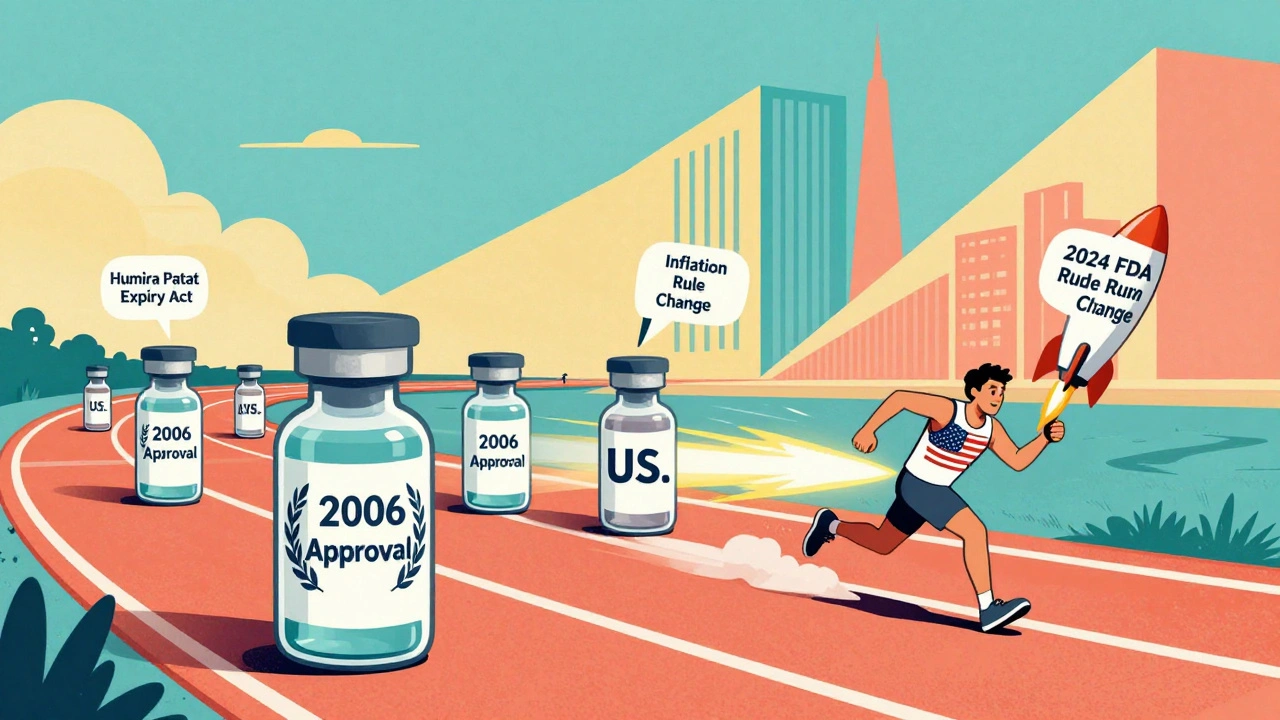
Then, in June 2024, everything changed. The FDA dropped the switching study requirement for interchangeable biosimilars. That’s a game-changer. Now, a biosimilar labeled as “interchangeable” can be swapped automatically at the pharmacy - just like a generic. No doctor’s approval needed. That’s how Europe works. And now, the US is finally catching up.
Why the US Is Playing Catch-Up - And Winning
The US market is smaller than Europe’s today - $10.9 billion in 2024 versus Europe’s $13.16 billion. But the growth rate? The US is faster. Projected CAGR for the US is 18.5% through 2033. Europe’s is 17.3%. Why? Because the US has more high-value biologics coming off patent.
Between 2025 and 2034, 118 biologics will lose patent protection in the US. That’s a $232 billion opportunity. Humira alone brought in $20 billion a year at its peak. Now, 14 biosimilars are approved for it. Six are on the market. And they’re priced 50-70% lower. That’s the kind of savings that changes healthcare economics overnight.
The Inflation Reduction Act of 2022 helped too. It closed the Medicare Part D coverage gap - the “donut hole” - and gave pharmacies and insurers real incentives to push biosimilars. No more financial penalty for choosing the cheaper option. Suddenly, switching made sense for everyone.
Companies are rushing in. Pfizer, Merck, and Samsung Bioepis are all building US biosimilar pipelines. And unlike Europe, where manufacturers are mostly European, the US market is seeing global players - from India to South Korea - compete for shelf space.
Therapeutic Areas: Where Each Market Leads
Europe started strong in autoimmune diseases. That’s where biologics were most expensive and most widely used. Biosimilars for adalimumab, infliximab, and etanercept took over fast. Oncology followed. Today, in countries like Sweden and the Netherlands, over 90% of new patients get a biosimilar for cancer treatment.
The US went the other way. First biosimilar? Filgrastim - a drug that helps cancer patients recover white blood cells after chemo. It’s not glamorous. But it’s high-volume, low-complexity, and easy to switch. That gave the system time to learn. Now, the US is moving into the big-ticket areas: rheumatology, inflammatory bowel disease, and diabetes (insulin biosimilars are starting to appear).
The difference? Europe had decades to build trust. The US is building it in years.
Regulation: The Real Difference
Both the EMA and FDA now agree on the science. Analytical data. Non-clinical studies. Clinical trials in one patient group - that’s enough to prove similarity. The big gap was interchangeability. Europe never required it. The US did - until 2024.
Now, the FDA’s new rules mean a biosimilar can be labeled “interchangeable” if it meets the same standards as the reference product - no extra switching studies. That’s the European model. And it’s going to unlock the US market. Pharmacies can now dispense interchangeable biosimilars without a doctor’s note. Insurers can automatically favor them. Patients won’t even notice the switch.
Europe’s system is still more centralized. EMA approves, then each country sets price and reimbursement. The US? A mess. FDA approves. CMS decides Medicare coverage. Private insurers set formularies. Pharmacy benefit managers negotiate rebates. It’s complicated. But with the FDA’s shift and the Inflation Reduction Act, the pieces are starting to align.
What’s Next? The Race to $100 Billion
By 2034, the global biosimilar market could hit $176 billion. Europe will still be big - projected at $65 billion. But the US? It could hit $30 billion. North America as a whole may overtake Europe in market size by 2027.
Manufacturing will keep expanding. More companies will enter. Prices will drop further. And patients will get access to treatments that were once out of reach.
One thing is clear: biosimilars aren’t a fad. They’re the future of affordable biologic care. Europe showed it could be done. The US is proving it can be done faster - and on a bigger scale.
What’s the difference between a biosimilar and a generic drug?
Generics are exact chemical copies of small-molecule drugs like aspirin or metformin. Biosimilars are highly similar - but not identical - copies of complex biologic drugs made from living cells. Because biologics are made by living organisms, even tiny changes in the manufacturing process can affect the final product. That’s why biosimilars require more testing than generics, but they’re still proven to be just as safe and effective.
Why are biosimilars cheaper than the original biologic drugs?
Biosimilars don’t need to repeat the full clinical trials the original drug went through. They rely on data showing they’re highly similar in structure and function. That cuts development costs dramatically - from over $1 billion for a new biologic to roughly $100-200 million for a biosimilar. That savings gets passed on to patients and payers, often at 20-70% lower prices.
Can a pharmacist switch me to a biosimilar without asking my doctor?
In Europe, yes - in many countries, substitution is automatic. In the US, it depends. Only biosimilars labeled as “interchangeable” by the FDA can be swapped without a doctor’s permission. Before June 2024, very few were. Now, more are being approved with that status, and pharmacists will soon be able to switch patients automatically - just like with generics.
Why did the US take so long to adopt biosimilars?
Three main reasons: patent lawsuits delayed launches, the FDA required extra switching studies that weren’t scientifically necessary, and the healthcare system is fragmented - insurers, pharmacies, and doctors didn’t have clear incentives to switch. All of that has changed. The FDA dropped the switching requirement in 2024, and new laws are pushing cost savings.
Are biosimilars safe?
Yes. Every biosimilar approved by the FDA or EMA must prove it has no clinically meaningful difference in safety, purity, or potency compared to the original biologic. Millions of patients in Europe have used them for over 15 years with no new safety concerns. The US has now approved over 20, and real-world data shows similar outcomes.
Which countries in Europe lead in biosimilar use?
Germany, France, the UK, Sweden, and the Netherlands lead in adoption. Germany is also the biggest manufacturing hub, with companies like Sandoz and Fresenius Kabi producing biosimilars for the whole world. These countries use hospital tenders, mandatory substitution policies, and strong physician education to drive uptake.
What’s stopping biosimilars from being used even more?
Still some barriers: physician hesitation (some still think biosimilars are “lesser”), patient concerns (lack of awareness), and complex reimbursement rules in the US. Also, next-generation biologics are getting more complex - making biosimilars harder and costlier to develop. But these are solvable problems. The momentum is clear.
The bottom line? Biosimilars are saving lives and money. Europe built the playbook. The US is now running the race - and it’s gaining speed.
Sangram Lavte
December 7, 2025 AT 18:54Biosimilars are a game-changer, no doubt. Europe’s model proves you don’t need to overcomplicate regulation to get results. The FDA’s shift on switching studies was long overdue. Now the real work begins: making sure these savings actually reach patients, not just corporate balance sheets.
Nicholas Heer
December 9, 2025 AT 14:43They don’t want you to know this but the FDA and Big Pharma are in bed together. Biosimilars? A distraction. The real goal is to keep you hooked on $20k/month drugs so the CEOs can buy their 3rd yacht. You think this is about science? Nah. It’s about control. They’ll make you think it’s safe… then they’ll switch you without telling you and you’ll get sick. Watch your back.
Kurt Russell
December 10, 2025 AT 23:17THIS IS HUGE. The US is finally waking up. For years we were stuck in patent hell while Europe saved millions. Now? The floodgates are open. Insulin biosimilars hitting the market next year? That’s going to save diabetic families thousands. This isn’t just policy-it’s a lifeline. We’re not catching up-we’re sprinting past them.
Wesley Phillips
December 12, 2025 AT 10:17Let’s be real nobody cares about biosimilars except the people who actually have to pay for them. Meanwhile the rest of us are over here scrolling memes while our premiums go up. The system is rigged. They’ll call it ‘innovation’ but it’s just repackaged greed. You think a 50% discount means anything when your deductible is $10k?
Desmond Khoo
December 12, 2025 AT 16:14This is the kind of news that actually gives me hope 🙌 Finally, someone’s fighting the good fight against pharmaceutical greed. Biosimilars = more access = more lives saved. Let’s hope this momentum keeps building. We can do this.
Louis Llaine
December 13, 2025 AT 14:20Wow. So Europe did it first. Big deal. We’re just now getting around to it because we finally stopped letting lawyers run healthcare. Took us long enough.
Jane Quitain
December 15, 2025 AT 09:43i just read this and cried a little. my mom’s on humira and we’ve been paying $1200 a month for years. if this actually works… i don’t know what to say. thank you to whoever made this happen.
Sam Mathew Cheriyan
December 17, 2025 AT 00:29Europe? More like Eura-PR. They’re just using biosimilars to control the population. You think they’re saving money? Nah. They’re tracking who gets what through the system. Next thing you know, your insulin dose is being rationed by an algorithm. The US is still free… for now.
Ernie Blevins
December 17, 2025 AT 17:2418.5% growth? That’s just math. Real talk: most of these biosimilars are garbage. You think a biologic made in Korea is the same as one made in Switzerland? Wake up. The FDA’s just playing catch-up to look good. Patients are the ones paying the price.
Stacy here
December 17, 2025 AT 20:01They’re calling this a revolution but it’s just another corporate takeover. The EMA didn’t care about safety-they cared about cost-cutting. And now the FDA’s copying them? So we’re trading one kind of risk for another? What about long-term effects? Who’s tracking the patients who switch? Nobody. We’re all just lab rats in a profit-driven experiment.
Ryan Sullivan
December 18, 2025 AT 14:09The regulatory divergence between EMA and FDA was never about science-it was about institutional inertia. The FDA’s prior insistence on switching studies was a regulatory artifact, not a scientific necessity. The 2024 policy shift aligns the US with the OECD consensus on biosimilar equivalence. This is not merely a market shift-it’s a paradigmatic correction in pharmacoeconomic governance.
Kyle Oksten
December 19, 2025 AT 00:36It’s interesting how we frame this as ‘catching up’ when the US has always had a more fragmented system. Europe’s centralized procurement made adoption easy. The US has to navigate PBMs, insurers, hospital formularies, and physician bias. The FDA’s rule change helps-but the real battle is cultural. Trust doesn’t come from a regulation. It comes from time.
Ted Rosenwasser
December 19, 2025 AT 23:43Let’s not pretend this is some heroic triumph. The US market is just now adopting biosimilars because the original biologics are finally expiring. It’s not innovation-it’s inevitability. And don’t get me started on the Indian and Korean manufacturers. They’re not here to save lives. They’re here to take market share. The real winners? The investors in Samsung Bioepis.
Oliver Damon
December 21, 2025 AT 02:50What’s fascinating isn’t just the cost savings-it’s how this changes the entire ecosystem of drug development. If biosimilars can be approved without repeating full trials, then maybe the entire model of pharma R&D needs rethinking. Are we incentivizing innovation or just legal maneuvering? The fact that the US is now moving toward Europe’s model suggests we’re finally prioritizing patient access over patent protection. That’s not just policy-it’s a moral shift.