
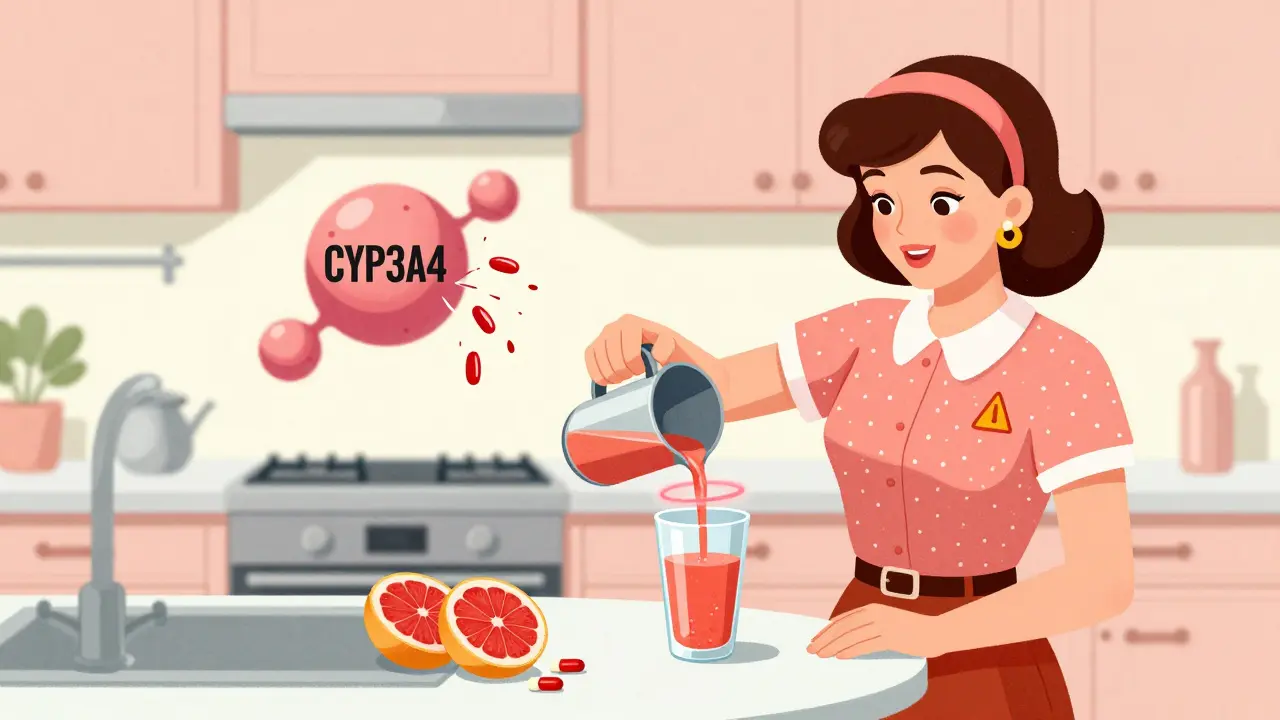
If you're taking a statin to lower your cholesterol, drinking grapefruit juice might seem like a healthy choice. But for some statins, it's a recipe for trouble. The interaction between grapefruit and certain statins isn't just a minor inconvenience-it can push your drug levels into dangerous territory, raising your risk of muscle damage, kidney failure, and worse. This isn't theoretical. It's been proven in labs, documented in hospitals, and warned about by the FDA for over a decade.
Why Grapefruit Changes How Statins Work
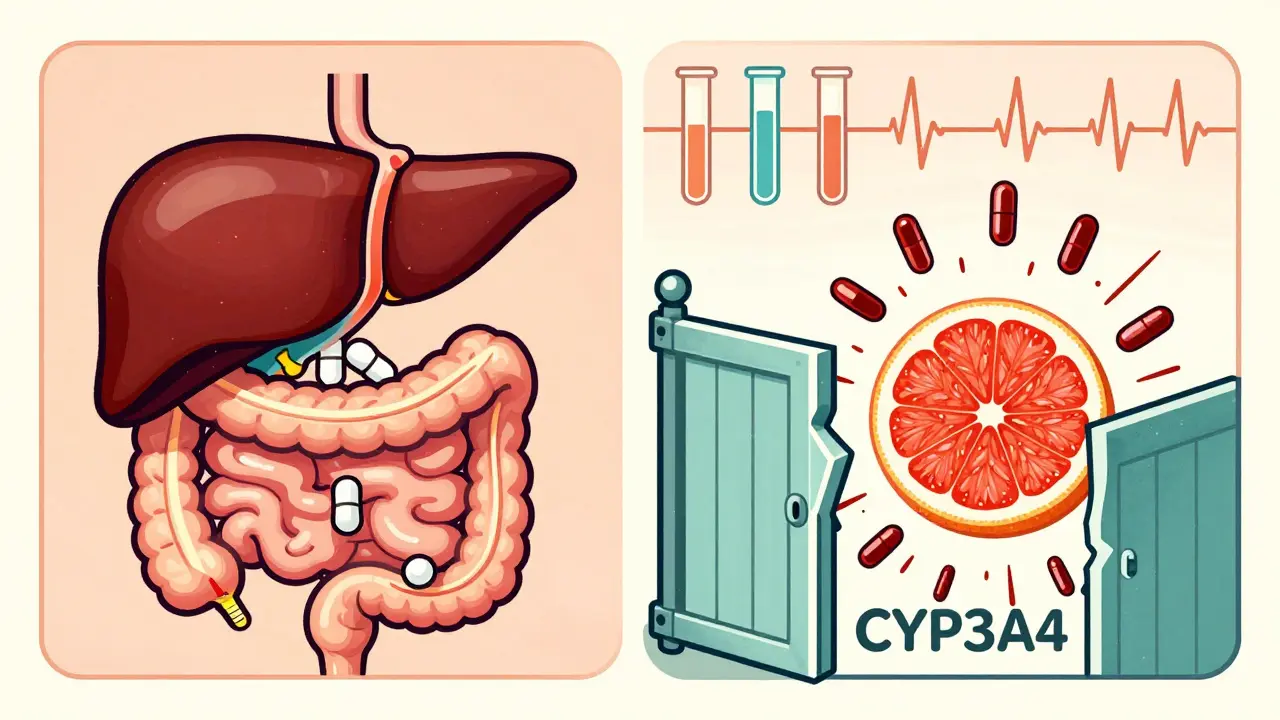
Grapefruit doesn't just add flavor-it changes how your body handles certain medications. The culprit? Furanocoumarins, natural chemicals found in grapefruit, Seville oranges, and pomelos. These compounds attack an enzyme in your gut called CYP3A4, which normally breaks down statins before they enter your bloodstream. When the enzyme is blocked, your body absorbs way more of the drug than it should.
This isn't a case of "too much juice." Even a single glass (200 mL) of grapefruit juice can trigger the effect. And it's not temporary. The enzyme doesn't just slow down-it gets permanently disabled. Your body needs about three days to make new enzymes and restore normal function. So if you drink grapefruit juice on Monday, your statin still acts like it's been doubled or tripled on Thursday.
Which Statins Are at Risk?
Not all statins react the same way. The danger depends on how much the drug relies on CYP3A4 for metabolism. Here's the breakdown:
- High risk: Simvastatin (Zocor), lovastatin (Mevacor), and atorvastatin (Lipitor). These are the most affected. Simvastatin, in particular, sees its blood levels spike up to 16 times higher after grapefruit juice.
- Moderate risk: Atorvastatin can still have dangerous spikes, especially at higher doses. Doctors often allow small, occasional amounts-but never daily.
- Safe: Pravastatin (Pravachol), rosuvastatin (Crestor), fluvastatin (Lescol), and pitavastatin (Livalo). These are processed by other pathways and don't interact significantly with grapefruit.
That means if you're on simvastatin or lovastatin, grapefruit is off-limits. No exceptions. Even a few sips can push you over the edge.
What Happens When Levels Get Too High?
The most common problem is muscle pain-a dull ache or weakness that feels like you've overworked without actually exercising. That's myalgia, and it affects 5-10% of people who mix grapefruit with high-risk statins.
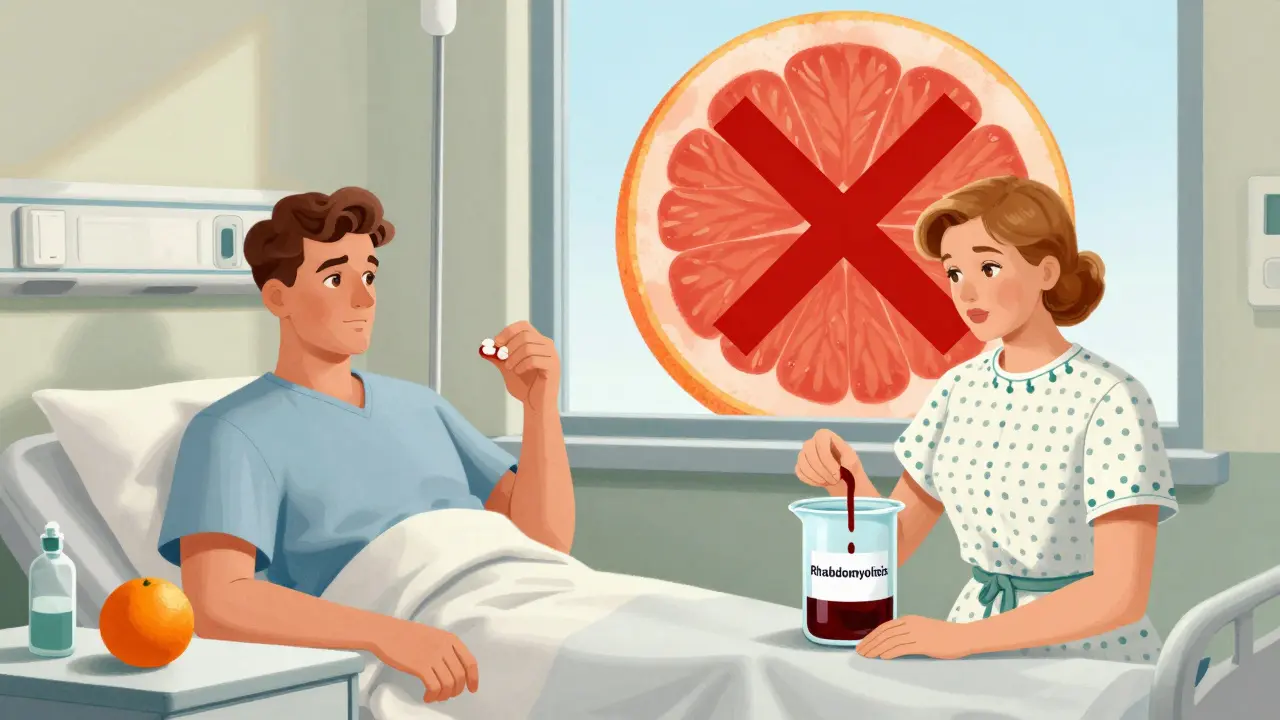
But that's just the warning sign. When muscle damage gets worse, it becomes rhabdomyolysis. This is rare-less than 1 in 10,000 statin users-but grapefruit can make it far more likely. In rhabdomyolysis, muscle cells break open and spill their contents into the blood. One of those contents, myoglobin, can clog your kidneys and cause sudden, life-threatening kidney failure.
Signs to watch for:
- Severe muscle pain, especially in the shoulders, thighs, or lower back
- Weakness so bad you can't stand or climb stairs
- Dark, tea-colored or cola-colored urine
If you have even one of these symptoms after drinking grapefruit juice and taking your statin, go to the ER. Don't wait. Don't call your doctor first. Go.
Real Cases, Real Consequences
A 40-year-old woman in Ohio developed rhabdomyolysis after eating grapefruit every day for 10 days while taking simvastatin. She didn't have other risk factors-no alcohol, no other drugs, no intense exercise. Just grapefruit and her cholesterol pill. Her creatine kinase (CK) levels, a marker of muscle damage, shot up to 10 times the normal range. She spent five days in the hospital on IV fluids to protect her kidneys.
Another case involved a 68-year-old man who drank grapefruit juice every morning with his atorvastatin. He didn't feel pain until he couldn't get out of bed. His CK was over 20,000 (normal is under 200). He needed dialysis. Both patients recovered, but they could have died.
What If You Love Grapefruit?
You don't have to give up citrus entirely. Regular oranges, lemons, and limes are safe. Only grapefruit, Seville oranges (the bitter kind used in marmalade), and pomelos are risky.
If you're on simvastatin or lovastatin, the only safe choice is to stop grapefruit completely. No "just once a week." No "I'll drink it at night, not in the morning." The enzyme damage lasts 72 hours. Timing doesn't help.
If you're on atorvastatin, your doctor might allow one small grapefruit or 8 ounces of juice once a week-but only if you're on a low dose and have no other risk factors like kidney disease or diabetes. Even then, it's a gamble.
The best solution? Switch to a safe statin. Rosuvastatin or pravastatin work just as well for lowering cholesterol, without the grapefruit risk. Many people switch without even noticing a difference in how they feel.
What Should You Do Right Now?
If you're on a statin and drink grapefruit juice, here's what to do today:
- Check your prescription bottle. Does it say "Zocor," "Mevacor," or "Lipitor"? If yes, stop grapefruit immediately.
- Look at the label. The FDA requires a warning for simvastatin and lovastatin. If it's not there, ask your pharmacist.
- Call your doctor or pharmacist. Say: "I drink grapefruit juice. What statin am I on, and is it safe?" Don't assume they know.
- If you're on a high-risk statin and can't give up grapefruit, ask about switching to rosuvastatin or pravastatin. They're just as effective.
- Don't stop your statin on your own. Stopping raises your risk of heart attack and stroke more than grapefruit ever could.
Why Do So Many People Still Take the Risk?
Here's the scary part: only 42% of doctors routinely ask patients about grapefruit when prescribing high-risk statins. And only 28% of patients say they were warned. Many people think grapefruit is just a "natural" food, so it can't be dangerous. Others assume the warning only applies to huge amounts-like a whole gallon a day. But the science is clear: even a glass can be enough.
Pharmacists are better at catching this. A 2021 study showed pharmacist-led interventions cut dangerous grapefruit-statin combos by 78% in Medicare patients. That's why it's worth asking your pharmacist when you pick up your prescription.
The Future: Grapefruit Without the Danger?
Scientists at the University of Florida are working on a solution: breeding grapefruit that tastes the same but has almost no furanocoumarins. Early results are promising. In a few years, you might be able to enjoy grapefruit with your statin without worry.
But until then, this isn't a risk worth taking. Your cholesterol medication saves your life. Grapefruit juice doesn't. Choose wisely.
Can I drink grapefruit juice if I take rosuvastatin or pravastatin?
Yes. Rosuvastatin (Crestor) and pravastatin (Pravachol) are not broken down by the CYP3A4 enzyme, so grapefruit juice won't affect them. You can safely enjoy grapefruit if you're on one of these statins. Other safe options include fluvastatin and pitavastatin.
What if I accidentally drank grapefruit juice with my statin?
If you're on simvastatin or lovastatin and drank grapefruit juice once, don't panic-but monitor yourself. Watch for muscle pain, weakness, or dark urine. If you feel fine and it was a one-time event, you're likely okay. But if you're on atorvastatin or take a high dose, or if you drink grapefruit regularly, call your doctor. Never wait for symptoms to get worse.
Is grapefruit juice worse than eating grapefruit?
No. The same compounds are in both the juice and the fruit. One small grapefruit equals about 8 ounces of juice, so they're equally risky. The form doesn't matter-only the amount of furanocoumarins. Avoid both.
Can I take my statin at night and grapefruit in the morning?
No. The enzyme inhibition lasts for about three days. Separating the timing by hours or even a day won't help. The damage to CYP3A4 is permanent until your body makes new enzymes. Avoid grapefruit completely if you're on simvastatin, lovastatin, or high-dose atorvastatin.
Are other citrus fruits like oranges or lemons dangerous?
No. Regular oranges, tangerines, lemons, and limes do not contain furanocoumarins and are safe with all statins. Only grapefruit, Seville oranges, and pomelos are a problem. You can still enjoy orange juice, lemon water, or lime in your tea.
Why do some statins interact and others don't?
It depends on how the drug is processed. Simvastatin, lovastatin, and atorvastatin are broken down by the CYP3A4 enzyme in the gut. Grapefruit blocks that enzyme. Pravastatin, rosuvastatin, and others are handled by different pathways-like the liver or kidney-so grapefruit doesn't interfere. That's why switching statins is often the best fix.
Can grapefruit interact with other medications besides statins?
Yes. Grapefruit affects many drugs metabolized by CYP3A4, including some blood pressure meds (like felodipine), anti-anxiety drugs (like buspirone), and even some cancer treatments. Always check with your pharmacist or doctor if you're on any prescription and drink grapefruit juice.
phara don
February 2, 2026 AT 05:35Just found out I’ve been drinking grapefruit juice with my Lipitor for 2 years 😳. My doctor never mentioned it. Time to switch to Crestor.
larry keenan
February 3, 2026 AT 04:21The pharmacokinetic interaction between furanocoumarins and CYP3A4-mediated statin metabolism is a well-documented phenomenon, with clinical significance confirmed in multiple randomized trials. The irreversible inhibition of intestinal CYP3A4 renders temporal separation of ingestion ineffective. Pravastatin and rosuvastatin remain the preferred alternatives in patients with persistent citrus consumption.
Brett MacDonald
February 5, 2026 AT 03:40so like… grapefruit is basically a drug smuggler? it sneaks into your gut, kicks out the bouncer (CYP3A4), and lets all the statin party guests in? 🤯
clarissa sulio
February 5, 2026 AT 04:14Why do we even have this problem? In America, we should be able to eat what we want. If you can’t handle a little grapefruit, maybe you shouldn’t be on meds at all. This is overregulated nonsense.
Vatsal Srivastava
February 6, 2026 AT 06:26Everyone’s panicking about grapefruit but no one talks about how statins themselves are overprescribed. You’re more likely to get rhabdo from a sedentary lifestyle than from juice. Also, CYP3A4 is just one enzyme among thousands. This is pharmaceutical fearmongering.
Ansley Mayson
February 7, 2026 AT 05:20So let me get this straight. You’re telling me I can’t have my morning grapefruit smoothie because some lab study says it might kill me? I’m 58, I’ve had high cholesterol since 30, and I’m not giving up citrus. My body’s fine. The real danger is trusting doctors who don’t even know what CYP3A4 stands for.
Dan Pearson
February 7, 2026 AT 18:36Oh wow, so grapefruit is the villain now? Next they’ll ban oxygen because it might make your statin work too well. I’m switching to orange juice… and also filing a lawsuit against the FDA for emotional distress. This is a joke. 🤡
Marc Durocher
February 8, 2026 AT 06:13For real though - if you’re on simvastatin and you like grapefruit, just switch to rosuvastatin. It’s not a big deal. I did it. No side effects, same cholesterol numbers. Your body doesn’t care what the pill’s brand name is - it just wants to not turn into a pile of melted muscle. Trust me, your future self will thank you.
Nick Flake
February 8, 2026 AT 21:08Life is a balancing act 🌱⚖️. One glass of grapefruit juice = tiny rebellion. One dose of simvastatin = lifelong commitment to survival. But what if… the real medicine isn’t the pill? What if it’s the joy of citrus? The tang on your tongue? The way the sun hits the pulp? Maybe we’re all just trying to taste something real in a world that wants us numb. 🍊💔
Akhona Myeki
February 9, 2026 AT 17:15As a South African medical researcher, I must emphasize that the CYP3A4 inhibition mechanism is universally applicable regardless of geography. The FDA warnings are not American exceptionalism - they are evidence-based. Those who dismiss this as overcaution are endangering not only themselves but also their families and healthcare systems.
Chinmoy Kumar
February 11, 2026 AT 02:30hmm i never knew grapefruit did this… i just thought it was healthy. i take crestor tho so im cool but wow this is wild. thanks for the info. maybe i should tell my dad hes on zocor and drinks juice every day… he’ll be mad but better safe than sorry 🙏
Bridget Molokomme
February 12, 2026 AT 17:02So I’m the only one who thinks this whole thing is just a fancy way for pharma to sell more expensive statins? Rosuvastatin costs 3x more. Coincidence? I think not. Also, I’ve had grapefruit with Lipitor for 8 years. Still standing. And I’m 72. 😎