
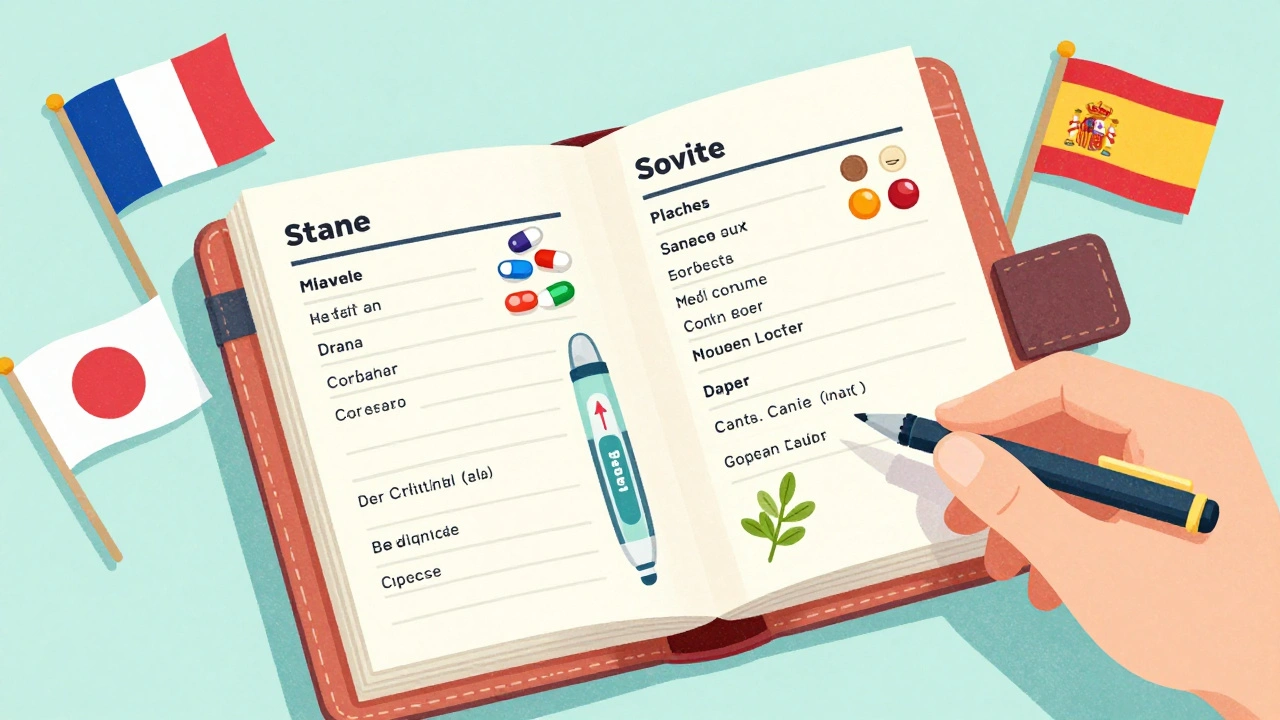
When you’re traveling abroad and something goes wrong-whether it’s a sudden allergic reaction, a heart palpitation, or a fall-you don’t have time to explain what medications you’re taking. If you can’t speak the local language, the stakes get even higher. Emergency staff won’t know if you’re on blood thinners, insulin, or a medication that could interact dangerously with what they’re about to give you. That’s why keeping a multilingual medication list isn’t just smart-it’s life-saving.
Why a Simple List Isn’t Enough
A piece of paper with pills written in English won’t help in Paris, Tokyo, or Cairo. In fact, research shows that language barriers increase medication errors by up to 50% during emergency visits. A 2020 study in JAMA Internal Medicine found that patients who carried a translated medication list had 28% fewer discrepancies when admitted to hospitals. That’s not a small number-it means fewer wrong doses, fewer dangerous interactions, and faster treatment. The problem isn’t just translation. Many people use apps or printouts that translate medication names literally. But what’s called “aspirin” in English might be “acetilsalicilat” in Romanian or “アスピリン” in Japanese. If the term doesn’t match what the local pharmacist or doctor recognizes, they might skip it entirely. And what about herbal supplements, traditional remedies, or over-the-counter drugs? Most standard lists leave these out-even though they’re often the cause of unexpected reactions.What Should Be on Your Multilingual Medication List
Your list needs to be clear, complete, and usable by someone who doesn’t speak your language. Here’s exactly what to include:- Medication name-both brand and generic (e.g., “Lipitor” and “atorvastatin”)
- Dosage-how much you take (e.g., “10 mg”)
- Frequency-how often (e.g., “once daily,” “every 8 hours”)
- Purpose-why you take it (e.g., “for high blood pressure,” “for diabetes”)
- Prescribing doctor-name and contact info if possible
- Start date-when you began taking it
- Allergies-especially if you’ve had reactions to penicillin, sulfa, or NSAIDs
- Supplements and herbs-even if you think they’re “natural” (e.g., garlic pills, ginkgo, St. John’s wort)
Don’t forget to include any medical devices you use-like an EpiPen, inhaler, or insulin pen. These are often overlooked but critical in emergencies.
Where to Get Reliable Translations
You don’t have to translate this yourself. Several trusted organizations have already done the work for you.- Tennessee Pharmacists Association (TPA) Universal Medication List-available in 10 languages including Spanish, Arabic, Chinese, Vietnamese, Russian, and French. It’s a clean, printable PDF with all the fields you need. You can download it for free from their website.
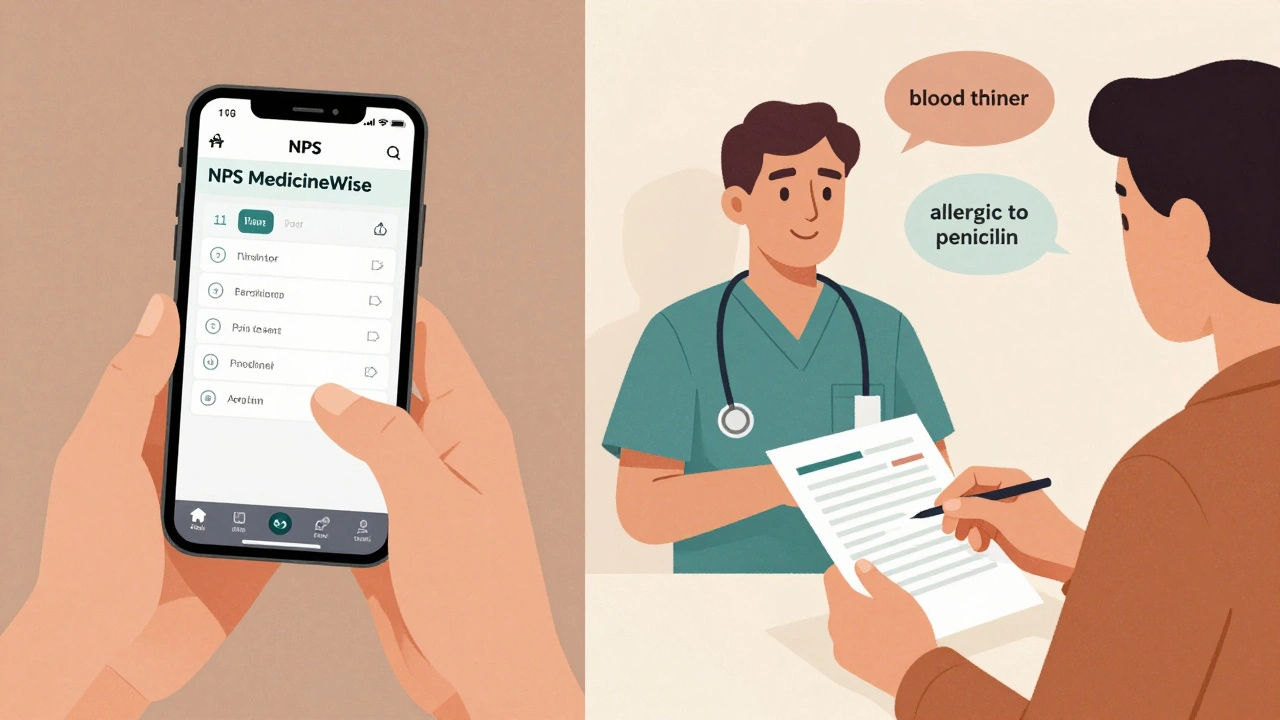
- NPS MedicineWise App (Australia)-available on iOS and Android. It lets you enter your meds, then exports them in 11 languages. It also sends reminders and stores your list digitally. Over 350,000 people use it monthly.
- British Red Cross Emergency Multilingual Phrasebook-not a medication list, but it includes key phrases like “I take…” and “I am allergic to…” in 36 languages. Great to carry alongside your list.
- MedlinePlus (U.S. National Library of Medicine)-offers drug safety info in over 40 languages. You can search for your medication and print the translated version.
Google Search now also pulls translated medication info from MedlinePlus for over 100 common drugs across 30 languages. Just type “atorvastatin [language]” and you’ll often see a translated summary in the search results.
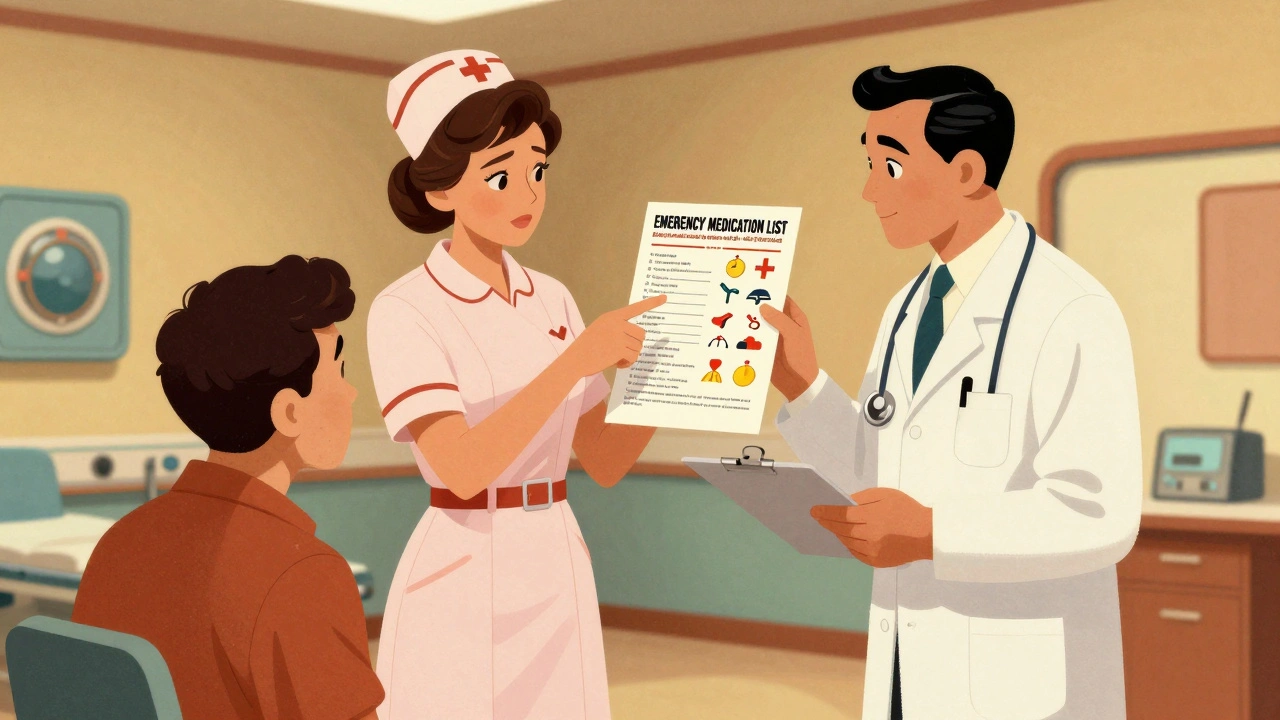
How to Use Your List in an Emergency
Having the list isn’t enough-you need to make sure it’s found and used when it matters.- Carry a printed copy in your wallet or purse. Keep it in a clear plastic sleeve so it doesn’t get damaged.
- Save a digital copy on your phone with a clear label like “MEDS EMERGENCY” in your photos or notes app.
- Give a copy to a travel companion or family member who’s with you.
- If you’re staying in a hotel, leave a copy at the front desk with your room number and emergency contact.
- Wear a medical alert bracelet if you have serious allergies or conditions like diabetes or epilepsy.
Pro tip: Write “EMERGENCY MEDICATION LIST” in large letters on top of your printed copy. Use bold font. Emergency staff are rushing. They need to spot it in seconds.
Language Tips: Avoid Common Mistakes
Not all translations are created equal. Here’s what goes wrong-and how to fix it:- Don’t use machine translation alone. Google Translate might turn “aspirin” into “aspirina,” but in some dialects, that word doesn’t exist. Use official sources like TPA or MedlinePlus.
- Include local names. If you take metformin, find out what it’s called in your destination country. In some places, it’s sold under a brand name only. Ask your pharmacist before you leave.
- Don’t leave out herbs. A patient in Italy once had a seizure because the ER didn’t know she took ginkgo biloba. It’s common in her home country, but not recognized in European medical records.
- Use simple terms. Instead of “hypertension,” write “high blood pressure.” Instead of “anticoagulant,” write “blood thinner.”
What to Do If Your Language Isn’t Covered
If your language isn’t in the official lists (like Hmong, Amharic, or Kurdish), here’s what to do:- Ask your pharmacist to translate it for you. Many have access to professional medical translators.
- Use a local community center or immigrant support group. They often have volunteers who can help translate medical forms.
- Write it in your native language and English side-by-side. Even if the staff can’t read it, they’ll know you’re trying to communicate.
- Record a short voice note in your language explaining your meds. Play it on your phone if you’re unable to speak.
A 2023 study found that patients who used a voice recording along with a written list had a 41% higher chance of being understood in an emergency.
Update It Like a Passport
Your medication list isn’t a one-time task. Every time you see your doctor, get a new prescription, or stop a drug, update it. A 2022 analysis showed that 78% of medication errors happen during transitions of care-like after a hospital stay or a doctor’s visit.Set a reminder on your phone every 3 months to check your list. If you’re traveling, update it the day before you leave. And always carry the latest version.
Real Stories: Why This Matters
In 2023, a woman in Chicago had a severe allergic reaction. She couldn’t speak English. But she had her Spanish-language TPA medication list in her wallet. The ER nurse spotted it immediately, saw she was allergic to penicillin, and avoided giving her the wrong antibiotic. She was discharged in 90 minutes. Another case: a man in Berlin collapsed with chest pain. His daughter had translated his list into German using the NPS app. The doctors saw he was on warfarin and knew to avoid giving him ibuprofen-which could have caused a bleed. He survived because the list was there. These aren’t rare cases. They happen every day.Final Checklist Before You Travel
Before you leave for your trip, do this:- Download or print your multilingual medication list from TPA, NPS, or MedlinePlus.
- Add your allergies, supplements, and devices.
- Translate any non-standard meds (like herbal pills) using a pharmacist’s help.
- Carry a printed copy and a digital copy on your phone.
- Give a copy to a travel buddy.
- Write “EMERGENCY MEDICATION LIST” in big letters on the top.
- Check that your phone is charged and your translations are visible without internet.
It takes less than 20 minutes. But it could mean the difference between confusion and care.
Do I need a multilingual list if I’m only going to a country where English is spoken?
Yes. Even in countries like Australia, Canada, or the UK, emergency staff may encounter patients who don’t speak English fluently. If you’re traveling with someone who has limited English, or if you’re visiting a diverse city, having a translated list ensures you’re understood. Also, you never know who might need your list in an emergency-like if you’re in a group and someone else has a reaction.
Can I use Google Translate to make my own list?
Only as a starting point. Google Translate often gets medical terms wrong. For example, “diabetes” might be translated as “sugar disease,” which isn’t used in medical settings. Always cross-check with official sources like MedlinePlus or your pharmacist. Never rely on machine translation alone for life-critical info.
What if my language isn’t supported by any official list?
Ask your pharmacist or local community center for help. Many have access to professional medical translation services. If that’s not possible, write your meds in your native language and English side by side. Record a short voice note explaining your medications in your language. Keep both on your phone. Emergency staff will see you’re trying to communicate-and they’ll work with you.
Should I include over-the-counter meds and vitamins?
Absolutely. Many serious reactions happen because of interactions with common supplements. For example, ginkgo or garlic pills can thin your blood and interfere with surgery or other drugs. Include everything-even if you think it’s harmless. Better safe than sorry.
How often should I update my list?
Update it every time you change your meds-whether it’s a new prescription, a dose change, or stopping something. Even if you don’t think it’s important, write it down. Set a reminder every 3 months to review. If you’re traveling, update it the day before you leave. Outdated lists can be more dangerous than no list at all.
James Kerr
December 3, 2025 AT 06:55Just printed mine out and stuck it in my wallet. Took 10 minutes. If I pass out in Tokyo, at least someone won’t have to guess what’s in my system. 🙌
Rashmin Patel
December 3, 2025 AT 19:28This is one of those things that seems overkill until you’re the one lying in an ER with a bag of pills in your pocket and no one understanding a word you say. I carry mine in three formats: printed, phone note, and a QR code linked to a Google Doc with voice recordings in Hindi, English, and Spanish. My pharmacist helped me translate the ayurvedic supplements too-turns out ‘ashwagandha’ is just ‘Indian ginseng’ in German. Who knew? Also, don’t forget to write ‘ALLERGIC TO PENICILLIN’ in ALL CAPS. ER nurses are busy, not psychic. 💯
sagar bhute
December 5, 2025 AT 07:52Why are we still talking about this like it’s revolutionary? This is basic hygiene. If you can’t be bothered to write down your meds in another language, you don’t deserve to travel. Stop pretending you’re ‘adventurous’-you’re just a liability waiting to happen.
Cindy Lopez
December 6, 2025 AT 17:01There’s a missing comma in the third paragraph under ‘What Should Be on Your Multilingual Medication List.’ Also, ‘dosage’ and ‘frequency’ should be hyphenated when used as compound adjectives before ‘medication.’ Small things matter when lives are on the line.
shalini vaishnav
December 7, 2025 AT 15:55Of course the US has a list for this. But in India, we don’t need this. We know our medicines. We’ve been using ayurveda for 5,000 years. Why are we copying Western medical bureaucracy? This is cultural imperialism disguised as safety.
vinoth kumar
December 7, 2025 AT 23:17I just shared this with my whole family. My mom takes 12 different things and speaks only Tamil. I’m getting her list translated by a local clinic next week. Thanks for the reminder-we all think we’ll be fine until we’re not.
bobby chandra
December 8, 2025 AT 17:57Let’s be real-this isn’t just about meds. It’s about dignity. When you’re gasping for air in a foreign hospital and someone finally reads your list and says, ‘Ah, you’re on warfarin’-that’s not just medical care. That’s humanity. I’m printing five copies. One for my suitcase, one for my glovebox, one for my wife, one for my dog’s collar (just kidding… maybe).
Archie singh
December 10, 2025 AT 12:26Why do people think translating a list is enough? Hospitals don’t use English. They use Latin. You need the chemical names. You need the ICD codes. You need the manufacturer batch numbers. This post is dangerously oversimplified. And don’t get me started on the NPS app-it’s Australian, not global. You’re trusting your life to a government agency that can’t even fix their own website.
Gene Linetsky
December 11, 2025 AT 17:10Did you know the WHO secretly tracks every medication list uploaded to apps like NPS? They’re building a global database to control drug access. That’s why they push these ‘free’ tools. Your list isn’t just for emergencies-it’s a backdoor for surveillance. I only use handwritten lists on recycled paper now. And I burn them after every trip.
Ignacio Pacheco
December 11, 2025 AT 18:19So… you’re telling me the solution to language barriers in emergencies is… more paperwork? Brilliant. Next you’ll tell us to bring a notarized birth certificate and a signed waiver for breathing.
Jim Schultz
December 13, 2025 AT 03:16Why is no one talking about the fact that most of these ‘official’ lists are written by pharmacists who’ve never traveled outside their own state? And why is everything in English first? What if you’re a Japanese tourist in rural Mexico? This whole system is built for privilege. You need a smartphone, a printer, a pharmacist, and a college education to survive an emergency. That’s not safety-that’s a class test.
parth pandya
December 13, 2025 AT 21:16great post! i just made mine using the tpa template and added my ginger tea and turmeric pills. forgot to spell ‘atorvastatin’ right the first time 😅 but fixed it. also printed a copy for my sister in case i get lost in italy. thanks for the reminder!
Albert Essel
December 15, 2025 AT 10:35One thing I’d add: if you’re on anticoagulants or insulin, include your most recent lab values (INR, HbA1c) on the list. ER staff can use that as a baseline if they can’t reach your doctor. Also, use a waterproof sleeve. I lost mine in the rain in Costa Rica-ended up rewriting it from memory on a napkin. Not fun.