
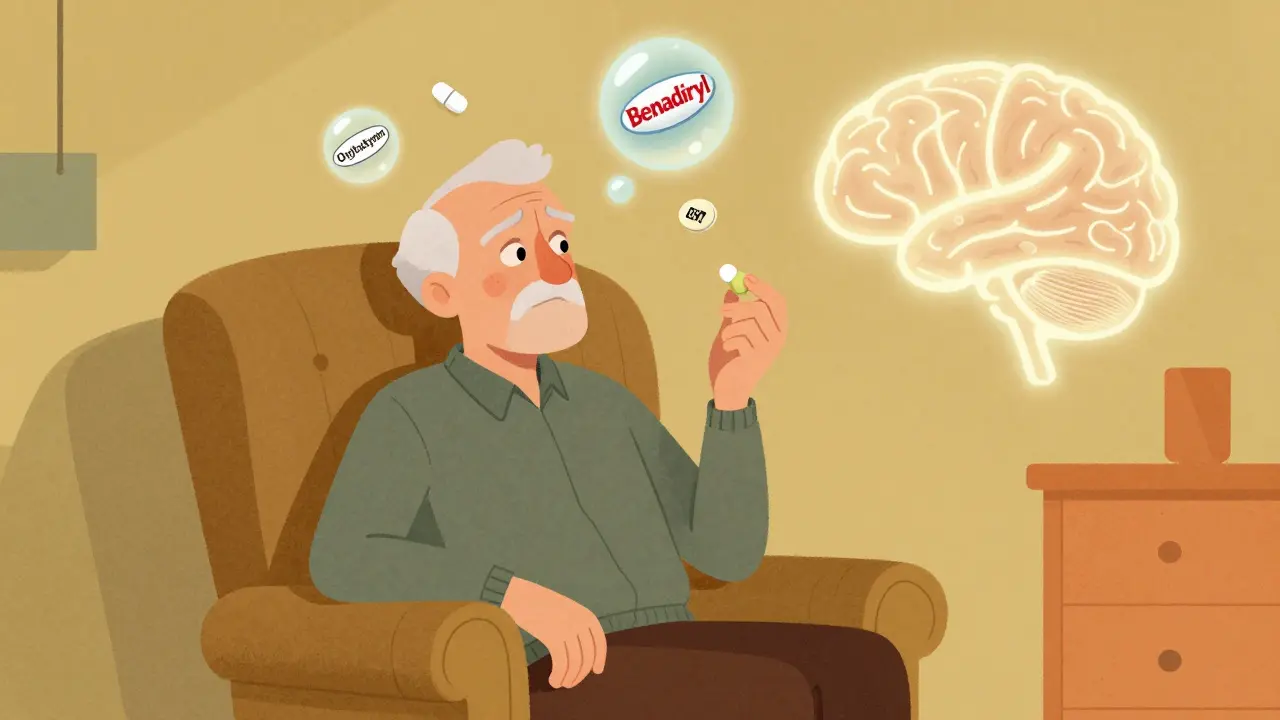
Many older adults start noticing changes in memory, energy, or balance and assume it’s just part of getting older. But what if those changes aren’t aging at all - but side effects from medications? It’s a quiet epidemic. Up to 70% of seniors take at least one drug that can cause confusion, forgetfulness, or dizziness - symptoms that look exactly like dementia or normal aging. The scary part? These symptoms often go away completely once the medication is stopped.
What Does Medication-Induced Aging Look Like?
When a drug mimics aging, it doesn’t slowly creep in like Alzheimer’s. It shows up fast. One day, your parent or loved one is fine. The next, they’re forgetting names, stumbling, or acting confused. These aren’t random. They’re classic signs of anticholinergic drugs medications that block acetylcholine, a brain chemical critical for memory and focus.
Think of acetylcholine like a spark plug in your car. If you shut it off, the engine sputters. That’s what these drugs do in the brain. Common culprits include:
- Diphenhydramine (Benadryl) - used for allergies or sleep
- Oxybutynin (Ditropan) - for bladder control
- Tricyclic antidepressants like amitriptyline
- Chlorpromazine and quetiapine (Seroquel) - prescribed for behavior issues
- Promethazine - for nausea or motion sickness
And it’s not just these. A 2021 NIH review found over 50 medications in this category. Seniors are especially vulnerable because their bodies process drugs differently. Liver and kidney function drop by 30-60% after age 65. That means drugs stay in the system longer, and brain exposure can be 50% higher than in younger adults.
How to Spot the Difference Between Medication Side Effects and Real Aging
True neurodegenerative diseases like Alzheimer’s don’t flip on like a light switch. They creep in over years. Medication side effects? They often appear within days or weeks of starting a new drug or changing the dose.
Here’s how to tell them apart:
- Sudden onset - Did confusion or memory loss start after a new prescription? That’s a red flag.
- Fluctuating symptoms - Do they seem better in the morning and worse at night? Or better on weekends when meds are skipped? That’s typical of drug effects.
- Physical clues - Dry mouth, constipation, blurry vision, or trouble urinating often come with cognitive changes. These are hallmarks of anticholinergic burden.
- No progressive decline - If your loved one’s symptoms plateau or improve after stopping a medication, it’s likely drug-related.
One real case from Indiana University involved a 68-year-old woman who couldn’t remember her grandchildren’s names. She was diagnosed with early dementia. Then, her pharmacist noticed she was taking four anticholinergic drugs - including Benadryl for sleep and oxybutynin for bladder issues. After tapering off those meds over six weeks, her memory returned to nearly normal.
The Hidden List: Beers Criteria and Anticholinergic Burden
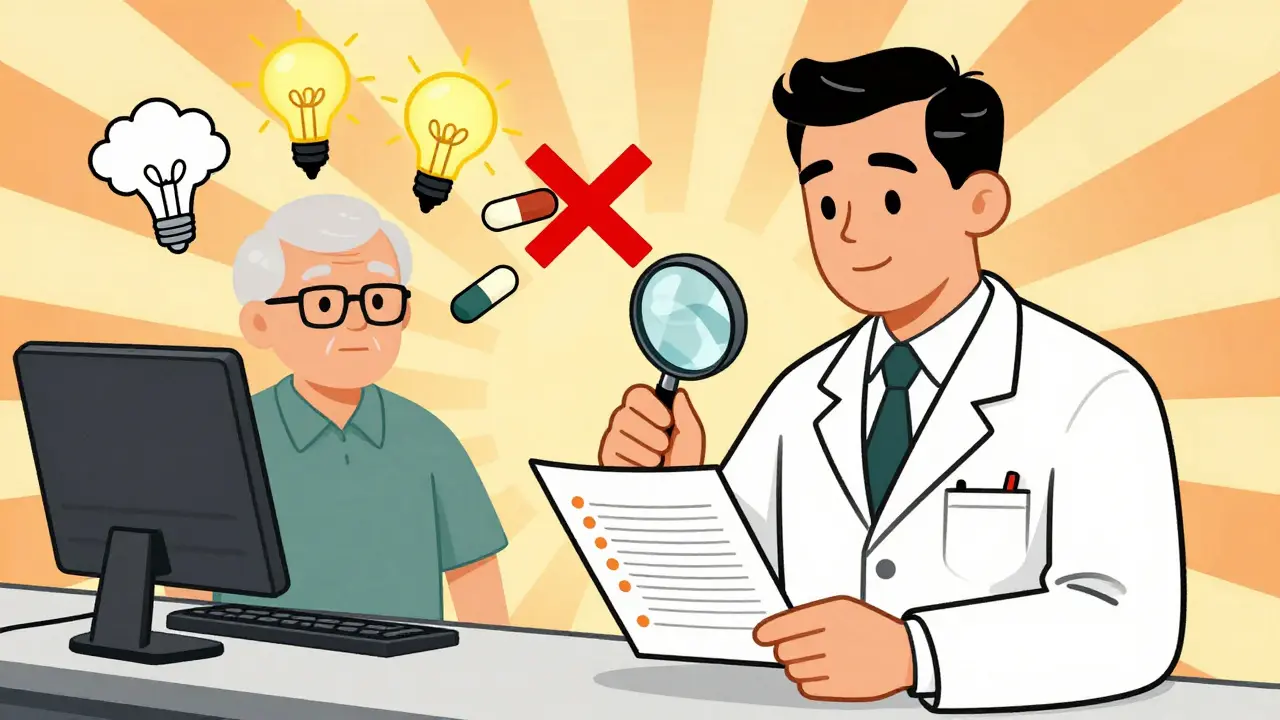
Doctors don’t always know which drugs are risky for seniors. That’s why the Beers Criteria a list of medications generally unsafe for adults 65+ due to high risk of cognitive side effects exists. Updated in 2019, it flags 30+ drugs that should be avoided or used with extreme caution.
For example:
- First-generation antihistamines (Benadryl, Dramamine)
- Bladder medications like tolterodine
- Older antidepressants (amitriptyline, nortriptyline)
- Antipsychotics not approved for dementia (quetiapine, risperidone)
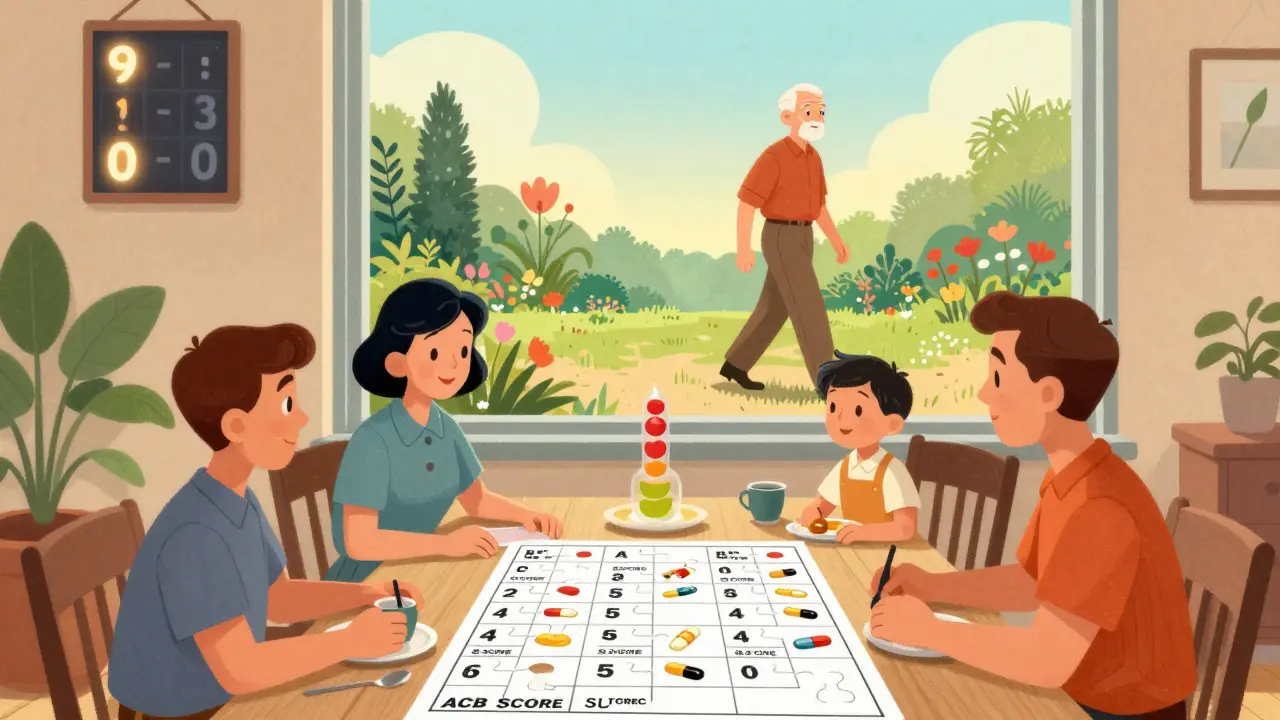
But it’s not just about one drug. It’s about the Anticholinergic Cognitive Burden (ACB) scale a scoring system that adds up the risk from multiple medications. Each drug gets a score: 1 for mild, 2 for moderate, 3 for high. A total score of 3 or more over time raises dementia risk by 49%.
Imagine someone taking:
- Benadryl (score 3)
- Oxybutynin (score 3)
- Amitriptyline (score 3)
That’s a total of 9 - a dangerously high score. And this isn’t rare. Studies show over 35% of seniors on four or more medications have an ACB score of 3 or higher.
Other Dangerous Medications Beyond Anticholinergics
Anticholinergics get the most attention, but they’re not the only offenders.
- Benzodiazepines (Xanax, Ativan, Valium): These sedatives cause short-term memory loss in 65% of seniors. Long-term use may increase dementia risk - though short-term use for anxiety or insomnia is still safe when monitored.
- Corticosteroids (prednisone): Can trigger mood swings, confusion, or even hallucinations. Often prescribed for arthritis or asthma, but rarely reviewed for cognitive impact.
- Opioids (oxycodone, hydrocodone): Even short-term use can cause memory lapses in 57% of older adults. The brain’s opioid receptors change with age, making seniors far more sensitive.
A 2023 study from West Hartford Health found that 42% of seniors on long-term steroids had noticeable mood changes, and 18% experienced psychotic episodes. These are often mislabeled as "late-life depression" or "personality changes," when they’re purely drug-induced.
What You Can Do: The 5-Step Plan
You don’t need to be a doctor to protect a loved one. Here’s what works:
- Make a full medication list - Include every pill, patch, cream, and OTC drug. Don’t forget herbal supplements. Bring it to every appointment.
- Ask about the Beers Criteria - "Is this drug on the list for seniors?" If the doctor says yes, ask why it’s still being prescribed.
- Check the ACB score - Ask the pharmacist to calculate it. Many pharmacies now have tools built into their systems.
- Watch for symptom timing - Did confusion start after a new prescription? Did it get worse after a dose increase? Write it down.
- Request a deprescribing plan - Don’t stop meds cold. Ask for a 4-12 week taper plan. Symptoms often improve within weeks.
One study showed that 35-45% of people diagnosed with dementia actually had medication-induced cognitive decline. And in over 80% of those cases, symptoms reversed after careful medication review.
Why This Is Still Overlooked
Even with all the evidence, doctors still miss it. Why? Because aging is assumed to be the culprit. A Medical University of South Carolina study found physicians attribute anticholinergic symptoms to aging or dementia in 10-20% of cases - even when the drug history is clear.
Also, many seniors take medications prescribed by different specialists - a cardiologist, a rheumatologist, a neurologist - each unaware of the others’ prescriptions. That’s polypharmacy. And it’s dangerous. Over half of seniors take four or more drugs. One in three takes five or more.
The good news? Medicare now requires a medication review during the Annual Wellness Visit. That’s 32.5 million seniors getting a chance to catch these issues early. But only 38% of primary care doctors actually do comprehensive reviews. You have to push for it.
What’s Changing in 2025 and Beyond
Things are improving - slowly. The FDA now requires stronger warnings on 17 high-risk drug classes. In 2024, they announced a plan to require cognitive side effect monitoring for 12 of them by Q3 2025.
Researchers are testing a blood test to measure acetylcholine levels - early results show 89% accuracy in spotting medication-induced cognitive decline. AI tools are being trained to scan electronic health records and flag risky combinations. Pilot programs are already predicting risk with 85% accuracy.
And the future? Pharmacogenomics. Some seniors metabolize drugs differently because of their genes. Testing for CYP2D6 and CYP2C19 variants can show who’s at higher risk - and guide safer prescribing.
This isn’t science fiction. It’s happening now. But right now, the best tool you have is awareness. And a printed list of medications.
Can stopping a medication really reverse dementia-like symptoms?
Yes - and often dramatically. Studies show that 30-40% of seniors diagnosed with dementia actually have medication-induced cognitive impairment. When anticholinergic drugs or other problematic medications are carefully tapered off, symptoms like memory loss, confusion, and disorientation often improve within weeks. In some cases, cognitive function returns to near-normal levels. The key is catching it early and avoiding abrupt stops - always work with a doctor to create a safe tapering plan.
Are over-the-counter drugs like Benadryl really dangerous for seniors?
Absolutely. Benadryl (diphenhydramine) is one of the top offenders. It’s an anticholinergic drug with a high score on the ACB scale (3 out of 3). Even one dose per day for a year can increase dementia risk. Seniors are especially vulnerable because their brains absorb more of the drug, and their bodies clear it slower. It’s often used for sleep or allergies, but safer alternatives exist - like non-drowsy antihistamines (loratadine) or melatonin for sleep.
How do I know if my parent’s new confusion is from medication or aging?
Look at timing. If confusion started within 14 days of a new medication or dose change, it’s likely drug-related. Also check for other signs: dry mouth, constipation, blurry vision, dizziness, or trouble urinating. True aging-related decline happens slowly over years, not suddenly. Keep a symptom journal - note when things get worse or better. Bring it to the pharmacist or geriatrician. They can compare it to the Beers Criteria and ACB score.
Is polypharmacy really that big of a risk?
Yes. Taking four or more medications doubles the risk of harmful side effects. In seniors, it’s even worse. Over 55% of older adults take five or more prescriptions. Each extra drug increases the chance of dangerous interactions and side effects that mimic aging. A 2021 study found that polypharmacy was present in 35% of seniors with medication-induced dementia. The solution isn’t necessarily fewer drugs - it’s smarter drugs. A pharmacist can help identify which ones are truly necessary and which can be safely stopped.
Can I ask my doctor to stop a medication even if it was prescribed by a specialist?
Yes - and you should. Your primary care doctor is your best ally in coordinating care. Specialists often focus on one condition, but your primary doctor sees the whole picture. If you suspect a medication is causing confusion or other aging-like symptoms, ask your primary doctor to review all prescriptions. They can contact specialists to discuss deprescribing. Many hospitals now have geriatric pharmacy teams that help with this. Don’t assume a specialist’s prescription is untouchable - safety comes first.
Recognizing medication side effects that mimic aging isn’t about fear. It’s about reclaiming clarity. Many seniors live with symptoms they think are inevitable - when in fact, those symptoms are reversible. A simple medication review, done right, can turn confusion into calm, forgetfulness into focus, and isolation back into connection. The power isn’t in a new drug. It’s in knowing which ones to stop.
Mark Harris
February 7, 2026 AT 17:30My grandma went from forgetting her own phone number to remembering every detail of her childhood after they pulled her off Benadryl and oxybutynin. Took three weeks. She cried when she recognized my face again. This isn’t theory-it’s real life.
Sarah B
February 9, 2026 AT 04:48Stop giving seniors antihistamines for sleep. It’s lazy medicine.
Heather Burrows
February 11, 2026 AT 01:33I’ve seen this happen three times in my family. Each time, the doctor said it was just aging. I kept pushing. The fourth time, I printed the Beers Criteria and handed it to the geriatrician. She looked at me like I’d shown up with a PhD in pharmacology. Turned out my uncle was on five drugs that should’ve been banned for seniors. He’s back to playing chess. Not perfect, but not lost anymore.
It’s not that doctors are bad. They’re just drowning in 15-minute visits and 300-patient panels. You have to be the squeaky wheel. The system doesn’t care unless you scream.
And don’t even get me started on how pharmacies still let people buy 50 Benadryl tablets like candy. That’s not healthcare. That’s negligence dressed up as convenience.
Paula Sa
February 12, 2026 AT 05:03This is one of those posts that makes you feel both furious and hopeful. Furious because we’ve known this for decades. Hopeful because people are finally talking about it.
I work with seniors in home care. I’ve seen so many who were labeled "demented"-only to have their minds clear up after a med review. One woman stopped taking amitriptyline and started remembering her wedding day again. She hadn’t spoken about it in 12 years.
The real tragedy isn’t the drugs. It’s that we’ve normalized cognitive decline as inevitable. We treat it like gray hair or wrinkles. But this? This is preventable. And it’s not even hard to fix. Just ask the right questions.
And yes-melatonin beats Benadryl. Always.
Mary Carroll Allen
February 12, 2026 AT 14:27OMG I JUST REALIZED MY MOM IS ON THREE OF THESE THINGS AND SHE’S BEEN "FORGETTING THINGS" SINCE LAST FALL
She’s been taking Benadryl for sleep, oxybutynin for bladder, and amitriptyline for nerve pain. I didn’t even know they were connected. I’m calling her pharmacist tomorrow. I’m so mad at myself for not asking sooner.
Also-why is this not on every Medicare form? Why isn’t this taught in every doctor’s office? I feel like I’ve been gaslit by the medical system.
Mayank Dobhal
February 12, 2026 AT 16:43India has the same problem. Elders on 7-8 meds. No one checks. No one cares. Pharmacies sell everything. Doctors don’t even know what’s in the bottle.
My aunt took anticholinergics for 8 years. Diagnosed with dementia. Then we found out she was on chlorpromazine + diphenhydramine + tolterodine. Score of 9. We stopped it. She remembered her son’s name after 4 weeks.
Why does the West get to have this conversation? We’re dying silently here.
Tola Adedipe
February 13, 2026 AT 17:07As a pharmacist in Toronto, I see this daily. Patients come in with 12 prescriptions. No one’s talking to each other. I had a 72-year-old man on 4 anticholinergics. His wife didn’t even know what they were for. We tapered him off over 8 weeks. He started reading the newspaper again. Said he felt "like himself for the first time in years."
Pharmacists are the unsung heroes here. We’re the ones catching the overlaps. But we need more authority. More time. More recognition.
And yes-Seroquel for agitation? Don’t do it. There are non-drug options. Always.
Marcus Jackson
February 13, 2026 AT 21:11You’re all missing the real issue. It’s not the meds. It’s the fact that we medicate aging instead of accepting it. We want a pill for everything. We don’t want to sit with our parents when they’re confused. So we give them a drug to make them quiet.
Benadryl isn’t evil. It’s a symptom of our culture’s fear of decline. We’d rather chemically dull someone than learn how to care for them.
Stop blaming the drugs. Start blaming the system that makes us think this is normal.
Eric Knobelspiesse
February 14, 2026 AT 01:55So… if I stop my grandma’s meds and she gets better, does that mean she didn’t have dementia? Or was she just temporarily demented? I’m confused. Like, philosophically.
Also, my uncle took Seroquel for 3 years. Now he’s fine. But the docs still say "it was early Alzheimer’s." I think they’re just too proud to admit they messed up.
Natasha Bhala
February 14, 2026 AT 05:14My mom’s on one of these. We’re tapering. She’s been calmer. More present. I didn’t know this was possible. Thank you for writing this. I’m sharing it with everyone.
Gouris Patnaik
February 15, 2026 AT 10:28Western medicine is a scam. We poison people then call it care. India doesn’t do this. We respect elders. We don’t drug them into silence.
But now even India is copying your broken system. Shame.