
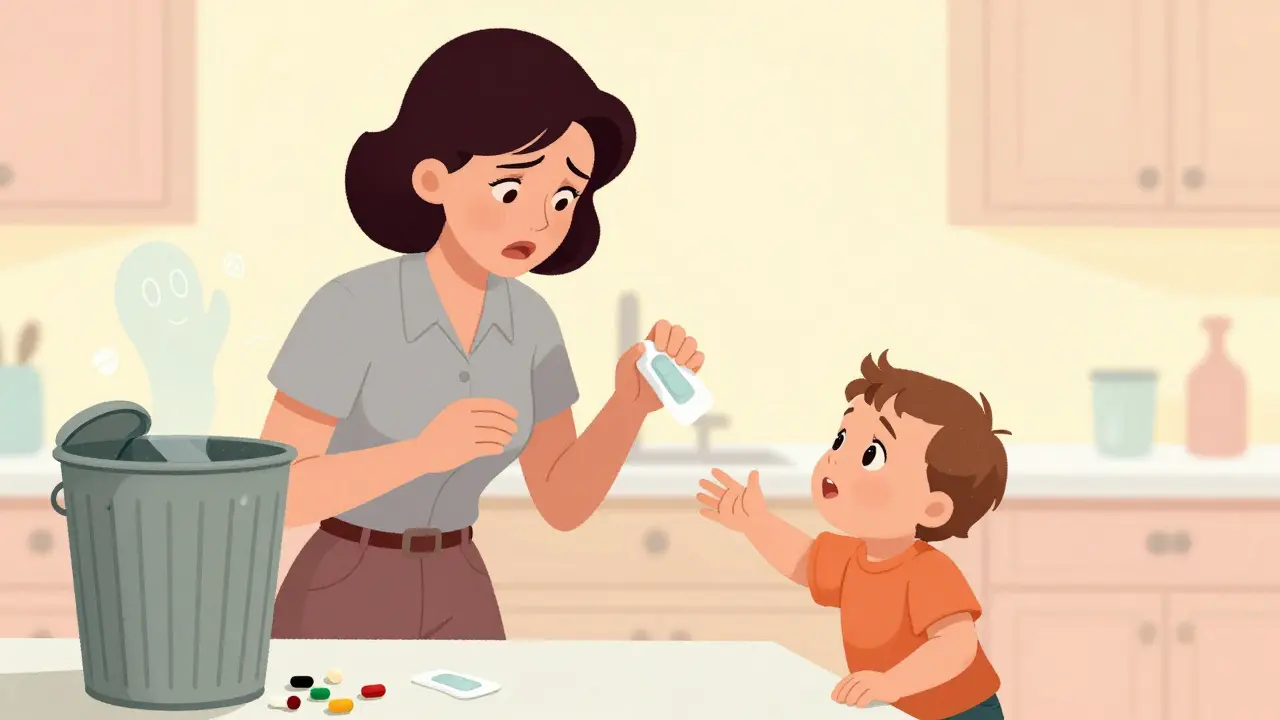
Every year, thousands of accidental poisonings and overdoses happen because someone found old pills in a kitchen drawer, a child’s backpack, or worse - the trash. If you’ve ever tossed expired painkillers, unused ADHD meds, or leftover anxiety pills into the garbage, you might be putting your family, neighbors, or even strangers at risk. The FDA flush list exists for one reason: to stop preventable deaths. Some medications are so dangerous that throwing them in the trash isn’t just irresponsible - it’s deadly.
Why Some Medications Can’t Go in the Trash
Most medicines can be safely disposed of by mixing them with coffee grounds or kitty litter, sealing them in a plastic bag, and tossing them in the trash. But that rule doesn’t apply to everything. Certain drugs are so potent, so easily misused, that even one pill or one patch can kill. These are the medications on the FDA’s official flush list - the only ones you’re supposed to flush down the toilet.Why flush? Because trash is not secure. Someone - a curious child, a teen experimenting, someone struggling with addiction - can dig through your garbage and find those pills. In 2022, the American Association of Poison Control Centers reported over 8,900 cases of fentanyl exposure, nearly half involving children under five. That’s not a statistic. That’s a child who found a patch in the trash and ended up in the ER.
Fentanyl is 50 to 100 times stronger than morphine. A single patch, if not destroyed, can be lethal. The same goes for oxymorphone, methadone, and buprenorphine. These aren’t just strong painkillers. They’re drugs that people actively hunt for. The Substance Abuse and Mental Health Services Administration found that over half of people who misuse prescription painkillers get them from friends or family - often by rummaging through their trash.
The FDA Flush List: Exact Medications to Flush Immediately
The FDA doesn’t make this list lightly. It’s updated based on real-world harm. Here are the exact medications you must flush, not trash:- Buprenorphine - brands: BELBUCA, BUAVAIL, BUTRANS, SUBOXONE, SUBUTEX, ZUBSOLV
- Fentanyl - brands: ABSTRAL, ACTIQ, DURAGESIC, FENTORA, ONSOLIS
- Hydromorphone - brand: EXALGO
- Meperidine - brand: DEMEROL
- Methadone - brands: DOLOPHINE, METHADOSE
- Morphine - brands: ARYMO ER, AVINZA, EMBEDA, KADIAN, MORPHABOND ER, MS CONTIN, ORAMORPH SR
- Oxymorphone - brands: OPANA, OPANA ER
- Tapentadol - brands: NUCYNTA, NUCYNTA ER
- Sodium oxybate - brands: XYREM, XYWAV
- Diazepam rectal gel - brands: DIASTAT, DIASTAT ACUDIAL
- Methylphenidate transdermal system - brand: DAYTRANA
If your medication has any of these active ingredients, flush it as soon as you no longer need it. No waiting. No mixing with coffee grounds. Just flush. The FDA says this is the only way to ensure it’s gone for good.
What to Do With Everything Else
If your medicine isn’t on the flush list, don’t flush it. Flushing non-listed drugs contributes to water pollution. Instead, follow these steps:- Take pills out of their original bottles.
- Don’t crush tablets or capsules - it can make them dangerous to handle.
- Mix them with something unappealing: used coffee grounds, cat litter, dirt, or even spoiled food.
- Put the mixture in a sealed plastic bag or container.
- Throw it in your household trash.
This makes the medicine unattractive and hard to recover. It doesn’t solve the environmental issue, but it stops someone from digging through your trash and finding a full bottle of antibiotics or cholesterol pills.
Why Flushing Doesn’t Ruin the Environment (Much)
You’ve probably heard that flushing meds pollutes rivers and drinking water. That’s true - but it’s not the whole story.Wastewater plants remove only 30% to 90% of pharmaceuticals. Some, like carbamazepine, barely get filtered at all. But here’s the trade-off: the EPA and FDA agree that for the medications on the flush list, the risk of death from accidental exposure is far greater than the environmental risk.
Dr. John Scott from the EPA testified in 2022 that the environmental impact of flushing one fentanyl patch is negligible compared to the risk of multiple overdoses if that patch ends up in a child’s hands. The same logic applies to methadone or oxymorphone. One patch, one pill, one dose - and someone dies. That’s the priority.
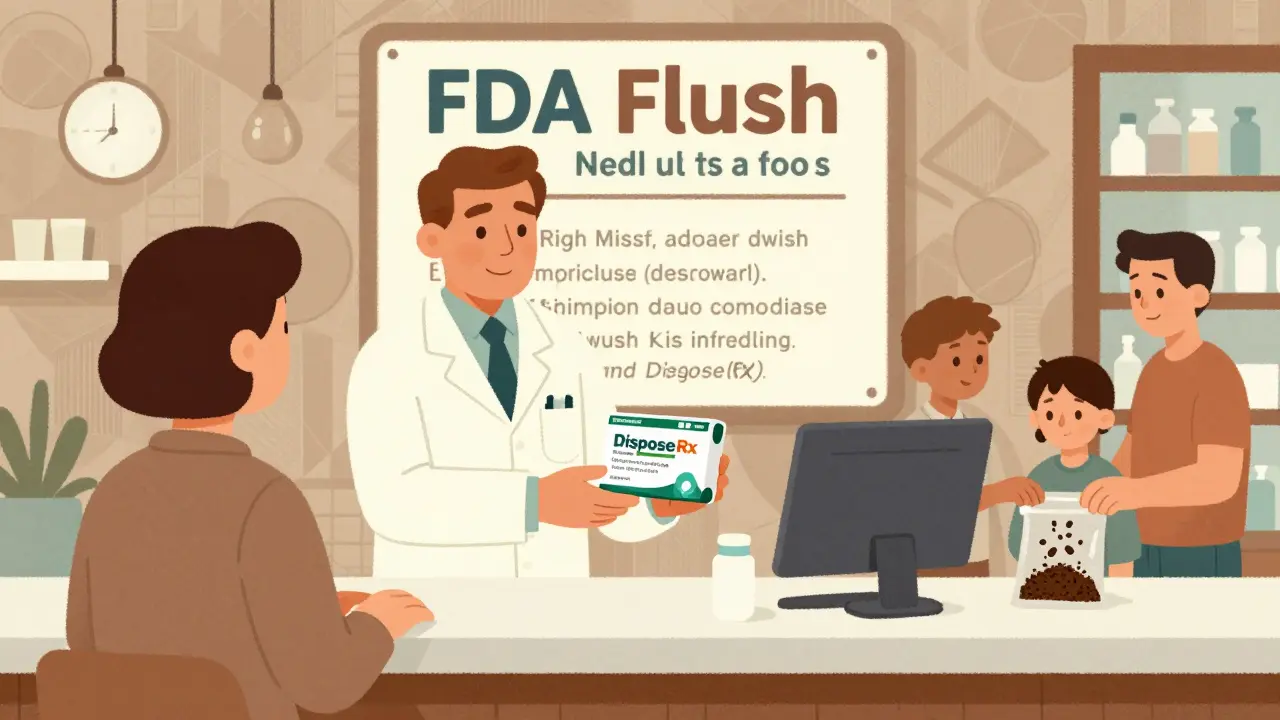
Environmental scientists aren’t ignoring the problem. They’re pushing for better solutions - like special disposal powders that break down drugs in water. Companies like DisposeRx sell single-use packets for $1.50 that turn pills into a gel you can safely throw away. Over 1,200 pharmacies now offer them. But until those become standard, flushing remains the safest option for the most dangerous drugs.
What You Can Do Right Now
You don’t need to wait for a government program or a new law. Here’s what to do today:- Check your medicine cabinet. Look for any of the drugs listed above.
- If you find them, flush them immediately. Don’t wait until you’re done with them - flush them the day you decide not to use them.
- For everything else, mix with coffee grounds and seal in a bag before trashing.
- Ask your pharmacist if your local pharmacy has a take-back bin. Walgreens and CVS have over 3,800 kiosks nationwide.
- Don’t rely on memory. Write down the names of any medications you’re flushing and keep that list with your medical records.
And if you’re unsure? Call your pharmacist. They’ve seen what happens when people guess wrong. They know which ones to flush and which ones to trash. Don’t risk it.
What Happens When People Ignore This
In 2021, a teenager in Montgomery County, Ohio, found a bottle of OPANA ER in a neighbor’s trash. He took one pill. He died. That case led to new local laws requiring special disposal for Schedule II drugs.On Reddit, a nurse posted about a 3-year-old who pulled a fentanyl patch from a trash bag and stuck it to his skin. He was hospitalized for days. His family didn’t know the patch was dangerous enough to flush.
These aren’t rare. They’re predictable. And they’re preventable.
Over 91,000 people died from drug overdoses in 2020. Many started with a pill they found in someone’s trash. You can’t stop every addiction. But you can stop one child from finding a lethal dose in your garbage.
Where to Find Help
If you’re struggling with unused medications - or if you’re worried about someone else’s access to them - here’s where to turn:- Pharmacies: Over 49 states have medication take-back programs. Walgreens and CVS have kiosks in most locations.
- Local law enforcement: Many police stations have drop boxes for unused prescriptions.
- Medication disposal kits: Ask your pharmacist about DisposeRx or similar products.
- DEA National Take Back Day: Held twice a year. Check the DEA website for dates.
Don’t wait for a tragedy to make you act. The safest choice is the one you make before someone gets hurt.
Can I flush any old medication down the toilet?
No. Only medications on the FDA’s flush list should be flushed. Flushing other drugs contributes to water pollution. For everything else, mix them with coffee grounds or kitty litter, seal them in a plastic bag, and throw them in the trash.
What if I don’t have a toilet? Can I still flush?
If you don’t have access to a toilet - for example, you live in a mobile home or RV - contact your local pharmacy or law enforcement. They may have a take-back program or disposal kit. Never bury or burn medications. Always seek an official disposal method.
Are generic versions of these drugs also on the flush list?
Yes. The flush list is based on the active ingredient, not the brand name. If your generic pill contains buprenorphine, fentanyl, oxymorphone, or any other listed substance, flush it. Check the label for the active ingredient - that’s what matters.
Why can’t I just crush the pills and throw them away?
Crushing pills is dangerous and ineffective for the drugs on the flush list. Fentanyl patches, for example, release their full dose slowly - crushing them can cause immediate overdose. Even for other drugs, crushing doesn’t make them safe. The FDA specifically advises against crushing tablets or capsules during disposal. Flushing is the only reliable method for high-risk medications.
Is it safe for the environment to flush these drugs?
It’s a trade-off. Flushing does add trace amounts of drugs to water systems, but the risk of death from accidental exposure is far greater. The FDA, EPA, and CDC all agree: for these specific medications, the immediate public safety benefit outweighs environmental concerns. That’s why they’re on the flush list.
What if I’m worried someone will find my trash?
Then flush the dangerous ones. For everything else, mix them with coffee grounds or dirt, seal them in a bag, and put them in an outdoor trash bin - not next to your front door. Consider using a take-back program if you’re concerned about privacy or safety.
Do I need to remove labels from pill bottles before disposal?
Yes. Remove or scratch out your name, prescription number, and dosage. This protects your privacy. You can recycle the empty bottle if your local program accepts it, but only after removing all personal info.
Can I donate unused medications?
No. In the U.S., it’s illegal to donate prescription medications, even if they’re unopened. They must be disposed of properly. Some states have medication donation programs, but they’re rare and tightly regulated. Always check with your pharmacist before attempting to donate.
steve ker
January 12, 2026 AT 12:43George Bridges
January 14, 2026 AT 05:20Faith Wright
January 15, 2026 AT 09:06Rebekah Cobbson
January 16, 2026 AT 05:33Audu ikhlas
January 18, 2026 AT 04:47Sonal Guha
January 18, 2026 AT 18:23TiM Vince
January 18, 2026 AT 22:58gary ysturiz
January 20, 2026 AT 10:06Jessica Bnouzalim
January 20, 2026 AT 17:54laura manning
January 20, 2026 AT 21:29