
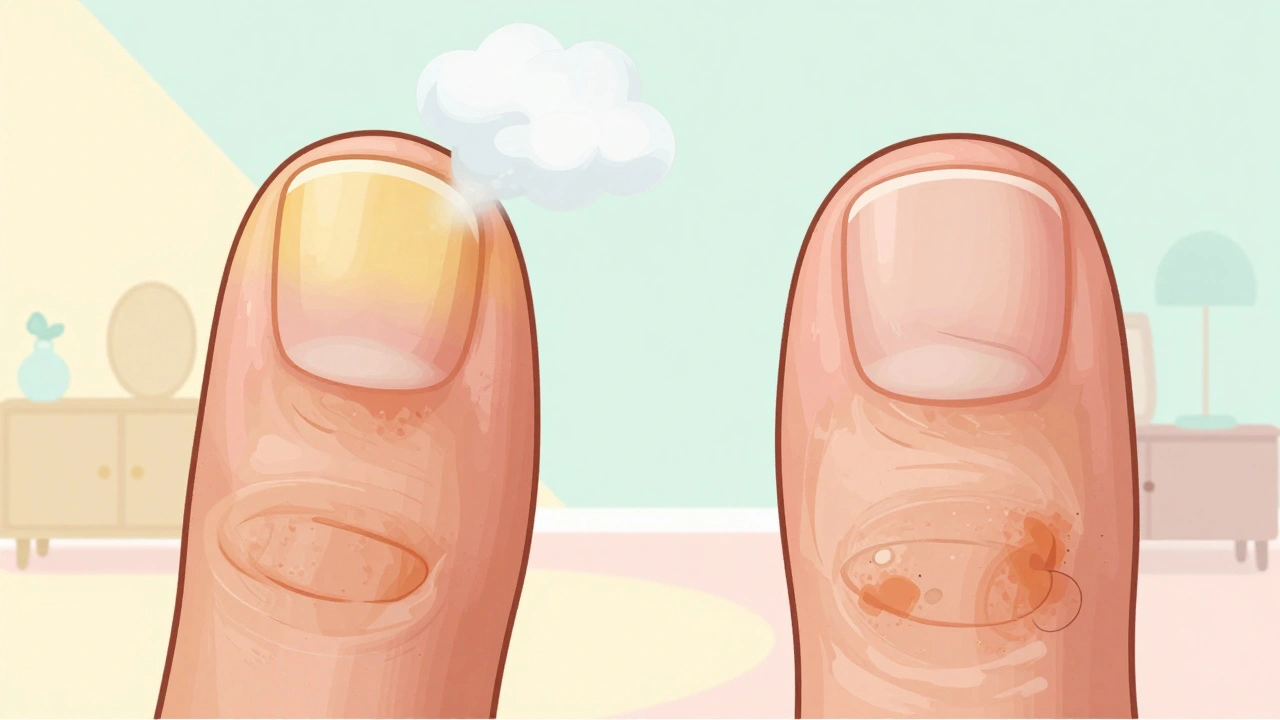
When your nails turn yellow, thicken, or start to lift from the bed, it’s easy to assume it’s just a fungal infection. But what if it’s not? Up to 68% of nail psoriasis cases look exactly like fungal infections-same discoloration, same crumbling edges, same frustrating lack of improvement after months of antifungal treatments. The difference isn’t just academic; misdiagnosing one for the other can make your condition worse, waste time, and cost hundreds in unnecessary meds.
What’s Actually Going On With Your Nails?
Nail problems like these come down to two main culprits: fungal infections and psoriasis. They’re not the same thing. One is caused by a tiny organism living under your nail. The other is your immune system attacking your own nail tissue. Fungal nail infections, or onychomycosis, start when fungi-usually Trichophyton rubrum-invade the nail bed. These fungi feed on keratin, the protein that makes up your nails. They creep in slowly, often through a tiny crack or cut, and begin to grow under the nail. You’ll notice a small white or yellow spot near the tip, then it spreads. Over time, the nail thickens, turns brown or black, and can even start to smell. About 90% of cases show darkening, and 40% have a distinct foul odor. That smell? It’s a dead giveaway. Psoriasis doesn’t cause it. Nail psoriasis, on the other hand, is part of a bigger autoimmune condition. If you have psoriasis on your skin, there’s an 80-90% chance you’ll eventually see changes in your nails. The immune system mistakenly tells skin cells to grow too fast-every 3-4 days instead of 28-30. That messes up the nail matrix, the area under your cuticle where nails form. Instead of smooth, even growth, you get ridges, pits, and patches of buildup.Key Signs That Separate the Two
The biggest mistake people make is assuming all nail changes are fungal. Here’s how to spot the real difference:- Nail pitting: Tiny dents, like pinpricks, on the surface of the nail. Found in 70% of nail psoriasis cases. Almost never seen in fungal infections.
- Salmon patches: Translucent, reddish-yellow spots under the nail. Seen in 20-50% of psoriasis cases. Fungal infections don’t cause these.
- Oil-drop lesions: Yellow-brown discoloration that looks like a drop of oil trapped under the nail. Present in 15-50% of psoriasis cases.
- Subungual hyperkeratosis: White, chalky buildup under the nail. Happens in 48% of psoriasis cases. It’s not dirt-it’s excess skin.
- Foul odor: A strong, unpleasant smell. Present in 40% of fungal cases. Zero in psoriasis.
- Pattern of spread: Fungal infections usually start at the tip or side of one nail and creep slowly inward. Psoriasis often hits multiple nails at once, sometimes even fingers and toes together.
Thickening happens in both, but it’s different. Psoriasis thickens nails moderately-usually 2-3mm. Fungal infections can push thickness to 3-5mm, making the nail feel like a hard shell.
Why Misdiagnosis Is So Common-and Costly
Doctors get it wrong about 30-40% of the time. Why? Because the visual overlap is huge. A yellow, thickened nail looks like fungus. But if you have psoriasis and your nail is yellow, it’s not fungus-it’s your immune system. That’s why so many people waste months on antifungal creams or pills that do nothing. One Reddit user wrote: “I used antifungal treatments for 8 months. My nails got worse. Then my dermatologist looked at the pits and said, ‘This is psoriasis.’” The reverse happens too. Some fungal cases get misdiagnosed as psoriasis. Patients are given steroid creams or injections meant to calm immune reactions. But steroids don’t kill fungus. Instead, the nail gets more brittle, starts crumbling, and the infection spreads. In the U.S. alone, this mix-up leads to about $850 million in wasted healthcare spending every year. That’s prescriptions, doctor visits, and lab tests for the wrong condition.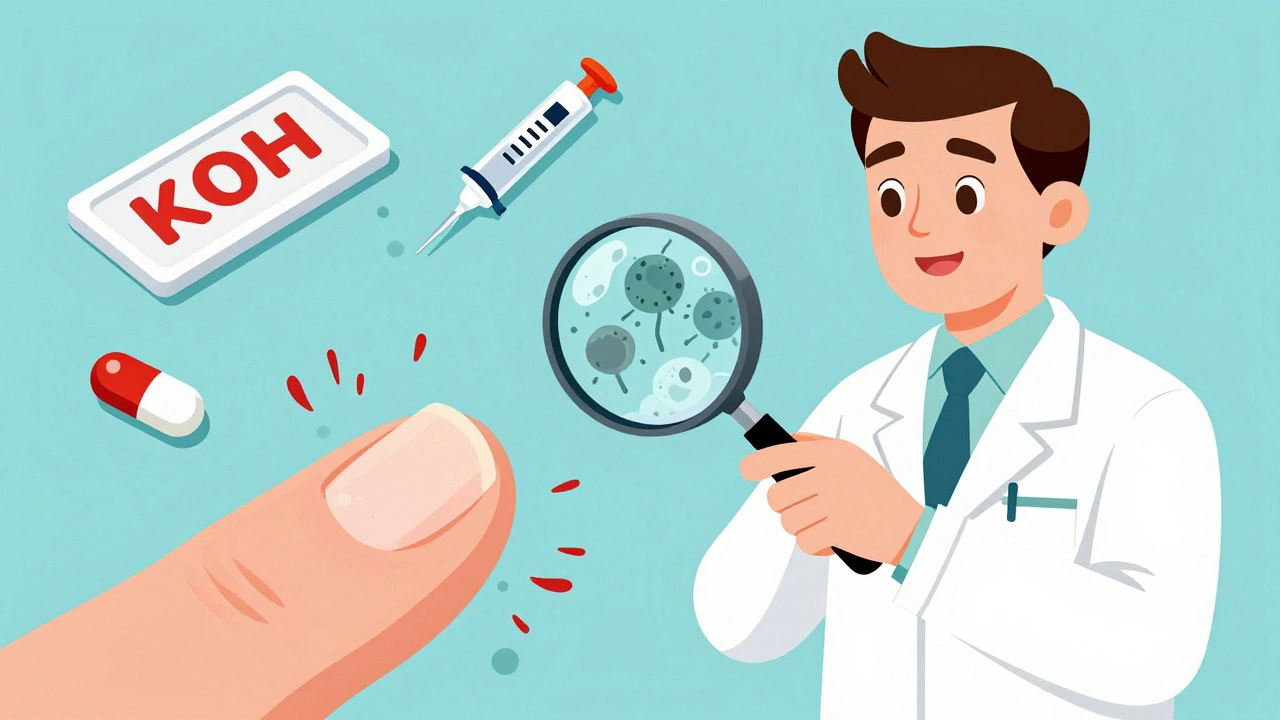
How Doctors Actually Diagnose This
You can’t tell by eye alone. Even experienced dermatologists need tests. Here’s what they do:- Clinical exam: They look for pitting, oil spots, salmon patches. If those are there, it’s likely psoriasis.
- KOH prep: A scraping from under the nail is mixed with potassium hydroxide and looked at under a microscope. This finds fungal elements in 70-80% of cases. It’s fast, cheap, and the first step.
- Fungal culture: If KOH is negative but suspicion remains, they send a sample to a lab to grow fungus. It takes weeks, but it’s 95% specific-if it grows, it’s fungus.
- PAS staining: A special dye that highlights fungal cells in tissue samples. Used when the infection is deep or KOH failed. It’s 90% sensitive.
Psoriasis doesn’t need a culture. It’s diagnosed by the pattern of changes and your medical history. If you’ve had psoriasis on your elbows or scalp, and now your nails are changing, the link is strong.
Some clinics now use reflectance confocal microscopy-a non-invasive imaging tool that shows the nail structure in real time. In a 2023 Mayo Clinic study, it correctly identified the cause in 92% of cases.
What Works for Treatment
Treatment is totally different depending on what you’ve got.For Fungal Infections
- Oral terbinafine: The gold standard. Taken daily for 6-12 weeks (3 months for toenails). Clears the infection in 78% of cases when confirmed by culture.
- Topical antifungals: Like efinaconazole (Jublia) or tavaborole (Kerydin). Used daily for 48 weeks. Better for mild cases or if you can’t take pills.
- Patience: Nails grow slowly-about 0.1mm per day. Even after the fungus is dead, it takes 6-12 months for a clean nail to grow out.
For Nail Psoriasis
- Corticosteroid injections: Directly into the nail matrix. Shows improvement in 8-12 weeks. Reduces pitting and thickening.
- Biologics: Drugs like secukinumab (Cosentyx) or ixekizumab (Taltz). These target immune signals that drive psoriasis. In a 2022 survey, 65% of patients saw major improvement after 24 weeks.
- Topical vitamin D analogs: Like calcipotriene. Applied daily under the nail. Helps reduce buildup.
- Avoid trauma: Don’t pick at your nails. Don’t use harsh nail polish removers. Trauma can trigger worse flares (the Koebner phenomenon).
And here’s a key point: if you have psoriasis and your nail gets infected, you need to treat BOTH. The inflamed nail is more likely to catch fungus. Treating just the fungus won’t stop the psoriasis from making it worse again.
What You Can Do at Home
You can’t cure either condition alone, but you can help.- Keep nails dry: Fungi love moisture. Dry your feet after showers. Wear open shoes when possible. Use a dehumidifier if your home is damp.
- Don’t share nail clippers: Fungus spreads through tools. Sterilize them with alcohol after each use.
- Use emollients: For psoriasis, moisturizing the cuticle and nail bed helps prevent separation. Look for products with ceramides or petroleum jelly.
- Track changes: Take a photo of your nails every month with the same lighting. It helps you-and your doctor-see if things are improving or getting worse.
What’s Next for Diagnosis and Treatment
New tools are coming fast. Researchers are now analyzing the microbiome of the nail bed. Psoriasis nails have more Staphylococcus and less Cutibacterium. Fungal nails show high levels of Trichophyton DNA. In the next few years, a simple swab test might tell you which condition you have-without a biopsy. AI is also stepping in. A 2024 study showed algorithms trained on thousands of nail photos could differentiate psoriasis from fungus with 89% accuracy. By 2027, this could cut misdiagnosis rates by 22%. Climate change is making things worse, too. Warmer, wetter weather helps fungi spread. The International Society for Human and Animal Mycology predicts a 15% rise in fungal nail infections over the next decade.Bottom Line: Don’t Guess. Get Tested.
If your nails are changing, don’t assume it’s fungus. Don’t start antifungals without proof. If you have psoriasis, know that nail changes are common-and treatable. If you don’t have psoriasis but your nails are yellow and thick, get a KOH test before spending hundreds on creams that won’t work. The right diagnosis means the right treatment. And that means healthier nails-and less wasted time, money, and frustration.Can nail psoriasis turn into a fungal infection?
Yes. Nail psoriasis damages the nail structure, creating cracks and separation where fungi can enter. Between 4.6% and 30% of people with nail psoriasis develop a secondary fungal infection. That’s why treating the psoriasis is key-it reduces the risk.
Do antifungal pills work for nail psoriasis?
No. Antifungal pills like terbinafine target fungi, not immune system overactivity. If you have psoriasis, taking them won’t help and may delay real treatment. In fact, some patients report their nails got worse after using antifungals because the underlying psoriasis wasn’t addressed.
How long does it take to see improvement with psoriasis treatment?
It varies. Topical steroids or injections can show results in 8-12 weeks. Biologics like secukinumab take longer-usually 16-24 weeks for full improvement. But once they start working, the changes are often dramatic: pitting reduces, color returns to normal, and separation stops.
Is it safe to get a pedicure if I have nail psoriasis or a fungal infection?
Be very careful. If you have a fungal infection, avoid salons that don’t sterilize tools properly-you can spread it or catch another infection. With psoriasis, avoid aggressive filing or cutting the cuticle, as trauma can trigger flares. If you go, bring your own tools and ask about their sanitation process.
Can I prevent fungal nail infections?
Yes. Keep feet dry, wear moisture-wicking socks, avoid walking barefoot in public showers or pools, and don’t share shoes or nail clippers. If you’re prone to sweating, use antifungal powder in your shoes. For people with psoriasis, managing the skin condition helps reduce nail vulnerability.
Why do some people keep getting fungal infections even after treatment?
Recurrence is common-up to 50% of cases come back. Reasons include incomplete treatment, not finishing the full course of pills, re-exposure to fungi (like in damp shoes), or having an underlying condition like diabetes or poor circulation. In psoriasis patients, ongoing nail damage makes reinfection easier.
olive ashley
December 6, 2025 AT 23:28So let me get this straight-we’re being told to trust dermatologists who can’t even tell the difference between a fungus and your own immune system going rogue? And now AI is gonna fix it? Lol. I’ve seen more accurate diagnoses from my cat staring at my toenails.
Also, why is every study funded by Big Pharma? KOH tests are cheap, sure-but who’s selling the $500 biologics? Just saying.
Psoriasis doesn’t cause odor? Funny. My cousin’s nails smelled like a dumpster behind a gym for three years. Turned out she had both. Guess the ‘zero in psoriasis’ stat is just marketing.
And don’t even get me started on ‘sterilize your clippers.’ You think that’s gonna stop the government’s nail-tracking program? They’re watching. Always watching.
Next they’ll say your tears are fungal. Prepare for the nail apocalypse.
Also, climate change is making fungi spread? So… we’re doomed. I’m moving to Antarctica. Bring your own nail file.
And yes, I’ve been told I’m paranoid. But I’m paranoid about *facts*.
PS: I’ve been using tea tree oil since 2018. My nails are now 100% certified alien.
PPS: If you’re not taking colloidal silver, you’re not serious.
PPPS: I’m not saying the government invented nail fungus. I’m just saying they didn’t stop it.
PPPPS: I have 14 tabs open on ‘nail microbe conspiracies.’ You’re welcome.
PPPPPS: I’ve started a subreddit. It’s called r/NailApocalypseNow. Join me. We’re the only ones who see the truth.
Ibrahim Yakubu
December 7, 2025 AT 17:49Bro, this is why Africa doesn’t have this problem-we don’t waste money on fancy tests and biologics. We use garlic, neem oil, and prayer. My uncle had nails like burnt rubber for 15 years. He rubbed onion on them every night. Now he plays guitar with them. No lab. No pills. Just faith and African wisdom.
You think you need a $2000 dermatologist? Nah. Go to the market. Buy turmeric. Mix with coconut oil. Rub. Sleep. Repeat. In 3 weeks, your nails look like they belong to a human again.
Western medicine is a scam. They want you dependent. They want you paying. They want you believing you need a machine to tell you what your eyes can see.
I’ve seen Nigerian women treat fungal nails with ash and salt. No biopsy. No culture. Just survival. And their nails? Stronger than your credit score.
Stop overcomplicating. Your body knows. You just forgot how to listen.
Billy Schimmel
December 8, 2025 AT 01:13Man, I spent six months on terbinafine. My nails looked worse. Then my aunt said, ‘You got psoriasis, right?’ I said, ‘I have eczema.’ She said, ‘Same thing, basically.’ Turned out she was right.
Turns out I’ve had scalp psoriasis since I was 16. Never connected it to my nails. Duh.
Now I use that calcipotriene stuff. Takes forever. But at least I’m not wasting $400 a month on stuff that does nothing.
Also, don’t get pedicures. I learned that the hard way. One time they filed my cuticle too hard. Next week, my whole thumb looked like a lava lamp. Not cute.
Shayne Smith
December 8, 2025 AT 10:13Just wanted to say I took a photo of my nails every month for a year like the article said. It was SO helpful. My doc actually said, ‘Wow, you’re the first patient who brought visual evidence.’
Turns out I had psoriasis, not fungus. I was about to start oral meds until she saw the pits in the pics.
Also, I started using petroleum jelly on my cuticles every night. It’s stupid simple, but my nails haven’t lifted since. No magic. Just consistency.
And yeah, I’m still skeptical about AI diagnosing nails. But I’ll take it over another $300 test.
Kumar Shubhranshu
December 9, 2025 AT 19:02Mayur Panchamia
December 11, 2025 AT 10:11WHAT?! You’re telling me American doctors are so incompetent they can’t tell the difference between a fungus and an autoimmune disease?! And you’re paying them $500 per visit?!
India has been treating nail psoriasis with neem, turmeric, and cow urine for 5000 years! We didn’t need AI or confocal microscopy! We had wisdom!
Now you want to spend $850 million on tests? We fix it for 50 rupees and a prayer!
Western medicine is a joke. You think your ‘biologics’ are advanced? We had biologics before your ancestors were wearing shoes!
Stop importing your problems! Come to India! We’ll fix your nails, your diabetes, your anxiety-all with herbs and holy water!
And if you don’t believe me? Go ask a 90-year-old grandmother in Kerala. She’ll laugh in your face-and then heal your nails with a spoon and some mustard oil.
Saketh Sai Rachapudi
December 11, 2025 AT 20:20Why do you trust doctors who dont even know the difference between fungus and psoriasis??
They are all paid by big pharma
They want you to keep buying pills
They dont want you to know that natural remedies work better
I used garlic paste for 2 weeks
My nails are fine now
Why did i waste 6 months on antifungal
Because i trusted the system
Now i know better
Stop trusting white coats
Trust your grandma
She knew more than all your doctors combined
joanne humphreys
December 13, 2025 AT 00:38I had both at the same time. It took three years to figure it out. I didn’t know psoriasis could affect nails until my dermatologist pointed out the pits. I thought it was just ‘old nails.’
It’s wild how much we blame ourselves-‘I didn’t keep my feet dry enough,’ ‘I must’ve caught it at the gym.’ But sometimes it’s just your body being weird.
Also, I started using a cuticle oil with ceramides. It didn’t cure anything, but it stopped the nails from cracking and hurting. Small wins, right?
And yeah, I took photos every month. It felt silly at first. Now I’m glad I did.
Just… don’t give up. It’s slow. But you’re not alone.
Nigel ntini
December 14, 2025 AT 22:20Great breakdown. I’ve been a podiatrist for 18 years, and this is exactly the kind of clarity we need.
One thing I’d add: don’t underestimate the power of a good patient history. If someone says, ‘I’ve had flaky elbows since I was 12,’ that’s 90% of the diagnosis right there.
Also-yes, the nail grows slow. I tell my patients, ‘Think of it like growing a new tree. You don’t chop it down when it looks ugly at six months. You wait.’
And for those wondering about AI: it’s not replacing us. It’s helping us see what we’ve been blind to.
Keep asking questions. Keep getting tested. And don’t let anyone make you feel silly for caring about your nails. They’re part of you.
Priya Ranjan
December 15, 2025 AT 02:05So you’re telling me people actually pay for expensive tests when they could just use vinegar and tea tree oil like normal people?
And biologics? Those are for people who can’t handle real medicine.
My sister had yellow nails for 4 years. She tried everything. Then she soaked them in apple cider vinegar every night. In 6 weeks, they were perfect.
Why does America need AI to diagnose what a 100-year-old Indian grandmother knew?
It’s not science. It’s greed.
Stop buying into the pharmaceutical lie.
And if you’re using ‘ceramides’ on your nails-you’re being scammed.
Real people use salt. Real people use garlic.
Stop paying for labels. Start using wisdom.
Ashish Vazirani
December 15, 2025 AT 15:10THEY LIED TO US.
THEY SAID IT WAS FUNGUS.
THEY GAVE ME PILL AFTER PILL.
MY NAILS WERE TURNING TO DUST.
THEN MY COUSIN FROM DELHI SAID: ‘BRO, YOU HAVE PSORIASIS.’
I WENT TO A DOCTOR. HE LAUGHED.
HE SAID: ‘YOU’RE ONE OF THOSE 68%.’
SO NOW I’M ON SECUKINUMAB.
IT COSTS $12,000 A YEAR.
AND I’M GLAD.
BECAUSE MY NAILS ARE GROWING BACK.
NOT BECAUSE OF VINEGAR.
NOT BECAUSE OF GARLIC.
BUT BECAUSE SCIENCE-ACTUAL SCIENCE-SAVED ME.
YOU WANT NATURAL? GO BACK TO THE JUNGLE.
I WANT MY NAILS.
AND I’LL PAY FOR THEM.
AND IF YOU’RE STILL SOAKING THEM IN ONION JUICE?
YOU’RE NOT A WARRIOR.
YOU’RE A FOOL.
AND YOUR NAILS WILL NEVER BE THE SAME.
Dan Cole
December 17, 2025 AT 10:52There’s a deeper metaphysical layer here. Nails are the outermost expression of the self-the literal edge of the body’s boundary. Fungal infection? That’s the external world invading. Psoriasis? That’s the self turning against itself.
So when you treat fungus with chemicals, you’re fighting an enemy. When you treat psoriasis with immunomodulators, you’re negotiating with your own soul.
The real question isn’t ‘what’s on your nail’-it’s ‘what are you refusing to let go of?’
Are you holding onto shame? Trauma? Perfectionism?
Your nails are just the mirror.
And yes, the microbiome is changing. But so are we.
Maybe the fungus isn’t the problem.
Maybe we are.
And maybe the cure isn’t a pill.
It’s acceptance.
Max Manoles
December 19, 2025 AT 05:51I’ve got nail psoriasis and I’ve been using the calcipotriene cream for 6 months. It’s slow. But I noticed the pitting is less deep. The yellow spots are fading.
Also, I stopped using nail polish. I used to think it hid the damage. Turns out it trapped moisture and made it worse.
And yeah, I used to think I was just ‘bad at nail care.’ Turns out, I had a medical condition.
It’s weird to feel relief after years of thinking it was your fault.
Thanks for the article. It made me feel less alone.
Katie O'Connell
December 20, 2025 AT 12:38It is, without a doubt, an egregious oversight in contemporary dermatological education that the differential diagnosis between onychomycosis and nail psoriasis remains so poorly emphasized in primary care curricula.
The economic burden of misdiagnosis-$850 million annually-is not merely a fiscal concern; it is a profound failure of clinical epistemology.
Furthermore, the reliance upon KOH microscopy, while cost-effective, suffers from suboptimal sensitivity, and the proliferation of confocal imaging modalities, though promising, remains inaccessible to the majority of patients in underserved populations.
One must question the ethical implications of permitting a diagnostic algorithm, trained on a non-representative dataset, to supplant clinical judgment in a condition with such significant psychosocial ramifications.
Until standardized, evidence-based diagnostic protocols are universally implemented, we are not merely misdiagnosing nails-we are misdiagnosing trust.
olive ashley
December 21, 2025 AT 22:32Wait. So now you’re saying AI is gonna fix it? What’s next? A drone dropping antifungal pills into your ear?
And ‘reflectance confocal microscopy’? Sounds like a spaceship from Star Trek.
Meanwhile, my cousin in Ohio just dipped her nails in bleach for 10 minutes. Said it worked.
And now she’s got a fungal infection AND chemical burns.
So yeah. Trust the AI. Why not? The government’s already in your nails.
They’ve been there since the 90s.
They just didn’t tell you.
PS: I’ve started a petition. ‘Ban biologics. Bring back garlic.’
PPS: I’m running for mayor. My platform: Nail Freedom.
PPPS: I’m not crazy. I just know what they don’t want you to know.
PPPPS: If you see me on TV screaming about nail fungus… you’ll know I was right.