

NSAID Heart Failure Risk Estimator
Patient Profile & Medication
Enter details to see how NSAIDs impact heart failure risks.
You pop two ibuprofen pills for a stiff back or a nagging knee ache. It’s routine. But if you have heart failure, this common move can trigger a dangerous chain reaction within hours. Your body starts holding onto water like a sponge. Your ankles swell. You gain weight rapidly. And suddenly, you’re staring down the barrel of an emergency room visit.
This isn’t just theoretical caution; it is a documented medical reality that catches thousands of patients off guard every year. The connection between non-steroidal anti-inflammatory drugs (NSAIDs) and worsening heart function is direct, physiological, and often severe. Understanding exactly how these painkillers sabotage your heart’s ability to pump effectively is the first step in protecting yourself from avoidable hospitalization.
The Hidden Mechanism: How NSAIDs Trap Fluid
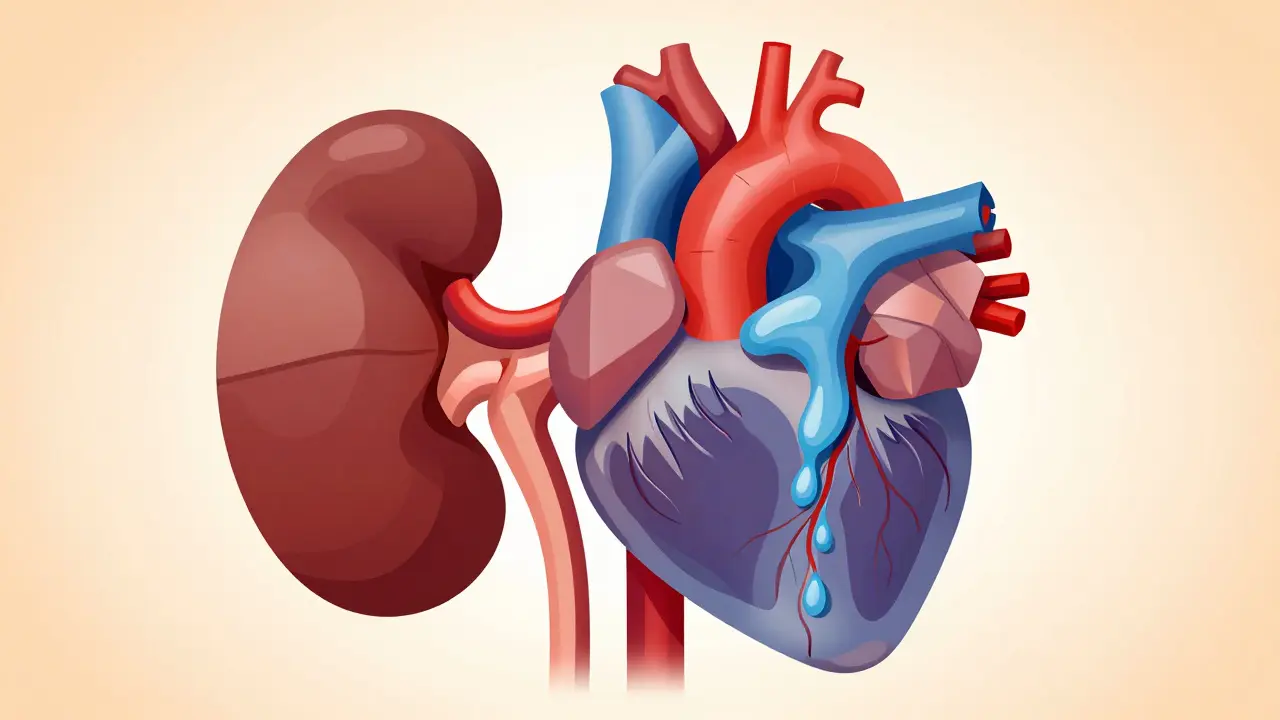
To understand why NSAIDs are risky, we need to look at what they actually do inside your body. These drugs work by blocking enzymes called cyclooxygenase (COX). Specifically, they inhibit COX-1 and COX-2. This stops the production of prostaglandins, which are chemicals that cause inflammation and pain. That’s the good part-it helps your headache go away.
But prostaglandins also play a vital role in your kidneys. They help keep blood vessels in the kidney open so blood can flow through freely. When NSAIDs block prostaglandin synthesis, those blood vessels constrict. Research by Bleumink et al., published in the journal *Drugs* in 2003, established that this leads to a measurable drop in renal blood flow-sometimes by 20% to 30% in susceptible patients.
When blood flow to the kidneys drops, the kidneys panic. They think your body is dehydrated because less blood is reaching them. In response, they start aggressively reabsorbing sodium and water. This is where the trouble begins. For a healthy person, this might mean slightly higher blood pressure. For someone with heart failure, whose heart is already struggling to pump blood efficiently, this extra fluid volume is a massive burden. It increases cardiac preload, forcing the weakened heart to work harder against a heavier load.
The Hospitalization Risk: Data Doesn't Lie
The consequences of this fluid retention are not subtle. A landmark study by Holt et al., published in the *European Heart Journal* in 2022, looked at a nationwide Danish cohort of patients with type 2 diabetes mellitus (T2DM), a group highly prone to both heart issues and pain conditions. Using a case-crossover design, they found that even short-term exposure to NSAIDs significantly spiked the risk of heart failure hospitalization.
| NSAID Type | Exposure Window | Odds Ratio (OR) |
|---|---|---|
| Celecoxib | First Week | 1.88 |
| Diclofenac | First Week | 1.75 |
| Ibuprofen | First Week | 1.65 |
| Naproxen | First Week | 1.24 |
An odds ratio of 1.88 means your risk nearly doubles during the first week of use. The study confirmed that this risk applies to all major classes of NSAIDs, including selective COX-2 inhibitors like celecoxib. Early hopes that COX-2 inhibitors would be "safer" for the heart were debunked. As Dr. Gysèle S. Bleumink noted in her seminal review, putative renal-sparing NSAIDs have similar effects on renal function as traditional ones. No NSAID is completely safe for heart failure patients.
Real-World Impact: Stories from Patients
Statistics are powerful, but personal experiences drive home the urgency. In clinical settings, doctors see the aftermath daily. MedlinePlus patient instructions, updated in July 2024, warn that symptoms such as swelling, rapid weight gain, and shortness of breath can appear within days of starting therapy.
Consider the experience shared in the r/heartfailure community, archived in March 2023. One user reported gaining 4.5 kg (10 lbs) of pure fluid weight within just 72 hours after taking two 400mg doses of ibuprofen for minor pain. That isn’t fat gain; that is water trapped in tissues and lungs due to kidney dysfunction triggered by the drug. Another survey by the American Heart Association in 2018 revealed that 37% of heart failure patients unintentionally used NSAIDs, and 62% of those individuals required medical intervention for acute decompensation.
Why does this happen? Because many people don’t realize that over-the-counter pain relievers carry the same risks as prescription strength versions. You might take aspirin or naproxen for arthritis without thinking twice, unaware that you are undermining your diuretic medications. NSAIDs reduce the effectiveness of antihypertensive drugs and diuretics, creating a perfect storm for fluid overload.
Who Is Most at Risk?
While any heart failure patient should avoid NSAIDs, certain groups face heightened danger. The elderly are particularly vulnerable. Dr. Bleumink emphasized that older adults are frequently prescribed these drugs but have reduced renal reserve, making them more sensitive to the blood-flow-reducing effects of NSAIDs.
Patients with pre-existing cardiovascular conditions or type 2 diabetes mellitus also fall into the high-risk category. The 2022 Danish study specifically highlighted T2DM patients, showing that the combination of metabolic stress and NSAID-induced renal constriction accelerates heart failure progression. Additionally, those with preserved ejection fraction (HFpEF) may be at specific risk; a 2020 study in the *Journal of the American Geriatrics Society* found that 22.3% of HFpEF patients received NSAID prescriptions within a year of diagnosis, despite the clear contraindications.
Safer Alternatives for Pain Management
If you cannot take NSAIDs, how do you manage pain? The gold standard alternative is acetaminophen. Unlike NSAIDs, acetaminophen does not inhibit prostaglandin synthesis in the kidneys, meaning it does not cause fluid retention or raise blood pressure. However, it lacks anti-inflammatory properties, so it may not help with inflammatory conditions like rheumatoid arthritis.
For inflammatory pain, clinicians often recommend topical treatments. Topical NSAIDs (like diclofenac gel) have much lower systemic absorption than oral pills, though they are not risk-free and should still be used with caution under doctor supervision. Other strategies include physical therapy, heat/cold therapy, and in some cases, low-dose opioids for short-term severe pain, though these come with their own set of risks.
The European Society of Cardiology’s 2021 guidelines explicitly state that NSAIDs should be avoided in all heart failure patients due to the high risk of worsening renal function and fluid retention. This is a Class III recommendation, meaning harm is proven. If treatment with NSAIDs absolutely cannot be avoided-for instance, in rare cancer-related pain scenarios-the Medsafe guidelines advise intensive monitoring, using the lowest effective dose for the shortest duration possible.
What You Should Do Today
Knowledge is your best defense. Start by auditing your medicine cabinet. Look for ibuprofen, naproxen, diclofenac, and even high-dose aspirin. If you have heart failure, these should generally stay out of reach. Educate your family members too. MedlinePlus notes that caregivers can help by monitoring sodium intake and avoiding harmful medicines. Often, well-meaning relatives offer NSAIDs for headaches or bruises, not realizing the potential catastrophe.
Talk to your cardiologist about a personalized pain management plan. Don’t wait until you are in pain to ask questions. Ask specifically about safe alternatives for your type of pain. And monitor your weight daily. A sudden gain of 2-3 pounds in a day or 5 pounds in a week is a red flag for fluid retention. If you’ve taken an NSAID and notice this, contact your healthcare provider immediately rather than waiting for shortness of breath to develop.
Can I take low-dose aspirin for my heart if I have heart failure?
Low-dose aspirin (81mg) is often prescribed for cardiovascular protection and has a different risk profile than high-dose NSAIDs used for pain. However, it still carries some risk of fluid retention and bleeding. Always consult your cardiologist before starting or stopping aspirin, as the benefits for stroke prevention may outweigh the risks in specific cases, but it is not a free pass for other NSAIDs.
How quickly does fluid retention happen after taking NSAIDs?
Fluid retention can begin within 24 to 72 hours of taking NSAIDs. Patient reports indicate significant weight gain and swelling can occur in as little as three days. The risk of hospitalization is highest during the first week of exposure, according to recent studies.
Is Celebrex (celecoxib) safer than ibuprofen for heart failure?
No. While celecoxib is a COX-2 selective inhibitor, research shows it causes similar renal side effects and fluid retention risks as traditional NSAIDs like ibuprofen. The 2022 Danish study showed celecoxib had one of the highest odds ratios for heart failure hospitalization among tested NSAIDs.
What are the signs that NSAIDs are worsening my heart failure?
Watch for rapid weight gain (more than 2-3 lbs in a day), swelling in ankles, feet, or abdomen, increased shortness of breath, especially when lying flat, and fatigue. These are signs of fluid overload and require immediate medical attention.
Can I use topical NSAID creams safely?
Topical NSAIDs have lower systemic absorption than oral pills, reducing but not eliminating risk. They are generally considered safer for localized pain but should still be used with caution and only under the guidance of your doctor, especially if you have advanced heart failure or kidney disease.