
Warfarin Medication Safety Checker
Check if Your Cold Medicine is Safe
Enter the name of your OTC cold medicine to check if it's safe to take with warfarin.
Most Dangerous Ingredients
- Aspirin - Even in "aspirin-free" products containing magnesium salicylate
- Ibuprofen (Advil, Motrin)
- Naproxen (Aleve)
- High-dose Acetaminophen (more than 2,000 mg/day)
Generally Safe Options
- Pseudoephedrine (Sudafed)
- Phenylephrine (Sudafed PE)
- Diphenhydramine (Benadryl)
- Chlorpheniramine (Chlor-Trimeton)
- Cetirizine (Zyrtec)
- Loratadine (Claritin)
- Guaifenesin (Robitussin)
Every year, millions of people on warfarin reach for an OTC cold medicine to beat the flu. They think it’s harmless - just a little stuffy nose, a sore throat, maybe a fever. But what they don’t realize is that warfarin doesn’t play well with many of these common remedies. Even something as simple as a cough syrup or headache pill can send their INR levels spiraling, leading to dangerous bleeding or clots. This isn’t a rare scare - it’s a well-documented, preventable risk that lands thousands in emergency rooms every year.
Warfarin, also known by the brand name Coumadin, is one of the most widely prescribed blood thinners in the U.S. It’s used to prevent clots in people with atrial fibrillation, deep vein thrombosis, or mechanical heart valves. But it’s not a simple drug. It has a narrow window of effectiveness. Too little, and you risk a stroke. Too much, and you risk internal bleeding. The target INR range is usually 2.0 to 3.0, and even small changes in your body’s metabolism can throw it off. That’s why so many OTC cold medications are dangerous.
What OTC Cold Ingredients Are Risky?
The biggest danger comes from NSAIDs - nonsteroidal anti-inflammatory drugs. These include ibuprofen (Advil, Motrin), naproxen (Aleve), and aspirin (Bayer, Excedrin). They’re common in cold and flu products because they reduce pain and fever. But when combined with warfarin, they double the risk of stomach bleeding. A 2019 JAMA study found that higher doses of aspirin increase bleeding risk by 3.2 times. Even products labeled "aspirin-free" can contain magnesium salicylate, like Doan’s Pills, which also harm platelet function and raise bleeding risk.
Here’s what to avoid in OTC cold products:
- Aspirin (acetylsalicylic acid)
- Ibuprofen
- Naproxen
- Magnesium salicylate (found in some pain relievers)
- Combination products that list any of these as active ingredients
According to the FDA’s 2021 Drug Safety Communication, 42% of warfarin-related ER visits involved NSAIDs. And 73% of these interactions happen because people don’t realize that multi-symptom cold pills - like Theraflu, DayQuil, or NyQuil - contain hidden NSAIDs or high-dose acetaminophen.
What About Acetaminophen (Tylenol)?
Acetaminophen is often called the "safe" choice for warfarin users. But that’s only true if you stick to the limit. The NHS and Mayo Clinic both say you should never exceed 2,000 mg per day. Why? Because taking more than that for more than three days in a row can impair platelet function - the same way NSAIDs do. A Reddit user named u/WarfarinWarrior was hospitalized after taking two doses of Theraflu (which contains 1,000 mg of acetaminophen per dose) over three days. Their INR jumped from 2.4 to 6.1 - a life-threatening level.
So even Tylenol isn’t risk-free. If you’re sick for more than a few days, talk to your anticoagulation clinic before using it.
What’s Safe to Use?
Not all OTC cold meds are off-limits. Here’s what most experts agree is safe at standard doses:
- Pseudoephedrine (Sudafed) - a decongestant that doesn’t affect INR
- Phenylephrine (Sudafed PE) - another decongestant, though less effective for some people
- Diphenhydramine (Benadryl) and Chlorpheniramine (Chlor-Trimeton) - first-gen antihistamines that don’t interfere with warfarin
- Cetirizine (Zyrtec) and Loratadine (Claritin) - second-gen antihistamines, also safe
- Guaifenesin (Robitussin) - an expectorant that helps loosen mucus
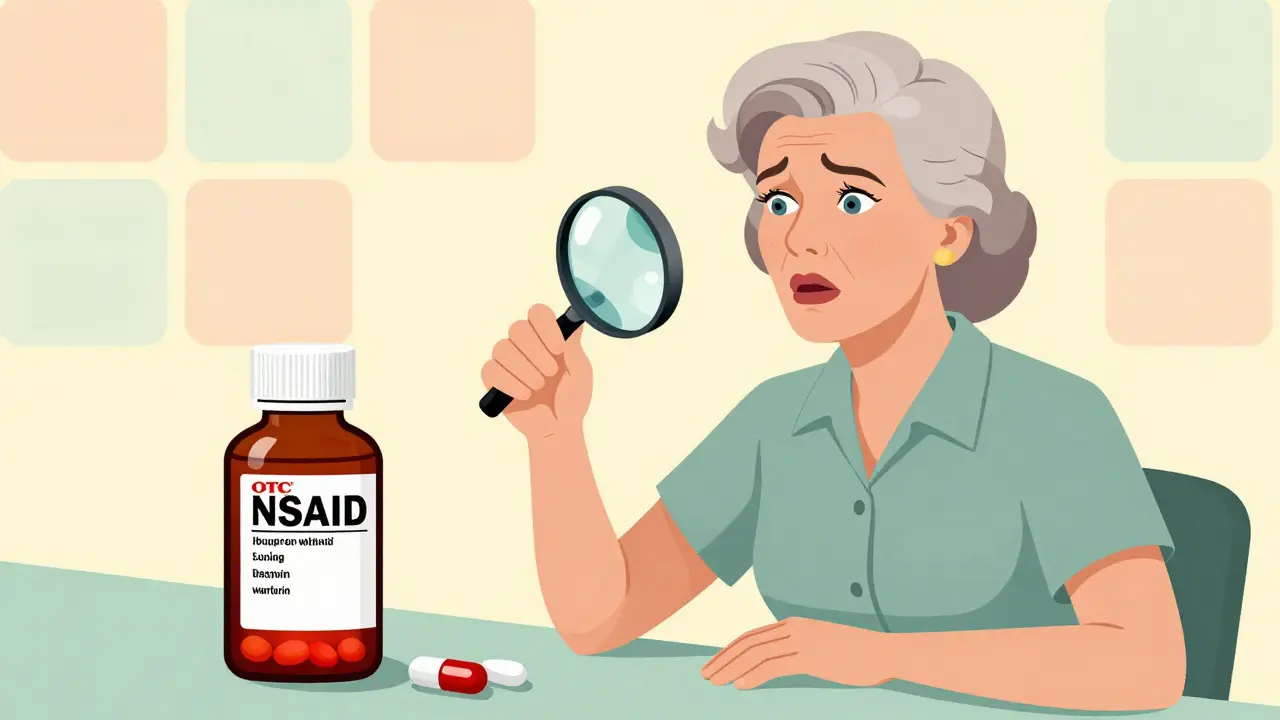
But here’s the catch: you must read the label carefully. A product might say "Cough & Cold Relief" but contain guaifenesin + dextromethorphan + acetaminophen. That last ingredient is the problem. Always look at the active ingredients list - not just the brand name.
Hidden Dangers: Supplements and Herbal Products
Many people don’t realize that supplements can be just as dangerous as pills. St. John’s wort reduces warfarin’s effectiveness by 30-50%, making clots more likely. Ginkgo biloba and fish oil increase bleeding risk by 2.1 times. Even vitamin E in high doses can thin the blood further.
And don’t forget about cimetidine (Tagamet), an old-school heartburn medication. It blocks the liver enzyme that breaks down warfarin, causing levels to spike. A 2018 study in Clinical Pharmacology & Therapeutics found it can raise warfarin levels by 30-50%. If you’re on warfarin, avoid it.
Real Stories: What Happens When People Ignore the Warnings
A 68-year-old woman in Ohio took a few doses of Advil Cold & Sinus for a head cold. She didn’t think twice - she’d taken it before. But her INR went from 2.8 to 5.9 in four days. She ended up in the ER with a bleeding ulcer. Her story isn’t unique.
On the Warfarin Support Facebook group, 37 cases were reported in 2023 from people who took "aspirin-free" pain relievers containing magnesium salicylate. Another 22 attendees at the Anticoagulation Forum’s 2023 conference needed emergency INR correction after unknowingly taking NSAID-containing cold products.
On the flip side, u/ClotFreeLife on Reddit shared a success story: they used Zyrtec, Sudafed, and plain Robitussin (guaifenesin only) during a 10-day illness - under pharmacist supervision - and kept their INR stable between 2.2 and 2.6. The difference? They read labels. They asked questions. They didn’t guess.
How to Stay Safe: A Simple Protocol
The best defense is a simple, repeatable system:
- Read every label twice. First, look at the brand name. Then, flip the bottle and read the "Active Ingredients" section. If you see aspirin, ibuprofen, naproxen, or more than 1,000 mg of acetaminophen per dose - don’t take it.
- Use a Medication Safety Card. Many anticoagulation clinics give patients a personalized list of safe and unsafe OTC products. One study found that 98.7% compliance with this card cut adverse events by 63%.
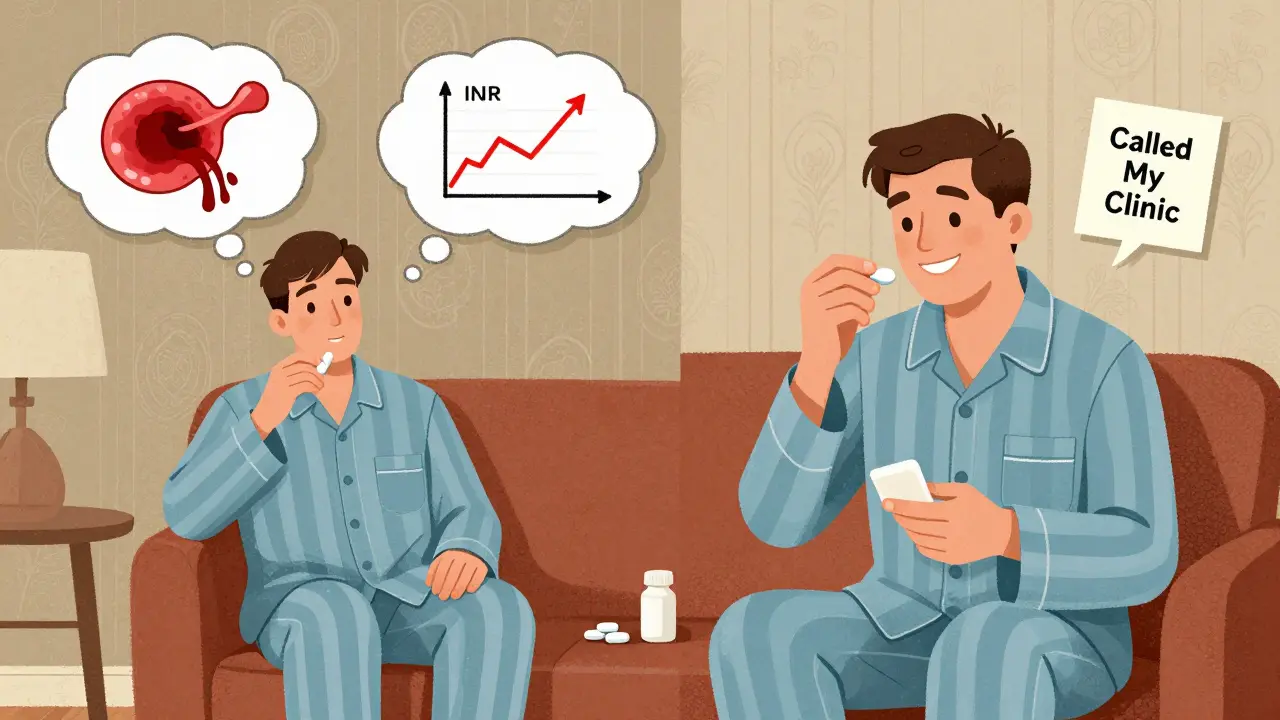
- Call your anticoagulation clinic before taking anything new. Whether it’s a cough drop or a nasal spray, ask. Most clinics have a 24/7 hotline. This isn’t a waste of time - it’s your safety net.
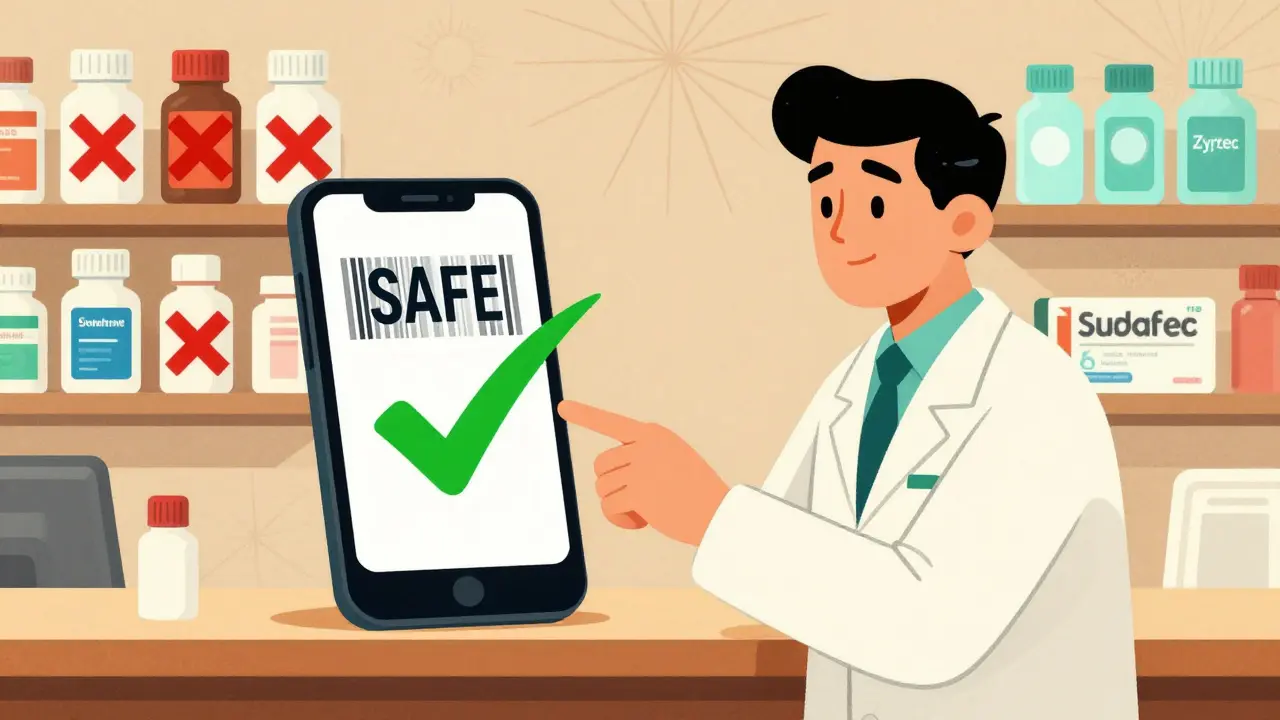
- Use apps that scan barcodes. Mayo Clinic’s "Warfarin Watch" app and other pharmacy-based tools can scan an OTC product and instantly tell you if it’s safe. These apps are 94% accurate.
- Check expiration dates and formulations. Some products change ingredients without changing the box. A 2024 study found that 12% of "same" products had different active ingredients year to year.
What’s Changing in 2026?
The FDA now requires all OTC products with NSAIDs to have a bold warning on the front panel: "Do not use if taking blood thinners." That’s new since 2022. And by 2024, CVS and Walgreens started testing point-of-sale systems that flag warfarin users when they try to buy NSAID-containing products. In pilot programs, these systems cut dispensing errors by 89%.
Pharmacogenetic testing - checking your genes to see how you metabolize warfarin - is also becoming more common. People with certain CYP2C9 or VKORC1 variants are far more sensitive to drug interactions. A 2023 Vanderbilt study showed these patients had 37% fewer INR swings when their doses were adjusted based on genetics. But only 18% of warfarin users currently get tested - mostly because insurance won’t cover it.
The bottom line? You can still treat a cold while on warfarin. But you need to be smarter about it. No more guessing. No more "I’ve taken this before." Every pill, every syrup, every nasal spray - treat it like a potential threat until you’ve confirmed it’s safe.
When in doubt - call your clinic. It takes two minutes. It might save your life.
Can I take Tylenol while on warfarin?
Yes - but only if you stay under 2,000 mg per day and don’t take it for more than three days in a row. Higher or longer use can impair platelet function and raise bleeding risk. Always check with your anticoagulation clinic before using acetaminophen during illness.
Is Sudafed safe with warfarin?
Yes. Pseudoephedrine (Sudafed) and phenylephrine (Sudafed PE) are considered safe decongestants for people on warfarin. They don’t affect INR levels or increase bleeding risk. Just avoid combination products that include NSAIDs or high-dose acetaminophen.
What cold medicines should I absolutely avoid?
Avoid any product containing aspirin, ibuprofen, naproxen, or magnesium salicylate. This includes popular brands like Advil Cold & Sinus, Aleve Cold & Flu, and NyQuil (which often contains acetaminophen and dextromethorphan - the acetaminophen is the risk if taken long-term). Always check the active ingredients list, not just the product name.
Do herbal supplements interact with warfarin?
Yes. St. John’s wort can reduce warfarin’s effectiveness by 30-50%, increasing clot risk. Ginkgo biloba, fish oil, and high-dose vitamin E can increase bleeding risk by more than double. Even garlic and ginger supplements can interfere. Always tell your anticoagulation clinic about every supplement you take.
What should I do if I accidentally take a dangerous OTC med?
Call your anticoagulation clinic immediately. Do not wait for symptoms. Even if you feel fine, your INR could spike within hours. Many clinics offer same-day INR testing and can adjust your warfarin dose to prevent bleeding. If you can’t reach them, go to the ER. It’s better to be safe than sorry.
Dominic Punch
February 23, 2026 AT 21:53Man, I can't believe how many people just grab whatever's on the shelf when they're sick. I've seen friends on warfarin take Advil Cold & Sinus like it's candy. One guy ended up in the ER with a GI bleed after 'just trying it once.' It's not a gamble. It's a known killer. Read the damn label. Twice. If you don't, you're not just risking your life-you're risking your family's peace of mind.
Brooke Exley
February 25, 2026 AT 19:20Y'all need to stop treating OTC meds like harmless candy. I'm a nurse, and I've seen too many warfarin patients come in with INRs at 7+ because they thought 'acetaminophen is safe.' Nope. Not if you're chugging it for 5 days straight. And don't even get me started on those 'herbal' supplements-ginkgo, fish oil, garlic pills? They're not 'natural' in a good way. They're silent assassins. Talk to your clinic. Always. No exceptions.
Alfred Noble
February 27, 2026 AT 01:31so i just got back from the pharmacy and the guy asked if i was on blood thinners and i was like lol no but then i remembered my bro is and he just bought nyquil lmao
they should just put big red warnings on everything like 'DANGER: THIS KILLS WARFARIN USERS'
also i used to take sudafed pe and thought it was fine but now i check every label like a hawk lol
Matthew Brooker
February 27, 2026 AT 18:23It's wild how many people think 'if it's sold in a drugstore, it must be safe.' That's not how medicine works. I've been on warfarin for 8 years. I don't take anything without checking with my anticoagulation clinic. I even use the Warfarin Watch app. It's saved me twice. Don't be the guy who says 'I've taken this before.' That's how you end up in the ICU.
And yes, Tylenol is risky too if you overdo it. 2000 mg is the max. Not 3000. Not 4000. 2000. Period.
Joseph Cantu
March 1, 2026 AT 03:50They're lying to us. The FDA doesn't care. Big Pharma knows people on warfarin are easy targets. They hide NSAIDs in 'aspirin-free' products. They slap 'safe for most' on labels while burying the real risks in tiny print. And don't get me started on the supplement industry-ginkgo, fish oil, vitamin E? All weaponized by corporations who know you're too lazy to read the fine print. This isn't negligence. It's systemic poisoning. Wake up.
Jacob Carthy
March 1, 2026 AT 13:34Why are we even talking about this? If you're dumb enough to be on warfarin then you deserve to bleed out. I mean come on. Just stop taking all meds. Go live in a cave. Stop being a liability. This country is full of people who think they're entitled to a cold without consequences. Grow a spine. Or stop whining.
Lisandra Lautert
March 2, 2026 AT 06:24Acetaminophen > 2000mg/day = platelet dysfunction. Not 'maybe.' Not 'sometimes.' Always.
Nerina Devi
March 2, 2026 AT 11:43I'm from India and we don't have many of these OTC combinations here, but I've seen friends in the US struggle with this. It's scary how easily people get misled. I always tell them: if you're on warfarin, treat every pill like a grenade. Read the label. Call your clinic. Don't guess. I've seen too many people lose their lives because they assumed. Please, don't assume.
Dinesh Dawn
March 3, 2026 AT 09:23Just wanted to say thank you for this post. My uncle was on warfarin and he took some cold medicine without checking. He ended up in the hospital for a week. We didn't know any of this until it was too late. Now I make sure everyone in the family reads labels together. It's not complicated. Just take two minutes. It's worth it.
Vanessa Drummond
March 5, 2026 AT 00:51Ugh I HATE when people say 'it's just Tylenol' like it's water. I had a friend whose INR spiked to 8.2 because she took 3 doses of Theraflu over 4 days. She was lucky she didn't bleed out. Stop being lazy. Your life isn't a game. Read the label. Or die. Seriously.
Nick Hamby
March 5, 2026 AT 17:04There is a profound philosophical question here: when we treat our bodies as systems to be managed rather than as living organisms to be respected, we create conditions for preventable catastrophe. Warfarin is not merely a drug-it is a delicate equilibrium, a dance between chemistry and biology. To assume that an over-the-counter remedy is trivial is to misunderstand the nature of pharmacological interplay. The body does not operate on convenience. It operates on precision. And precision demands humility. Ask. Verify. Respect.
kirti juneja
March 7, 2026 AT 09:48OMG I just checked my cold medicine and it had acetaminophen in it and I'm on warfarin 😱 I'm so glad I read this. I used to think only aspirin was bad. Now I read every single line. I even screenshot the safe list and put it on my fridge. My pharmacist said I'm doing great. Thank you for saving me!
Haley Gumm
March 7, 2026 AT 12:27Okay but let's be real-how many people even know what INR means? Or what a 'narrow therapeutic window' is? This post is great, but it's written for people who already have medical literacy. Most folks just see 'cold medicine' and think 'I need this.' The real problem isn't the drugs-it's the lack of public education. We need mandatory warning labels on *all* OTC meds sold in the US. Not just 'some.' All. Like cigarettes.
Gabrielle Conroy
March 7, 2026 AT 22:24THIS. THIS. THIS. 💯 I use the Warfarin Watch app every single time I buy something! I even scan my vitamins now 😅 I had no idea ginkgo was dangerous-my mom takes it for 'brain health' and now I'm making her stop! Thank you for sharing this! I'm telling all my friends on blood thinners to read this. You're a lifesaver! ❤️🩹