
When you pick up a bottle of medication from the pharmacy, you assume it will work exactly as it should - even if it’s been sitting on the shelf for a year. But how do drugmakers know it won’t break down, lose strength, or turn harmful over time? That’s where stability testing comes in. It’s not a one-time check. It’s a multi-year, highly controlled process that tracks every pill, capsule, or injection from the moment it leaves the factory until long after it’s been sold. This isn’t just paperwork. It’s the difference between a safe medicine and a dangerous one.
Why Stability Testing Isn’t Optional
In 2021, nearly 1 in 6 drug recalls in the U.S. happened because the product degraded after manufacturing. Some lost potency. Others formed toxic breakdown products. These weren’t manufacturing errors - they were stability failures. That’s why the FDA and global regulators require every new drug to prove it stays safe and effective under real-world conditions. The standard? ICH Q1A(R2), a set of rules created in 2003 by regulators from the U.S., Europe, and Japan. It’s not a suggestion. It’s the law.Stability testing answers three basic questions: How long can the drug last? How should it be stored? And what happens if it’s exposed to heat, humidity, or light? Without answers to these, pharmacies can’t print expiration dates. Doctors can’t trust prescriptions. Patients risk taking ineffective or unsafe medicine.
How Stability Testing Actually Works
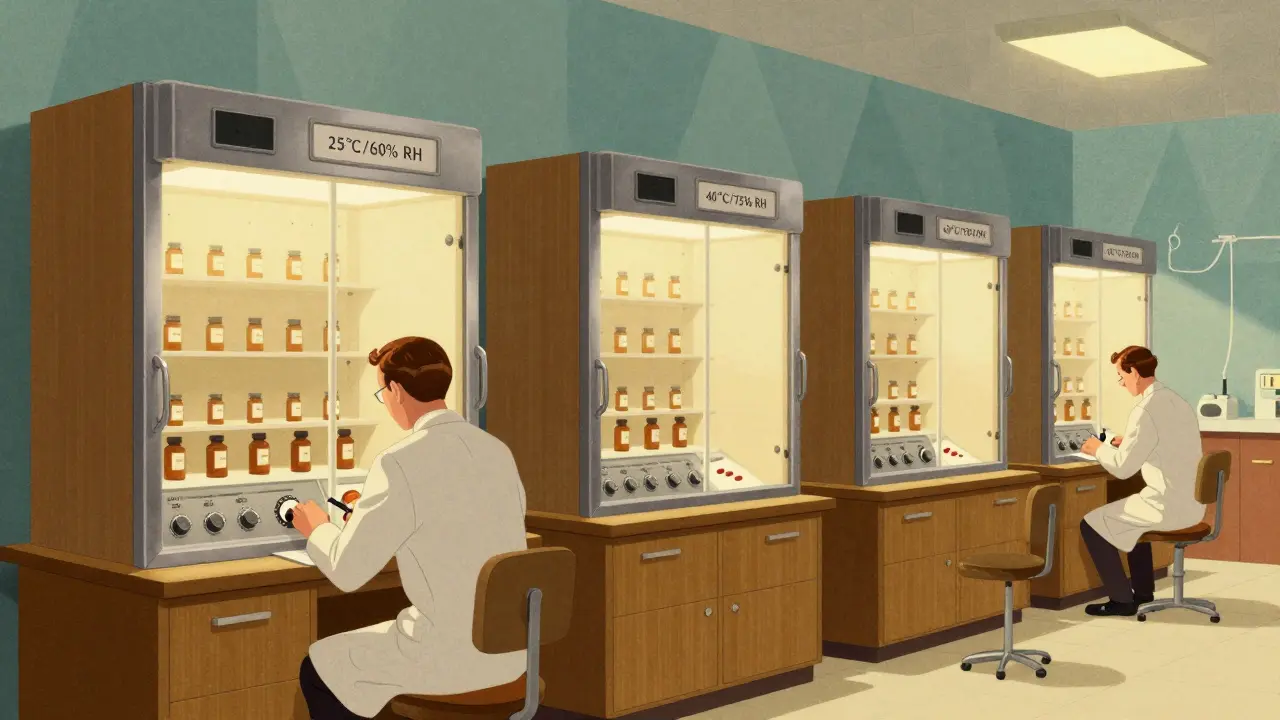
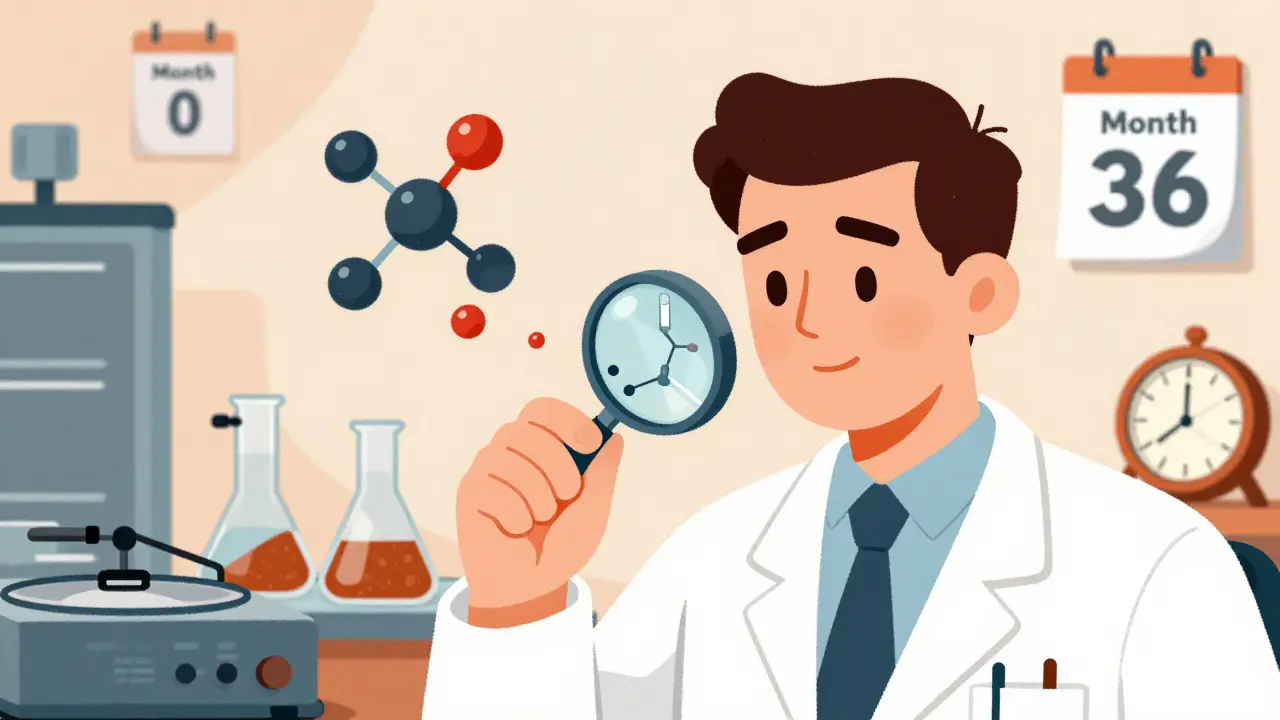
Imagine a room where temperature and humidity are locked in like a vault. These are stability chambers - climate-controlled environments that mimic the real world. A batch of pills gets split into dozens of samples. Each goes into a different chamber: one at 25°C and 60% humidity (room temperature), another at 40°C and 75% humidity (accelerated stress), and a third exposed to bright light to test photostability.At 0, 3, 6, 12, 24, and 36 months, technicians pull out samples and run tests. They check:
- Appearance - Did it change color or texture?
- Strength - Is the active ingredient still at 90-110% of labeled amount?
- Degradation - Are harmful byproducts forming? (e.g., formaldehyde in some antibiotics)
- Dissolution - Does it break down in the body the same way as when new?
- Microbial growth - Is it still sterile, if it’s an injection?
These aren’t simple visual checks. They use advanced tools like HPLC (high-performance liquid chromatography) and mass spectrometry to detect changes at the molecular level. Every test method must be validated to prove it can spot even tiny changes - a requirement under ICH Q2(R1).
The Cost of Getting It Right
Stability testing isn’t cheap. A single product study can cost between $50,000 and $150,000. For a company with 20 products, that’s over $2 million a year just on testing. Add in the chambers, sensors, calibration, and staff, and it’s easily 15-20% of total quality control spending.Why so expensive? Because every sample must be tracked. Every test result logged. Every deviation investigated. If a chamber hits 27°C instead of 25°C for six hours, that’s an out-of-specification (OOS) event. It triggers a full investigation. If the cause isn’t found and fixed, the entire study might be thrown out. One company lost $2.3 million in delayed market entry because humidity spikes caused a 3-month data gap.
That’s why many smaller drugmakers outsource to CROs like SGS, Eurofins, or Charles River Labs. These labs have the chambers, the expertise, and the audit trails. But even outsourcing requires deep oversight. The drugmaker still owns the data - and the liability.
What Happens When Stability Testing Fails
In 2021, the FDA issued a warning letter to a manufacturer of a cancer drug after they ignored repeated OOS results. The drug was losing potency faster than expected. Instead of pausing production and investigating, they kept shipping. The result? Approval delayed by 14 months. Patients went without treatment. The company’s reputation took a hit.But stability testing also prevents disasters. In 2022, a biologic drug manufacturer used stability data to discover a chemical reaction between the drug and its glass vial. The vial was leaching metal ions that degraded the protein. They switched packaging before launch - avoiding a potential $500 million recall.
Between 2020 and 2022, the International Pharmaceutical Aerosol Consortium found that stability testing blocked 47 unsafe products from reaching patients. These weren’t obvious failures. They were subtle changes - a 2% drop in potency, a trace impurity that only showed up after 18 months. Without testing, those would’ve gone unnoticed until someone got sick.
Challenges and Real-World Pain Points
The biggest headache for quality teams? Chamber maintenance. Temperature mapping studies - required every quarter - cost about $8,500 per chamber. Calibration must be done by ISO 17025-accredited labs. One slip-up, and the whole study is questionable.Another issue? Data overload. A single stability report can contain 20+ data points per time point, over 10+ time points, for 5+ batches. Paper records are a nightmare. Companies using electronic systems cut review time by 55%. But validating those systems takes 6-9 months. Many small firms still use Excel spreadsheets - a major red flag during FDA inspections.
And then there’s the timeline. Real-time stability takes 2-3 years. For a new drug, that means you can’t set an expiration date until after the product is already on the market. That’s why accelerated testing (40°C/75% RH for 6 months) is used to predict shelf life. But it’s not perfect. A 2021 study in the Journal of Pharmaceutical Sciences showed accelerated data overestimated stability in 30% of cases. Real-time data is still the gold standard.
The Future: Faster, Smarter, Risk-Based
The industry is changing. In 2023, the ICH finalized Q13, new rules for stability testing in continuous manufacturing - where drugs are made nonstop instead of in batches. This demands real-time monitoring, not just periodic sampling.Companies are also using ICH Q12, a framework that lets them make changes to manufacturing after approval without restarting stability studies. One generics company cut sample sizes by 40% and saved $120,000 per product annually.
AI is coming. By 2027, machine learning models could predict degradation pathways with 80% accuracy, cutting testing time by 30-40%. Imagine training a model on 10,000 past stability studies to forecast how a new drug will behave - without waiting three years.
But regulators won’t abandon real-time data anytime soon. Even with AI, the FDA still requires actual test results for approval. The future isn’t about replacing testing - it’s about making it smarter. Risk-based approaches are gaining ground. For well-understood, stable small-molecule drugs, maybe you don’t need 36 months of data. Maybe 12 months, backed by solid science, is enough.
What This Means for You
As a patient, you don’t see stability testing. But you feel its impact. Every expiration date on your medicine? That’s the result of years of testing. Every time your prescription works as expected - even after sitting in your cabinet for a year - that’s stability testing working.For the industry, it’s a costly, complex, and non-negotiable part of quality. For regulators, it’s the last line of defense before a drug reaches millions. And for the people running the labs? It’s a daily reminder that a single number, a single test, can mean the difference between health and harm.
Stability testing doesn’t make headlines. But it keeps the system running. And in a world where drug shortages and recalls still happen, that’s not just important - it’s essential.
How long does stability testing take for a new drug?
For most new drugs, real-time stability testing runs for 24 to 36 months under normal storage conditions (25°C/60% RH). Accelerated testing (40°C/75% RH) is done for 6 months to predict long-term behavior. The full shelf life can’t be officially set until the real-time data is complete - even if the drug is already on the market.
What happens if a drug fails stability testing?
If a drug fails - meaning it drops below potency, forms unsafe impurities, or changes physically - the manufacturer must stop distribution. They must investigate the cause, fix the issue, and often resubmit data to regulators. In severe cases, the drug’s approval can be delayed or revoked. The FDA may issue warning letters or even initiate a recall if the drug is already on the market.
Are stability requirements the same worldwide?
Most major markets - the U.S., EU, Japan, Canada, and Australia - follow ICH guidelines, so requirements are very similar. Emerging markets are increasingly aligning with ICH standards, but enforcement varies. Companies exporting globally must test under conditions relevant to each region - for example, testing at 30°C/65% RH for products sold in hot, humid countries.
Can stability testing be shortened or skipped for some drugs?
For very stable, well-understood small-molecule drugs, regulators are open to risk-based approaches. ICH Q12 allows manufacturers to use prior knowledge and data to reduce testing duration or frequency. But this requires strong scientific justification and regulatory approval. It’s not a loophole - it’s a smarter, evidence-based process. Biologics and complex formulations still require full testing.
Why do stability chambers need to be mapped every quarter?
Stability chambers aren’t perfectly uniform. Hot spots, cold spots, and humidity variations can exist. Quarterly temperature mapping uses dozens of sensors to document the actual conditions inside the chamber. If the data shows a problem - say, a corner is 3°C hotter than the center - the chamber can’t be used for testing until it’s fixed. This ensures every sample is exposed to the exact conditions required by the protocol.
Fabio Raphael
December 26, 2025 AT 03:12Man, I never thought about how much work goes into making sure my pills don’t turn into poison. This is the quiet hero work that keeps people alive, and no one talks about it. Respect to the lab techs running these tests in climate-controlled rooms like scientists in a sci-fi movie.
Sophia Daniels
December 27, 2025 AT 21:27Let’s be real - this whole system is a money machine. $150k per drug? That’s why your $5 prescription costs $500. Pharma’s got us hooked on over-engineered safety while they rake in billions. The real scandal? They could’ve tested 10x more drugs if they didn’t spend half their budget on fancy HPLC machines and consultant fees.
roger dalomba
December 28, 2025 AT 23:17Wow. A whole article about how companies don’t cut corners. Groundbreaking. Next up: ‘How Airplanes Don’t Just Fall Out of the Sky.’
Peter sullen
December 30, 2025 AT 13:25It is imperative to underscore, with unequivocal clarity, that the ICH Q1A(R2) framework constitutes a non-negotiable, globally harmonized regulatory imperative - not a recommendation, not a guideline, but a codified standard of care that underpins the entire pharmacovigilance ecosystem.
Amy Lesleighter (Wales)
January 1, 2026 AT 01:15They test for everything except how long it takes you to remember you even took the pill. 😅 But seriously - this stuff matters. I’ve seen grandma’s meds sit in a hot bathroom for years. Scary.
Brittany Fuhs
January 1, 2026 AT 20:37And yet, American pharma still outsources 70% of this to India and China. You think they’re running ISO 17025 labs in rural Gujarat? Please. This is all theater. We’re trusting our lives to cost-cutting with a fancy label.
Nikki Brown
January 2, 2026 AT 09:15This is why we need more government oversight. 🙄 People don’t realize how much of this is just… guesswork. And if you’re not on a $200k drug, you’re basically a guinea pig. 😔
Becky Baker
January 3, 2026 AT 17:02My cousin works at one of these labs. She says the chambers are basically fancy ovens with mood lighting. And yeah, they do mess up sometimes. One time they left a batch in a 30°C room for a week and just… didn’t say anything. 🤷♀️
Rajni Jain
January 5, 2026 AT 16:07From India, we see this every day. Some of our local meds are great, some… not so much. But the fact that companies even test? That’s more than most countries do. We’re lucky to have even basic standards.
Natasha Sandra
January 6, 2026 AT 12:44OMG I had no idea!! 😱 So that’s why my insulin expired in 28 days?? I thought it was just the pharmacy being extra. This makes me feel so much better about my meds now 💖
Erwin Asilom
January 7, 2026 AT 22:02Real-time monitoring via IoT sensors is the future. Automated data capture reduces human error. The regulatory burden is high, but the ROI in patient safety is incalculable.
Sumler Luu
January 8, 2026 AT 04:52I get why this is necessary, but it’s wild how much of this feels like medieval ritual. You test for 3 years to prove something that should be obvious. Why not just trust the science? It’s not like we’re making wine.
sakshi nagpal
January 10, 2026 AT 03:35Interesting how this mirrors global inequality. In the U.S., we have climate-controlled labs. In parts of Africa, people store insulin in baskets under beds. The science is perfect - but the system isn’t. We need to fix access, not just data.
Sandeep Jain
January 11, 2026 AT 02:20my uncle was a pharma tech… he said most of the time they just follow the checklist and hope. no one has time to really dig deep. sad but true.
Steven Destiny
January 11, 2026 AT 20:31Let me tell you something - if you think this system is perfect, you’re living in a fantasy. I’ve seen data falsified, chambers mislabeled, and OOS reports buried. The FDA audits? They show up once every three years. This isn’t science - it’s a performance. And we’re all watching.