
When a child asks why their medicine looks different from last time, or why it costs less, they’re not just being curious-they’re ready to learn. Many parents and teachers assume kids don’t need to understand the difference between brand-name and generic drugs. But the truth is, teaching children about generic medications early builds lifelong habits of safe, smart medicine use. It also helps reduce fear, confusion, and misuse down the road.
What Are Generic Drugs, Really?
Generic drugs are the same as brand-name drugs in every important way: they contain the same active ingredient, work the same way in the body, and are just as safe and effective. The only differences are the name, the shape or color of the pill, and the price. Generic drugs cost up to 80% less because their makers don’t have to spend millions on advertising or re-doing the original research.
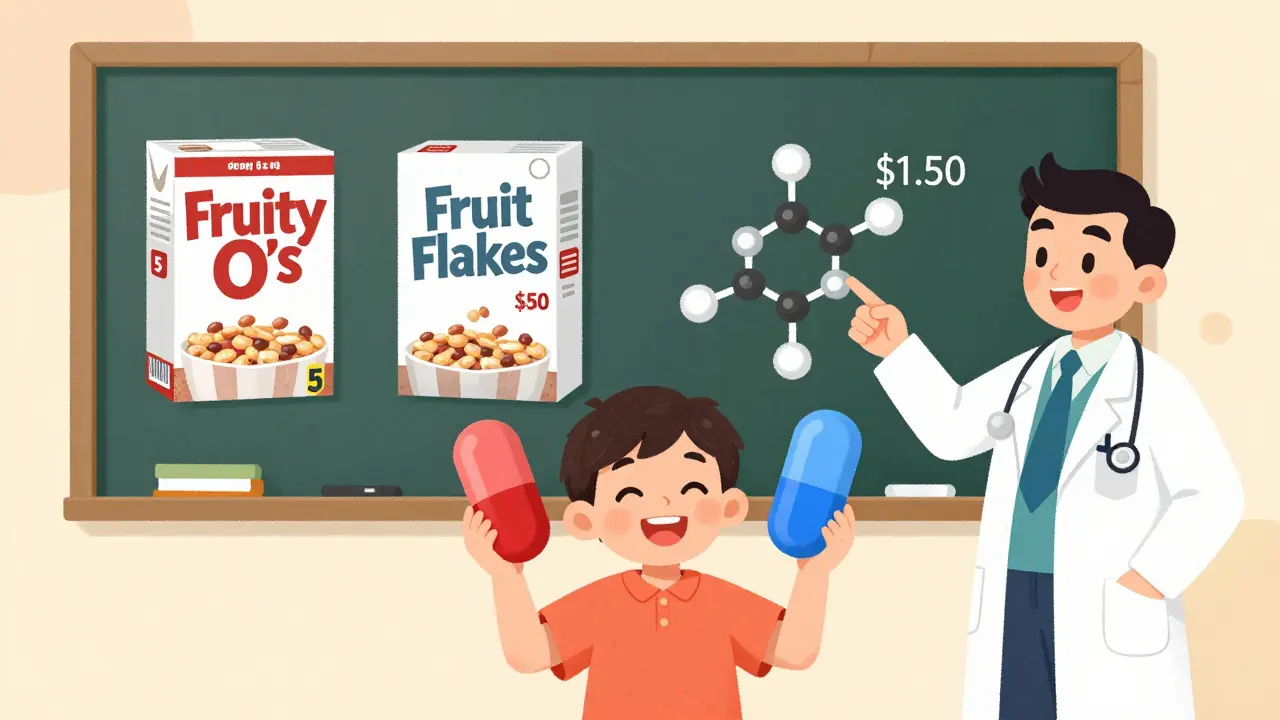
Think of it like buying cereal. One box says "Fruity O’s" and costs $5. Another says "Fruit Flakes" and costs $1.50. They both have the same sugar, same flavor, same ingredients. One just has a fancy logo. That’s what generic drugs are-same medicine, different packaging.
Every generic medicine must pass strict tests by the U.S. Food and Drug Administration (FDA) before it can be sold. The FDA requires that generics work exactly like the brand-name version. So if your child takes a generic version of amoxicillin for an ear infection, it will cure the infection just as well as the brand-name version.
Why Teach Kids About Generic Drugs?
Children hear adults talk about "saving money" or "getting a cheaper medicine." If they don’t understand what that means, they might think cheaper means weaker, or even unsafe. That fear can lead them to refuse needed medicine, or worse-trust advice from strangers online who claim "brand names are better."
Teaching kids about generics helps them:
- Understand that cost doesn’t equal quality
- Feel confident taking prescribed medicine, even if it looks different
- Ask smart questions when a new prescription comes in
- Resist peer pressure or misinformation about "real" medicine
A 2023 study from the American Academy of Pediatrics found that children who understood the basics of generic drugs were 60% more likely to take their medicine as directed than those who didn’t. That’s not just about saving money-it’s about health outcomes.
How to Explain Generic Drugs to Young Kids (Ages 3-8)
For little ones, keep it simple and visual. Use toys, drawings, or even snacks to show the idea.
Try this:
- Grab two identical-looking toy pills (or two different-colored candies that taste the same).
- Say: "This one is called "SunnyMed," and it costs $5. This one is called "HappyMed," and it costs $1.50. But guess what? They both make your tummy feel better in exactly the same way."
- Let them hold both and say: "They’re like twins-one wears a fancy hat, the other doesn’t. But they’re the same inside."
Use books like "The Medicine Monster" by Dr. Katie Summers, which shows a character learning that "different-looking pills can do the same job." Many pediatric clinics and pharmacies give these out for free.
Also, make it part of routine care. When you pick up a prescription, say out loud: "This is the generic version of the medicine we used before. It’s cheaper, but just as strong."
Teaching Tweens and Teens (Ages 9-16)
Older kids can handle more detail. This is the time to talk about how drugs are made, why prices differ, and how companies market them.
Here’s a simple way to start the conversation:
- "Brand-name drugs are like new cars. The company spent a lot of money designing them, testing them, and telling everyone they’re the best."
- "Generic drugs are like used cars that are just as reliable-but way cheaper because no one’s paying for flashy ads."
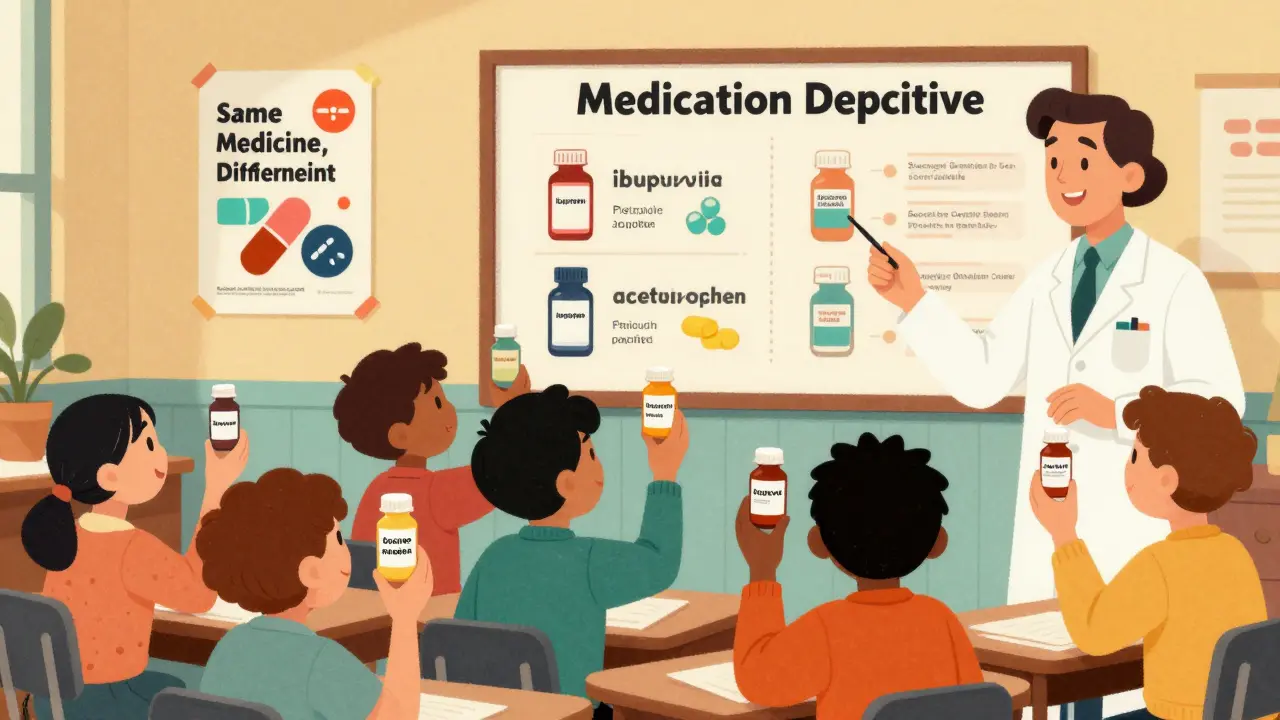
Use real examples. Show them a bottle of ibuprofen. Point out the active ingredient: "ibuprofen." Then show two brands-one is "Advil," the other is "Store Brand Ibuprofen." Ask: "What’s the same? What’s different?"
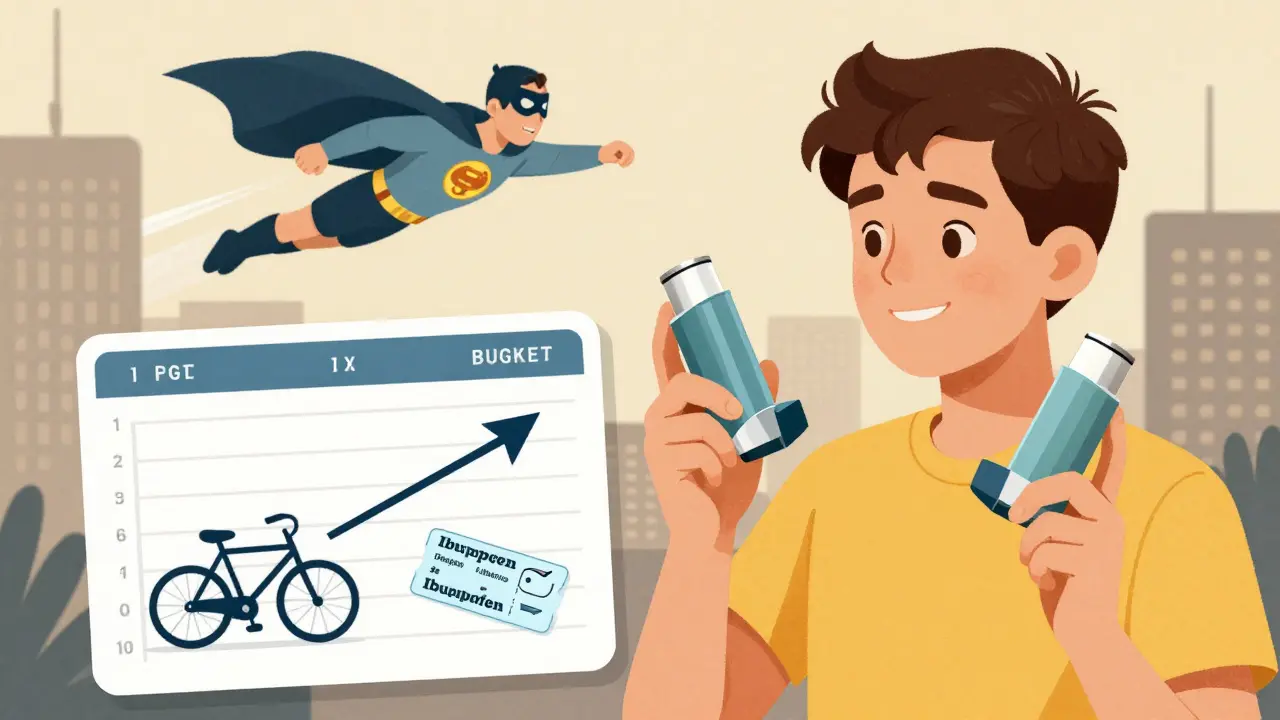
Then bring in real-world stakes: "If we use generic medicine, we can save money for your soccer camp, or your new bike. But we’re not saving money by using something weaker. We’re saving money by skipping the fancy packaging."
Teens are exposed to social media myths. Some influencers claim "brand names work better" or "generics have fillers that hurt you." Teach them to check the FDA website (or ask a pharmacist) for proof. A 2022 survey by the National Institute on Drug Abuse found that teens who could identify generic drugs were 40% less likely to believe misinformation about medications online.
What Schools Are Doing Right
Programs like Generation Rx, run by The Ohio State University College of Pharmacy, are now used in over 1,500 U.S. schools. They don’t just teach kids about drugs-they teach them how to think about them.
In one lesson, fifth graders play a game called "Medication Detective." They look at pill bottles and match active ingredients. They learn that "acetaminophen" is the same whether it’s Tylenol or CVS brand. They learn to read labels, not logos.
Another program, "Medicine Science and Safety," gives third graders a workbook where they draw what medicine does in the body. One child wrote: "The medicine is like a superhero. It doesn’t matter what cape it wears-it still fights the bad germs."
These programs work because they’re interactive, not scary. They don’t say "drugs are bad." They say: "Here’s how they work. Here’s how to use them right."
What to Avoid
Don’t say: "Generic drugs are cheap because they’re not good." That’s the exact wrong message.
Don’t use fear. Telling kids "some generics are fake" or "they might not work" creates distrust in all medicine. That’s dangerous.
Don’t skip the conversation because you think "they’re too young." Kids notice everything. If you avoid the topic, they’ll get their answers from YouTube, TikTok, or friends-and those sources aren’t always right.
Also, don’t assume your child knows what "active ingredient" means. Explain it like this: "That’s the part that actually fixes the problem. Everything else is just flavor, color, or filler to make it look nice."
Real-Life Impact
In Manchester, a primary school started a monthly "Medicine Talk" with pharmacists. After six months, parents reported a 70% drop in kids refusing medicine because "it didn’t look right." One boy told his teacher: "I thought my new medicine was fake. Now I know it’s just the same one in a different jacket."
Another family saved £120 a year on asthma inhalers by switching to generics-and used that money for a family trip. The child, now 10, proudly says: "We saved money because we picked the right medicine."
How to Start Talking Today
You don’t need a degree to teach your child about generic drugs. Just start with these simple steps:
- When you get a prescription, say: "This is the generic version. It’s cheaper, but just as good."
- Keep a small medicine cabinet at home with labeled bottles. Let your child see the difference between brand and generic side by side.
- Play a game: "Find the same medicine in two different bottles." (Use empty boxes or pictures.)
- Answer questions honestly. If they ask why it’s cheaper, say: "Because the company didn’t spend money on ads or fancy packaging."
- Visit your local pharmacy. Many offer free kid-friendly brochures. Ask for them.
And if you’re unsure about a medicine, ask the pharmacist. They’re trained to explain this to kids too. Most will happily show you the active ingredient on the label and say: "This is what matters."
What Comes Next
Once kids understand generics, the next step is learning about when to take medicine, how to store it safely, and why never to share pills. These lessons build on each other.
Teaching children about generic drugs isn’t about making them pharmacists. It’s about giving them the power to make smart choices. It’s about helping them see that value isn’t about the logo-it’s about what’s inside.
And that’s a lesson that lasts a lifetime.
Are generic drugs really as safe as brand-name drugs?
Yes. Generic drugs must meet the same strict safety and effectiveness standards as brand-name drugs, set by the U.S. Food and Drug Administration (FDA). They contain the same active ingredient, work the same way, and are tested to make sure they’re absorbed into the body at the same rate. The only differences are in the color, shape, or inactive ingredients-none of which affect how well the medicine works.
Can I switch my child from a brand-name drug to a generic without asking the doctor?
In most cases, yes. Pharmacists can substitute a generic version unless the doctor writes "dispense as written" or "no substitution" on the prescription. If you’re unsure, always ask the pharmacist or doctor. But know this: switching to a generic is safe and common. Over 90% of prescriptions filled in the U.S. are for generics.
Why do generic drugs look different from brand-name ones?
By law, generic drugs can’t look exactly like the brand-name version, even if they have the same active ingredient. That’s to avoid confusion and trademark issues. So the shape, color, or markings may be different-but the medicine inside is identical. Think of it like two different brands of apple juice: one has a red label, the other has a green one. They both taste like apples.
Is it true that generic drugs have more fillers or additives?
No. Both brand-name and generic drugs contain the same active ingredient and similar inactive ingredients (like binders or coatings). The FDA requires that these inactive ingredients be safe and approved. Sometimes generics use different fillers to make the pill easier to swallow or to match the size of the original-but these don’t change how the medicine works. If your child has an allergy to a specific filler, check the label or ask your pharmacist.
How can I help my child remember which medicine is which?
Teach them to look for the active ingredient on the label, not the brand name. For example, if they take "ibuprofen," show them that both "Advil" and "Store Brand Ibuprofen" list "ibuprofen 200mg" as the main ingredient. Use a simple chart at home: write the medicine’s purpose (e.g., "for fever") and the active ingredient next to each bottle. Kids remember patterns better than names.
sue spark
December 16, 2025 AT 02:44My 7-year-old asked why his pink pill looked different this time and I just said it was the same medicine in a new outfit. He nodded like it made perfect sense. Kids get it if you keep it simple.
Tiffany Machelski
December 16, 2025 AT 10:39i never thought about teaching kids this but now i feel like a bad parent for never explaining it. my son thinks the blue pill is fake because it doesnt have the same logo. oops.
SHAMSHEER SHAIKH
December 17, 2025 AT 05:59It is with profound respect for public health education that I commend this article. The systematic dismantling of pharmaceutical stigma through early childhood pedagogy is not merely commendable-it is imperative. Generic medications are not inferior; they are democratized science. The FDA’s rigorous bioequivalence protocols ensure that a child’s life is not compromised by cost-conscious substitution. This is not a compromise-it is equity in action.
James Rayner
December 18, 2025 AT 05:42It’s funny how we teach kids to judge things by their packaging. Cars, clothes, phones… and now medicine. We tell them to look inside, but we never show them how. This post made me realize we’re raising a generation that thinks the logo is the medicine.
And maybe that’s why so many adults still believe brand names work better. We never unlearned it.
Souhardya Paul
December 20, 2025 AT 03:28I work in a school library and we started using the Generation Rx materials last year. The kids love the "Medication Detective" game. One girl matched three different bottles all with "acetaminophen" and yelled "THEY’RE ALL THE SAME!" like she solved a mystery. That’s the moment you know it’s working.
Josias Ariel Mahlangu
December 21, 2025 AT 10:02This is dangerous. You’re teaching kids to accept whatever the system gives them. What if the generic is made in a factory with bad quality control? Who’s checking? The FDA is corrupt. I’ve seen the reports.
anthony epps
December 23, 2025 AT 06:38i never knew generics were the same. i thought they were weaker. my kid takes amoxicillin and i always got the name brand. guess i wasted money.
Andrew Sychev
December 25, 2025 AT 03:08THIS IS A BIG PHARMA TRICK. THEY WANT YOU TO THINK GENERIC IS JUST AS GOOD SO YOU’LL STOP BUYING THE REAL STUFF. THEY’RE MAKING BILLIONS OFF BRAND NAMES AND NOW THEY’RE PUSHING CHEAP ONES TO CONTROL THE MARKET. YOU THINK YOUR KID’S MEDICINE IS SAFE? THINK AGAIN.
Dan Padgett
December 26, 2025 AT 18:09Back home in Nigeria, we call this "the same water in a different bottle." People think if it’s not branded, it’s not medicine. But the truth? The body doesn’t care about the label. It cares about the molecule. And if that molecule is right, the magic happens. This post? It’s the kind of quiet revolution we need.
Hadi Santoso
December 27, 2025 AT 04:03Love this. My daughter’s school does this too. She came home last week and said "Dad, the purple pill and the yellow pill both have ibuprofen, so they’re twins!" I almost cried. Also, typo: "fancy hat" should be "fancy hat"-wait no, that’s fine. 😅
Mike Smith
December 27, 2025 AT 23:30As an educator with over two decades in public health outreach, I can affirm that early pharmaceutical literacy is one of the most underutilized tools in preventive medicine. The cognitive scaffolding established in children who understand bioequivalence translates into lifelong adherence, reduced anxiety, and critical thinking skills that extend far beyond medicine. This is not a parenting tip-it is a public health intervention.
Ron Williams
December 29, 2025 AT 18:10My kid doesn’t care what the pill looks like. He just wants to know if it tastes bad. So I tell him: "It’s the same taste, different wrapper." He’s 5. He gets it. Sometimes the simplest explanations are the ones that stick.
Kitty Price
December 30, 2025 AT 21:47My daughter started asking about pills after seeing the "Medicine Monster" book. Now she checks the label before taking anything. I’m so proud. 🌟
SHAMSHEER SHAIKH
December 31, 2025 AT 15:01Thank you for sharing the anecdote regarding the "Medication Detective" game. Such pedagogical innovation is precisely what transforms abstract medical concepts into tangible, child-friendly epiphanies. The cognitive leap from logo recognition to active ingredient identification is monumental. This is not merely education-it is the cultivation of pharmaceutical autonomy.
sue spark
January 1, 2026 AT 07:07My kid now says "this is the twin pill" every time we get a new prescription. I didn’t teach him that. He just figured it out from the cereal analogy.