
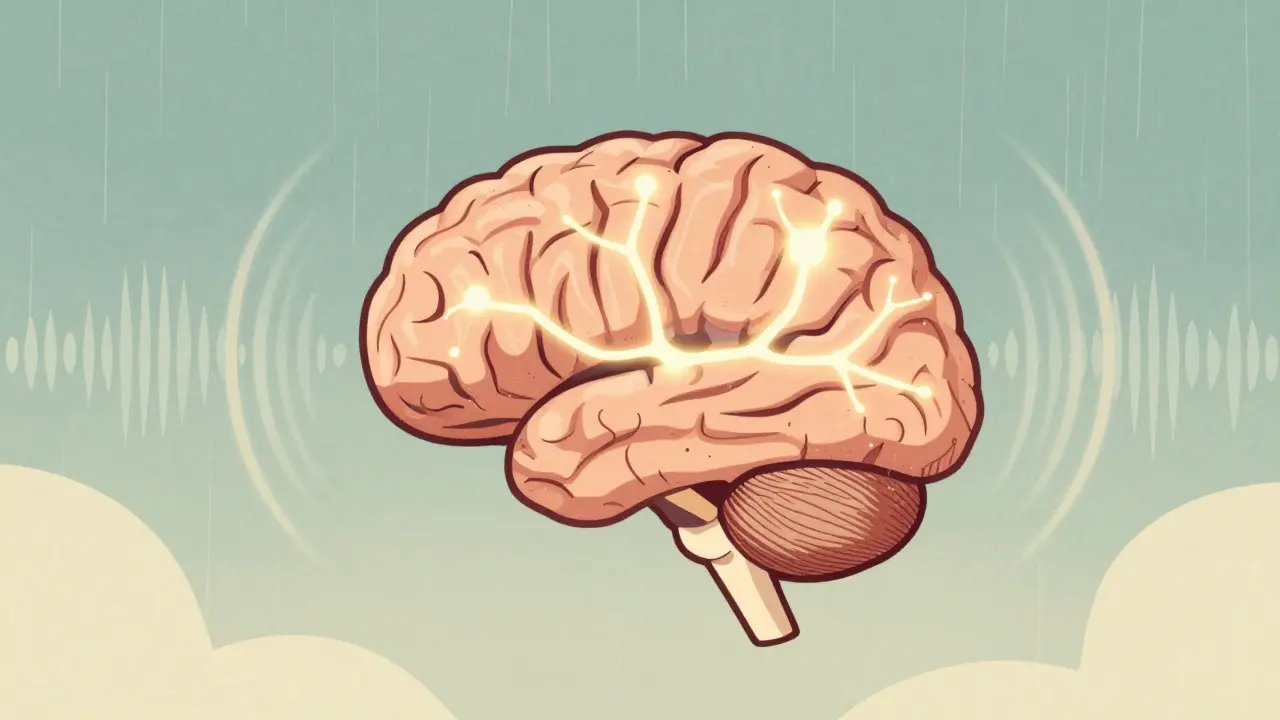
Most people with tinnitus think the goal is to make the ringing, buzzing, or hissing in their ears disappear. But what if the real solution isn’t about silencing the sound - but changing how your brain reacts to it?
Why Tinnitus Feels So Overwhelming
Tinnitus isn’t a disease. It’s a symptom. Your ears might be fine. Your hearing might be normal. But your brain has learned to treat the internal noise like a threat - like a fire alarm that won’t turn off. That’s why it feels unbearable. The louder you focus on it, the more your brain amplifies it. You start dreading quiet rooms. You avoid social events. You lose sleep. And the stress makes the tinnitus worse. It’s a loop - and it’s not your fault.This isn’t just "being anxious." Brain scans show real changes. The auditory cortex, the part of your brain that hears, gets stuck in a feedback loop with the amygdala - the fear center. The signal doesn’t just get louder. It gets emotional. That’s where traditional hearing aids or white noise machines often fall short. They mask the sound, but they don’t rewire the brain’s response.
What Is Tinnitus Retraining Therapy (TRT)?
Tinnitus Retraining Therapy, or TRT, was developed in the early 1990s by Dr. Pawel Jastreboff at the University of Maryland. It’s not a quick fix. It’s not a pill. It’s a neuroscience-based process designed to help your brain unlearn its fear of tinnitus. The goal isn’t to make the sound go away. It’s to make you stop noticing it - not because it’s gone, but because your brain no longer cares.TRT works in two parts: counseling and sound therapy. Together, they target the root problem: the brain’s learned reaction to tinnitus. Studies show that 80% of patients who complete the full program report significant improvement - not because their tinnitus is quieter, but because it’s no longer stressful.
The Counseling: Rewriting the Brain’s Story
This is the part most people underestimate. TRT counseling isn’t therapy in the psychological sense. It’s education - deep, detailed, and repeated. You sit with a trained audiologist for 60 to 90 minutes at a time, usually once a month for the first few months. They don’t just tell you what tinnitus is. They show you how it works - using diagrams of the cochlea, the auditory nerve, the limbic system. They explain how your brain turns harmless neural noise into a threat signal.You learn that tinnitus isn’t a sign of damage. It’s not a warning. It’s just background static - like the hum of a refrigerator. The problem isn’t the sound. It’s your brain’s reaction to it. The counselor helps you reframe it: "This isn’t dangerous. It’s not going to get worse. It’s just there."
By the end of 12 to 18 months, patients report a shift. They still hear the tinnitus. But they don’t jump when they hear it. They don’t check their phone for the time because they’re afraid of silence. They don’t dread bedtime. The emotional weight lifts. That’s habituation - the brain’s natural ability to ignore things that aren’t important.
The Sound Therapy: Gentle Background Noise
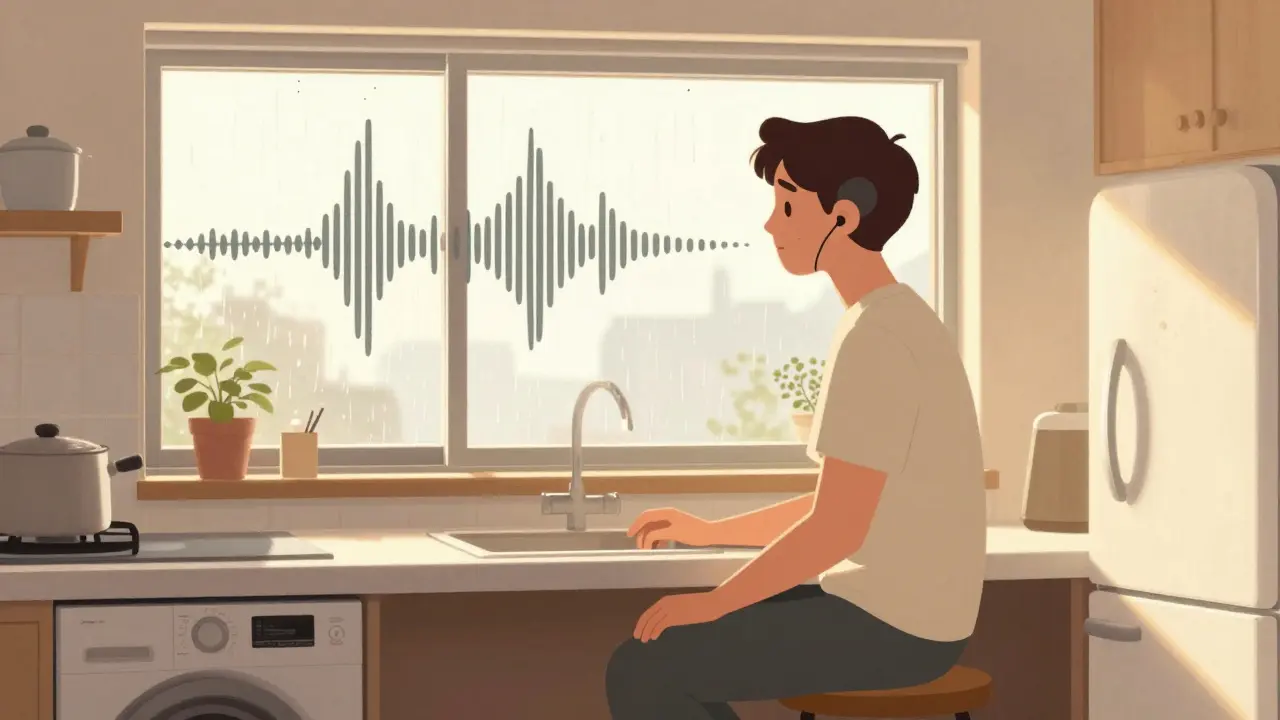
Sound therapy in TRT isn’t about drowning out tinnitus. It’s about balancing it. You wear small devices - like hearing aids or custom sound generators - that emit a low-level, broadband noise. Think of it as a quiet hiss, like a fan or gentle rain. The volume is set just below your tinnitus level. Not loud enough to cover it. Just enough to reduce the contrast.Why does this work? Your brain is constantly comparing signals. If tinnitus is the only sound in your ears, it stands out like a scream. Add a quiet, constant background noise, and your brain starts treating it like part of the environment. Over time, the neural pathways that react to tinnitus become less active. Studies show that after 12 months of TRT, patients’ minimal masking levels increase by 3 to 5 dB - meaning their brains are naturally better at filtering out the tinnitus signal.
You’re expected to wear these devices for 6 to 8 hours a day. Not while sleeping - while you’re awake. While working, cooking, walking. The key is consistency. You’re not trying to escape the sound. You’re teaching your brain that it’s safe to ignore it.
Who Is TRT For? The Four Groups
TRT isn’t one-size-fits-all. Patients are grouped based on hearing status and tinnitus characteristics:- Group 1: Normal hearing, tinnitus present - uses sound generators only.
- Group 2: Hearing loss, but tinnitus only noticeable in quiet - uses hearing aids only.
- Group 3: Hearing loss with noticeable tinnitus - uses both hearing aids and sound generators.
- Group 4: Has hyperacusis (sensitivity to everyday sounds) - needs specialized protocols.
Getting the right group matters. A person with hearing loss who uses only sound generators might not get full benefit. Someone with hyperacusis who gets loud sound therapy could make things worse. That’s why TRT requires a trained clinician - not just a device you buy online.
How Long Does It Take?
TRT isn’t a 30-day challenge. It’s a marathon. Most people start noticing changes around 6 months. Significant improvement usually takes 12 to 24 months. That’s because habituation isn’t forced - it’s grown. Your brain needs time to unlearn what it’s been conditioned to fear.Dropout rates are high - 30% to 40% quit before finishing. Why? Because it’s tedious. Wearing sound devices all day. Going to monthly appointments. Listening to the same explanations over and over. It’s not glamorous. But for those who stick with it, the payoff is life-changing. One patient in Seattle told me: "I didn’t realize how much energy I was spending just trying not to hear it. When I stopped fighting it, I got my life back."
Is TRT Proven?
Yes. Multiple clinical studies confirm its effectiveness. A 2019 review in JAMA Otolaryngology found TRT improved Tinnitus Functional Index scores by an average of 13.2 points more than standard care. The American Academy of Otolaryngology classifies TRT as a Level A treatment - the highest level of evidence.But there’s a catch. Only about 15% to 20% of audiologists in the U.S. are certified in TRT. The Jastreboff Foundation requires 40 hours of training plus supervised clinical hours. Many clinics offer "TRT-like" programs - counseling with white noise apps. But if the counseling doesn’t follow the neurophysiological model, or the sound therapy isn’t calibrated properly, results drop to around 55% success - half of what certified providers achieve.
Cost and Accessibility
In the U.S., TRT typically costs between $2,500 and $4,000. That includes all counseling sessions and the sound generators (which cost $500 to $1,200 each). Insurance rarely covers it. Some patients use HSA or FSA funds.Since 2021, telehealth certification has made TRT more accessible. You can now do counseling remotely. But you still need in-person evaluations to set up the sound therapy correctly. There are only about 500 certified TRT providers in the U.S. - mostly in major cities. If you’re in a rural area, travel might be necessary.
TRT vs. Other Treatments
The other evidence-based treatment for tinnitus is Cognitive Behavioral Therapy (CBT). CBT focuses on changing thoughts and behaviors around tinnitus. TRT focuses on rewiring the brain’s automatic response. They’re not mutually exclusive - some clinics combine them.TRT has one advantage: it doesn’t require daily journaling or cognitive exercises. You don’t have to think about tinnitus. You just wear the sound and listen to the science. For people who find therapy exhausting, TRT can feel less mentally taxing.
But it’s not for everyone. If you’re looking for a quick fix, TRT isn’t it. If you’re unwilling to commit to daily sound use and monthly appointments for over a year, it won’t work. But if you’re tired of fighting your own ears - and ready to let your brain do the healing - it’s one of the most effective paths available.
What’s New in TRT?
Research is evolving. A 2023 clinical trial is testing TRT combined with transcranial magnetic stimulation (TMS). Early results show 92% of patients improved at 6 months - faster than TRT alone. Digital apps that track sound usage and provide virtual counseling are also being tested. But the core remains unchanged: habituation through education and sound.For now, TRT remains one of the few treatments that doesn’t promise to eliminate tinnitus - but gives you back your peace.
Can TRT make tinnitus disappear completely?
TRT doesn’t aim to make tinnitus disappear. Instead, it helps your brain stop noticing it. Most people who succeed with TRT still hear the sound - but only 5% to 15% of the time during waking hours, compared to 80% to 100% before treatment. The difference is emotional freedom, not silence.
Do I need hearing aids for TRT?
Only if you have hearing loss. TRT uses different tools based on your hearing profile. If you have normal hearing, you’ll use sound generators. If you have hearing loss, you’ll likely use hearing aids - sometimes with added sound generators. Your provider will assess your hearing before recommending the right setup.
How do I know if I’m a good candidate for TRT?
You’re a good candidate if your tinnitus causes distress, anxiety, or sleep problems - and you’re willing to commit to daily sound use and monthly appointments for at least a year. If you’re looking for a quick solution or don’t want to wear devices regularly, TRT may not be the right fit.
Are sound generators uncomfortable to wear?
They’re small and discreet - like hearing aids. Most people adjust within a week. The sound is low and non-intrusive, often described as a gentle hiss or rain. If it feels too loud, your provider can adjust the volume. The goal isn’t to cover your tinnitus - just to slightly reduce the contrast between it and background noise.
What if TRT doesn’t work for me?
TRT has an 80% success rate when delivered by certified providers. If you don’t see improvement after 12 months, your provider will reassess. You might need to adjust your sound therapy settings, or combine TRT with CBT. In rare cases, other treatments like neuromodulation or targeted sound therapies may be explored. But most people who quit early don’t give it enough time - the real changes happen after 6 to 12 months.
Astha Jain
January 19, 2026 AT 00:02ok but like… trt sounds like a scam my aunt tried this and ended up buying 3 sound machines and a $2000 ‘neuroplasticity journal’ that was just a notebook with glitter on it. why are we paying people to tell us to ignore a sound? just put on a podcast.
Jacob Hill
January 19, 2026 AT 11:48Thank you for this. I’ve been researching TRT for over a year now, and this is the most accurate, nuanced summary I’ve ever read-especially the part about the amygdala-auditory cortex feedback loop. The neurophysiological model is so under-discussed. Most ‘tinnitus solutions’ online are just repackaged white noise apps. TRT isn’t magic-it’s neuroscience. And yes, it’s tedious. But so is physical therapy after a knee surgery. You don’t skip reps because it’s boring.
Aman Kumar
January 20, 2026 AT 22:15As a certified audiologist with 14 years in auditory neuroscience, I must emphasize: TRT is not a ‘therapy’ in the colloquial sense-it is a neuroplastic retraining protocol grounded in Jastreboff’s model of tinnitus habituation, which fundamentally reconfigures the limbic-auditory integration pathway. The 80% success rate is only attainable when the sound generators are calibrated to the individual’s minimal masking level (MML), and counseling is delivered with fidelity to the neurophysiological framework. Most ‘TRT-like’ programs fail because they conflate masking with habituation. This is not semantics-it is epistemological.
Furthermore, the 2019 JAMA meta-analysis demonstrated a Cohen’s d of 1.2 for TFI reduction, which is clinically significant. If you’re not seeing results after 12 months, it’s not TRT’s fault-it’s implementation failure. Also, hyperacusis patients require differential protocols; you cannot apply broadband noise to a sensitized auditory system without risk of iatrogenic exacerbation.
And yes, the cost is prohibitive. But consider this: the lifetime cost of untreated tinnitus-sleep aids, SSRIs, lost productivity, ER visits for anxiety attacks-far exceeds $4,000. This isn’t a luxury. It’s a medical intervention. Stop treating it like a wellness fad.
Also, telehealth is viable for counseling, but in-person audiometric mapping remains non-negotiable. Don’t let Amazonians sell you ‘TRT in a box.’
And for the record: if you think ‘just listen to podcasts’ is a solution, you’ve fundamentally misunderstood the pathophysiology. Tinnitus isn’t an auditory problem-it’s a threat-processing disorder. You can’t podcast your way out of amygdala hyperactivity.
And yes, I’ve seen patients go from suicidal ideation to hiking in the Rockies after 18 months. It’s not hype. It’s neurobiology.
Jackson Doughart
January 21, 2026 AT 18:26I’ve been doing TRT for 14 months now. I still hear the ringing-sometimes louder than ever on bad days. But I don’t flinch anymore. I don’t check the time when I wake up. I don’t avoid coffee shops. I don’t cry when the fridge turns off.
It’s not about the sound. It’s about the silence between the sounds. The quiet moments I used to dread? Now they’re just… quiet. And that’s enough.
It’s not glamorous. It’s not viral. But it’s real.
Lydia H.
January 23, 2026 AT 05:09Reading this made me think of how we treat all chronic conditions like they’re bugs to be fixed, not signals to be understood. Tinnitus isn’t noise-it’s a whisper from your nervous system saying, ‘Hey, you’ve been ignoring me for too long.’ TRT doesn’t silence it. It invites you to listen differently.
I used to hate the sound. Now I call it my ‘internal weather.’ Sometimes it’s drizzle. Sometimes it’s thunder. But it’s just weather. It doesn’t mean the sky is falling.
Also, the part about hyperacusis? Huge. So many people don’t realize that sensitivity to everyday sounds is part of the same system. It’s not ‘being annoying.’ It’s neurological.
And I’m glad someone mentioned the 12–24 month timeline. We live in a TikTok world where ‘healing’ is a 7-day challenge. But brains don’t rewire on a sprint schedule.
Christi Steinbeck
January 24, 2026 AT 18:40I was skeptical until I tried it. I thought I was just being dramatic about the ringing. Turns out, my brain was treating it like a screaming alarm. TRT didn’t make it go away-but it made me stop panicking every time I heard it. I wear the devices while I cook, walk the dog, even work. It’s weird at first, but you adjust. And after 9 months? I slept through a thunderstorm for the first time in 5 years.
Don’t give up if it feels slow. Your brain is learning a new language. It takes time. But the peace? Worth every minute.
Lewis Yeaple
January 26, 2026 AT 02:10While the anecdotal success rates cited are compelling, the methodological limitations of the Jastreboff studies must be acknowledged. The majority of trials lack double-blinding, and placebo-controlled designs are nearly nonexistent due to the nature of the intervention. Furthermore, the 80% figure is derived from self-reported TFI scores, which are inherently subjective. The 2019 JAMA review, while authoritative, included studies with heterogeneous populations and inconsistent outcome measures. Until large-scale, RCT-based evidence emerges, TRT remains a plausible but not definitively validated intervention. One must also consider the opportunity cost: patients may delay proven interventions-such as CBT or neuromodulation-while pursuing TRT’s multi-year commitment.
Malikah Rajap
January 27, 2026 AT 23:48My mom did TRT and it changed her life-she stopped hating quiet. But I think the real magic isn’t in the sound machines or the counseling… it’s in the fact that someone finally said, ‘This isn’t your fault.’ For years, she felt broken, like she was just too anxious. No one told her her brain was just stuck in a loop. That one sentence-that it’s not damage, it’s just static-was the first time she felt seen. And that? That’s the real therapy.
Also, I just bought a $12 fan for my bedroom. It’s not a sound generator. But it helps. Sometimes, the simplest thing is the one that lets you breathe.