
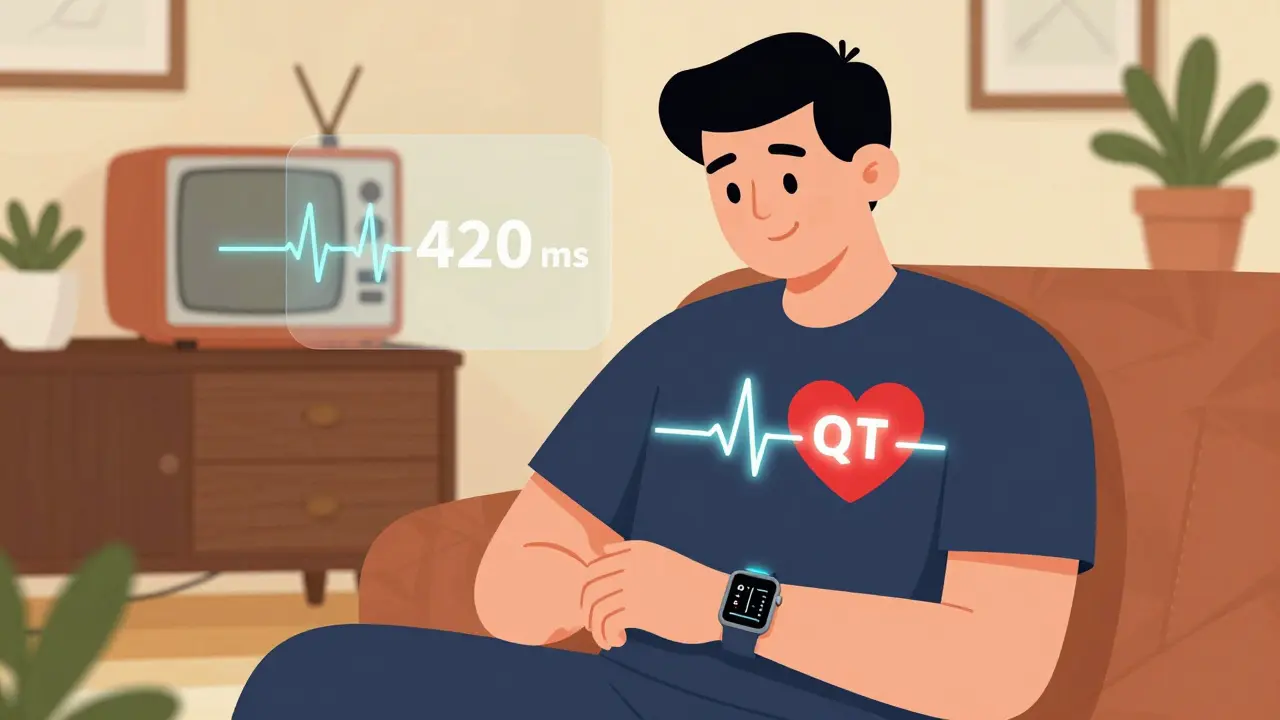
QT Interval Calculator
Calculate your corrected QT interval (QTc) to assess cardiac safety risk. QT prolongation can indicate increased risk of dangerous heart rhythms.
Normal QTc: Less than 450 ms (men) / 470 ms (women)
Warning: QTc over 500 ms significantly increases risk of torsades de pointes
Emergency: QTc over 600 ms requires immediate medical attention
Enter your data to see results
Every year, thousands of people take medications that can dangerously lengthen the QT interval - a measure of how long it takes the heart to recharge between beats. Drugs like certain antibiotics, antipsychotics, and even some COVID-19 treatments can push this interval past safe limits, increasing the risk of a life-threatening heart rhythm called torsades de pointes. Until recently, detecting this risk meant frequent clinic visits, bulky Holter monitors, or delayed lab results. Now, with wearable ECG devices, real-time QT safety monitoring is becoming a practical reality - even in your home.
What Exactly Is the QT Interval, and Why Does It Matter?
The QT interval is the time between the start of the Q wave and the end of the T wave on an electrocardiogram. It reflects how long the heart’s ventricles take to depolarize and repolarize. If this interval gets too long - known as QT prolongation - the heart can misfire, triggering irregular, rapid beats that may lead to sudden cardiac arrest. It’s not rare: up to 1 in 200 people on certain medications show measurable QT prolongation. The problem? Many of these patients have no symptoms until it’s too late.
Traditionally, doctors checked QT intervals with a 12-lead ECG in a clinic or hospital. But that’s a snapshot - a single moment in time. What if the dangerous prolongation happens hours later, after taking a dose? That’s where wearables change the game.
How Wearable ECGs Detect QT Prolongation in Real Time
Today’s consumer-grade ECG devices aren’t just for spotting atrial fibrillation. The Apple Watch Series 4 and later, along with the KardiaMobile 6L, now have FDA-cleared algorithms to measure the QT interval. These devices use single- or six-lead ECGs to capture the heart’s electrical activity. The Apple Watch asks you to press your finger on the digital crown for 30 seconds. The KardiaMobile 6L, a palm-sized device, requires you to place your thumbs on the top electrodes and your left ankle or knee on the bottom ones - creating a full circuit for six-lead data.
Studies show these devices are surprisingly accurate. A 2021 study in Scientific Reports found the Apple Watch’s QT measurements correlated strongly with standard 12-lead ECGs - with correlation coefficients above 0.88 for key leads. The KardiaMobile 6L matched standard ECG readings within ±20 milliseconds in a 2024 Cleveland Clinic review. That’s clinically acceptable. For context, manual measurements by cardiologists can vary by ±40 ms. These devices don’t just detect arrhythmias - they can catch subtle, dangerous shifts in QT length before symptoms appear.
Real-World Impact: From Pandemic to Daily Use
The push for wearable QT monitoring exploded during the early days of the pandemic. Hydroxychloroquine and azithromycin - both linked to QT prolongation - were widely prescribed for COVID-19, even without strong evidence. Hospitals were overwhelmed. Patients couldn’t come in for ECGs. That’s when the FDA stepped in. In April 2020, it formally allowed the use of KardiaMobile 6L for QT interval measurement in COVID-19 patients. It was the first time a consumer device received explicit regulatory backing for this specific use.
One case from 2020 showed how critical this was. A patient on hydroxychloroquine and azithromycin developed a QT interval of 510 ms - well above the 500 ms danger threshold. The Apple Watch alerted the patient’s doctor in real time. Without it, the patient might have had a cardiac event at home, undetected. Since then, this tech has moved beyond pandemic response. It’s now used in outpatient drug trials, chronic illness management, and even for patients on long-term antipsychotics.
Limitations and What These Devices Can’t Do
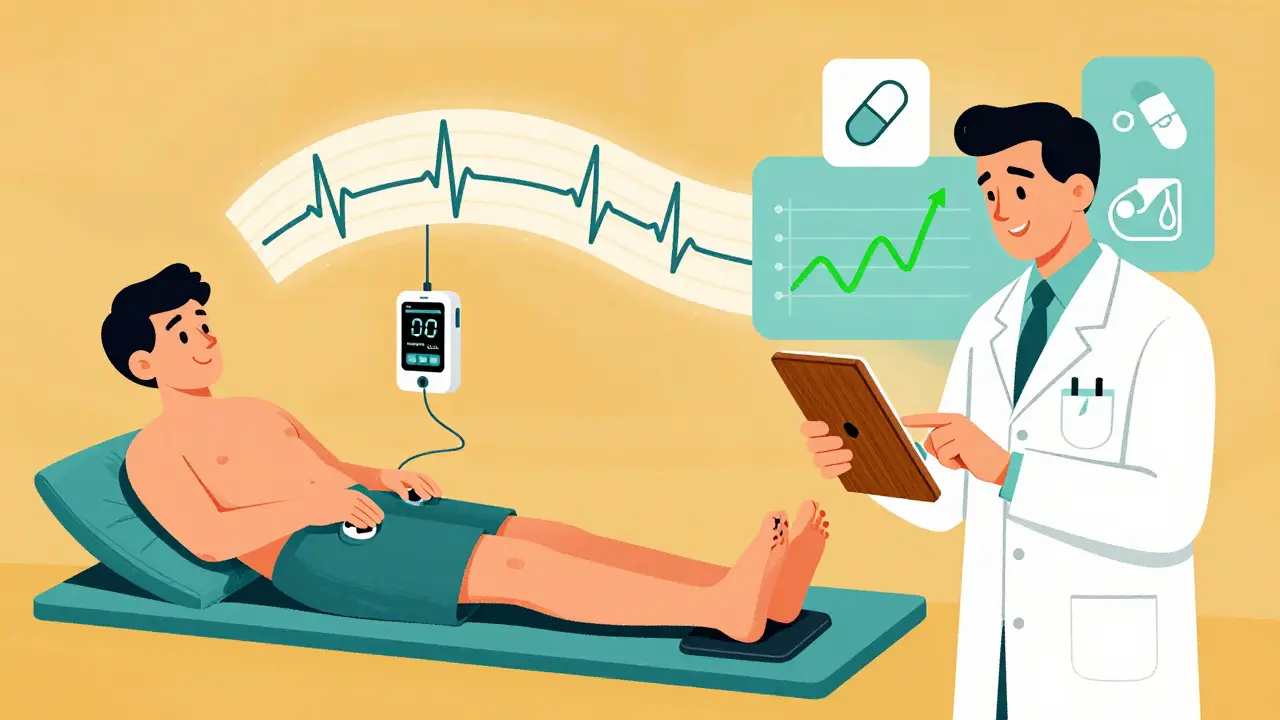
Don’t mistake these for full diagnostic tools. Wearable ECGs are excellent at detecting QT prolongation - but they’re not designed to diagnose other heart problems. A 2023 study found they missed over 79% of pathologic Q waves, which can signal heart attacks. They’re also less reliable for detecting supraventricular tachycardia or complex arrhythmias. The signal quality can drop if the skin is dry, sweaty, or if the device isn’t placed correctly. The Apple Watch needs firm finger contact. KardiaMobile requires precise leg contact. One wrong placement, and the reading becomes noisy.
Another big gap: most consumer devices still don’t have built-in QT analysis. The Apple Watch shows you an ECG trace - but it doesn’t automatically calculate the QT interval. You need a separate app or clinician to interpret it. The KardiaMobile 6L does offer automated QTc alerts, but only if you’re using the FDA-cleared version with the right software. Many users still rely on manual measurements, which introduces delay and human error.
The AI Breakthrough: Automating QT Analysis
The biggest leap forward isn’t in hardware - it’s in software. In 2024, researchers at the University of Manchester published a deep learning model in PLOS Digital Health that can predict QT prolongation from just two ECG beats. The model, built on a Residual Neural Network, analyzed data from 686 patients with genetic heart conditions. It identified QTc values over 500 ms - the danger zone - with 94% accuracy. This is huge. Right now, a cardiologist must manually review every wearable ECG reading. That’s impossible at scale. AI changes that. Imagine your smartwatch not just recording your heart rhythm, but instantly flagging a rising QT interval and alerting your doctor - all within seconds.
Pharmaceutical companies are already using this tech. In Phase I clinical trials, sponsors now use wearable ECGs to monitor cardiac safety in real time. One sponsor reduced data collection time by 60% and improved compliance by 45%. No more weekly clinic visits. No more missed doses. Just continuous, reliable data flowing in.
Who Should Be Using This Today?
This isn’t for everyone. But if you’re taking any of these drugs, it’s worth considering:
- Antibiotics like moxifloxacin or azithromycin
- Antipsychotics like haloperidol, ziprasidone, or quetiapine
- Antiarrhythmics like sotalol or dofetilide
- Antidepressants like citalopram or escitalopram
- Any new medication with a known QT risk warning
Patients with a history of long QT syndrome, electrolyte imbalances (low potassium or magnesium), or kidney disease are at higher risk. For them, a wearable ECG isn’t a luxury - it’s a safety net.
What’s Next? The Future of QT Monitoring
By 2027, we’ll likely see FDA-approved smartwatches that automatically calculate and alert on QT intervals - no app needed. Some companies are testing clothing with woven ECG sensors, making monitoring seamless during sleep or daily activity. AI models are being trained on millions of real-world ECGs to reduce false alarms and improve accuracy. The goal? To make outpatient drug loading - like starting a new heart medication at home - as safe as doing it in a hospital.
Regulators are keeping pace. AliveCor has received FDA clearance for 16 different ECG-related uses, including QT measurement. The European Medicines Agency is now reviewing similar guidelines. This isn’t science fiction - it’s the next step in personalized cardiac care.
Practical Tips for Getting Started
If you’re considering a wearable ECG for QT monitoring:
- Choose a device with FDA clearance for QT measurement - KardiaMobile 6L or Apple Watch Series 4+ with the ECG app.
- Use it consistently - ideally at the same time each day, especially after taking medications.
- Keep your skin clean and dry before use. Moisture or dirt can distort readings.
- Don’t rely on the device alone. Always share results with your doctor. Use it as a tool, not a diagnosis.
- Set up alerts if your device supports them. Some apps let you trigger a notification if QTc exceeds 470 ms (men) or 480 ms (women).
Remember: a single elevated reading doesn’t mean danger. But a pattern - rising QT over days - does. That’s the power of continuous monitoring.
Can a smartwatch really detect QT prolongation accurately?
Yes, FDA-cleared devices like the Apple Watch Series 4 and later, and the KardiaMobile 6L, have been validated in multiple studies to measure QT intervals with accuracy within ±20 milliseconds of standard 12-lead ECGs. Correlation coefficients in peer-reviewed studies exceed 0.88, meaning the readings are clinically reliable for tracking trends over time - though not for diagnosing other heart conditions.
Which wearable device is best for QT monitoring?
The KardiaMobile 6L is currently the most accurate for QT measurement because it records a full 6-lead ECG, similar to a hospital machine. The Apple Watch offers convenience with its always-on design and automatic rhythm detection, but it only records a single lead. For patients needing precise, frequent QT tracking - especially on high-risk medications - the 6-lead device is superior. For general monitoring, the Apple Watch is a strong option.
Do I need a doctor’s prescription to use a wearable ECG for QT monitoring?
No, you don’t need a prescription to buy these devices. However, if you’re using them for medical reasons - like monitoring QT prolongation from a prescribed medication - you should discuss it with your doctor. Some insurance plans may cover the cost if it’s deemed medically necessary. Also, your doctor can help you interpret the results and set safe thresholds based on your health history.
Can these devices replace a hospital ECG?
No. Wearable ECGs are excellent for continuous monitoring and catching trends, but they can’t replace a full 12-lead ECG in a clinical setting. They don’t detect heart attacks, structural issues, or complex arrhythmias with the same reliability. Think of them as early warning systems - not diagnostic tools. Always follow up abnormal readings with a professional evaluation.
Are there any risks to using a wearable ECG for QT monitoring?
The main risk is false reassurance. If the device shows a normal QT interval, you might assume you’re safe - even if you’re experiencing symptoms like dizziness or fainting. Conversely, a false alarm can cause unnecessary anxiety or medical visits. Always use these devices as part of a broader monitoring plan, not as the sole source of medical decision-making. Proper training and doctor oversight reduce these risks significantly.
Tommy Chapman
February 21, 2026 AT 10:33Let me get this straight - you’re telling me some guy in his pajamas is gonna save lives with a $300 watch? Meanwhile, real doctors are out here doing 12-lead ECGs with calibrated equipment and years of training. This isn’t innovation, it’s a marketing scam wrapped in FDA paperwork. I’ve seen too many patients panic over false alarms because they trusted a gadget more than their cardiologist. We’re turning healthcare into a TikTok trend.
Nina Catherine
February 22, 2026 AT 06:42omg i just got an apple watch last month and i had no idea it could do this!! i’m on citalopram and my doc never mentioned qt risks but now i’m checking it every morning after my pill 🥹 i’ve been so scared i’m gonna drop dead in my sleep and now i feel like i have a tiny superhero on my wrist?? thank you for this post!!
Caleb Sciannella
February 22, 2026 AT 17:18While the technological advancement represented by consumer-grade wearable ECGs is undeniably significant, one must approach its integration into clinical practice with methodological rigor. The correlation coefficients cited - while statistically robust - do not equate to clinical equivalence. Variability in skin contact, motion artifacts, and individual physiological anomalies introduce confounding variables that are not adequately addressed in peer-reviewed validation studies. Furthermore, the absence of standardized protocols for longitudinal QT trend interpretation among lay users presents a substantial risk of iatrogenic harm through delayed clinical intervention or unwarranted anxiety. The transition from diagnostic tool to surveillance device must be accompanied by robust physician oversight and algorithmic transparency.
Chris Beeley
February 24, 2026 AT 03:50You Americans think you invented medicine because you put a sensor on a watch. In Nigeria, we’ve been monitoring heart rhythms since the 1980s with analog ECGs and intuition. Your ‘FDA-cleared’ device? My cousin in Abuja used a modified phone app with a 20-dollar clip-on electrode and got better data than your Apple Watch. You’re not innovating - you’re monetizing fear. And let’s not forget: the AI models you brag about? Trained on Western datasets. What about African populations with different QT baselines? You’re not saving lives - you’re building a surveillance capitalism empire with a cardiac twist.
Arshdeep Singh
February 25, 2026 AT 22:15Let’s cut through the Silicon Valley fluff. Wearable ECGs aren’t about safety - they’re about data extraction. Every time you press your finger on that crown, you’re feeding your heartbeat into a corporate data farm. Who owns your QT interval? Apple? AliveCor? The insurance company that gets a subscription fee? You think this is healthcare? No - it’s behavioral conditioning disguised as prevention. And don’t even get me started on how these devices normalize medical anxiety. The moment you start checking your QT like a stock ticker, you’re no longer a patient - you’re a product. Real medicine doesn’t need apps. It needs trust, experience, and human judgment - not algorithms trained on 686 people from Manchester.
James Roberts
February 26, 2026 AT 05:29So… we’ve gone from ‘Don’t touch that wire!’ to ‘Hey Siri, is my heart about to kill me?’ I mean - congrats, tech bros. You turned cardiac arrest into a push notification. 🎉
But seriously - if your doctor didn’t warn you about QT prolongation before prescribing citalopram, maybe they’re not the one you want making decisions. These devices are great… as long as you use them to *inform* your doctor, not replace them. Also - yes, the KardiaMobile 6L is objectively better. The Apple Watch is basically a fancy pedometer with a heart monitor attached. Don’t let marketing fool you.
Danielle Gerrish
February 28, 2026 AT 03:58I just started taking ziprasidone last week and I’ve been terrified - like, sobbing-at-3am terrified - because I read about torsades and thought I was gonna drop dead in my shower. Then I got the KardiaMobile and started using it every morning. First day: 460ms. Second day: 475ms. Third day: 482ms. I freaked out and called my psych nurse. She said ‘That’s expected, let’s adjust your dose.’
Now I feel like I’m not just surviving - I’m *thriving*. I even showed my mom and she cried. This isn’t just tech - it’s peace of mind. I’m not gonna lie - I’ve started naming my device. His name is Quin. He’s my little heart guardian. 💙
Liam Crean
March 1, 2026 AT 18:21Interesting read. I’ve been using the Apple Watch for 18 months. Never had an issue. But I only use it when I’m feeling off - not daily. My doctor says that’s fine. I’m not a tech person. I just want to know if I’m okay. Seems like the real value is in catching trends over time, not single readings. I’ll keep using it. Not because it’s smart - but because it’s quiet.
Jeremy Williams
March 1, 2026 AT 18:43While the utility of consumer ECG devices is apparent, one must consider the socioeconomic implications of their deployment. In regions with limited access to cardiology, such devices may serve as vital triage tools. However, in affluent markets, their proliferation reflects a broader trend toward the medicalization of everyday life. The normalization of continuous biometric surveillance - particularly for asymptomatic individuals - risks reinforcing health anxiety and eroding trust in clinical judgment. Moreover, the commercial incentive to expand FDA-cleared indications may outpace evidence-based validation. One must ask: are we enhancing care - or expanding markets?
Ellen Spiers
March 1, 2026 AT 23:25The cited correlation coefficients (r > 0.88) are statistically significant but clinically insufficient. The standard deviation of ±20 ms for consumer devices exceeds the inter-observer variability of trained cardiologists (±12 ms), rendering them unsuitable for diagnostic decision-making. Furthermore, the reliance on single-lead recordings fundamentally limits the ability to detect ischemic changes, conduction abnormalities, or repolarization variants beyond the QT interval. The FDA’s clearance is a regulatory loophole, not a validation of clinical efficacy. This is not innovation - it is commodified surveillance under the guise of preventive medicine.
Jonathan Rutter
March 2, 2026 AT 01:40I’ve been on quetiapine for 12 years. My cardiologist told me to get a Holter monitor - $1,500, strapped to my chest for 48 hours. I said no. Then I bought a KardiaMobile for $100. I’ve caught two spikes in my QT - one at 515ms after a bad flu. I called my doctor. They adjusted my dose. Saved me. But here’s the thing - no one warned me. Not my psychiatrist, not my pharmacist. Just some random Reddit thread. So now I’m telling everyone I know. If you’re on antipsychotics, get this thing. Don’t wait until you’re in the ER. Your heart doesn’t care how ‘informed’ you are - it just wants to beat.
Jana Eiffel
March 3, 2026 AT 23:00There is a deeper philosophical question here: When we outsource our physiological awareness to machines, do we surrender not just data - but our embodied relationship with health? The heart is not merely an electrical circuit to be optimized. It is the seat of vulnerability, rhythm, and human fragility. To reduce its integrity to a QTc value measured by an algorithm is to domesticate the sacred. Perhaps the greatest danger of this technology is not false positives - but the quiet erosion of our capacity to listen to our own bodies without mediation.
Freddy King
March 5, 2026 AT 22:58Look - I’m not anti-tech. But this whole ‘wearable QT monitoring’ thing is just another way for Big Pharma to shift liability. They make the drug. You buy the watch. You monitor yourself. If you die? Well, you didn’t check your QT often enough. Genius. Meanwhile, the companies that make these devices? They’re not giving you free access to the raw data. They’re selling it to insurers. And guess who’s gonna get denied coverage next year? The guy whose QT trend went up 15ms over 3 weeks. This isn’t healthcare. It’s predictive capitalism with a stethoscope.